15

This good answer ended up with a lot of comments about whether the phrase is "close-minded" or "closed-minded." Since this debate seems to have reasonable arguments on both sides, I thought a new question would be prudent.

Personally, I think it is close-minded, the opposite of open-minded, and that both of these (open and close) use the intransitive forms of these verbs. In another words, I think the mind opens or the mind closes, as opposed to the mind being opened or closed.

But I thought the comments raised some interesting points about the word formation, and I may have to reconsider my opinion.

Is it "close-minded" or "closed-minded"?

EDIT: The NGrams are nice to demonstrate usage, but what I would like to know is more along the lines of why rather than which.

Kit Z. Fox
  • 27,819
  • I'm not going to spend ages counting the numbers, but my impression is that if you compare usage in, say 1970 against 2000, you'll see a preponderance of academic/clinical sources for closed-minded in the 70's that's not really there 30 years later. I think that supports my (admittedly suppositional) why. – FumbleFingers Jun 07 '11 at 18:47
  • Would you believe there's a Facebook discussion on this? – Callithumpian Jun 08 '11 at 03:28

5 Answers5

11

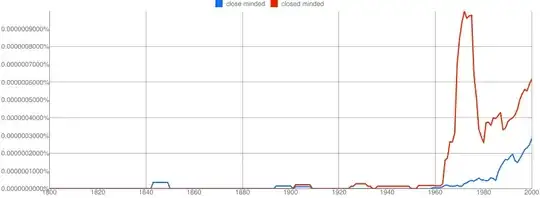
Close-minded was first, but closed-minded is dominant:

http://ngrams.googlelabs.com/graph?content=close+minded%2C+closed+minded&year_start=1800&year_end=2000&corpus=0&smoothing=3

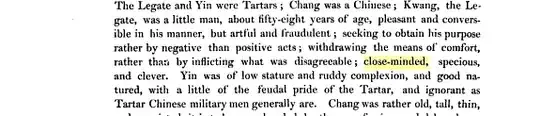
Here's the earliest close-minded reference I can find from a Narrative of a Journey in the Interior of China, by Clarke Abel, 1818:

http://books.google.com/books?id=q68aAAAAYAAJ&pg=PA352&dq=%22close+minded%22+OR+%22closed+minded%22&hl=en&ei=EGTuTdWQKOTV0QHws5zfAw&sa=X&oi=book_result&ct=result&resnum=1&ved=0CDEQ6AEwAA#v=onepage&q=close%20minded&f=false

I found closed minded back to 1913 in The Century Magazine:

http://books.google.com/books?id=CLgGAQAAIAAJ&q=%22closed%20minded%22&dq=%22closed%20minded%22&hl=en&ei=bWnuTY2yOMjx0gGO3eDeAw&sa=X&oi=book_result&ct=result&resnum=6&ved=0CEQQ6AEwBQ

Edit:
After considering @FumbleFingers' comments here and his subsequent answer, I have to agree that most of the earlier close-minded references found through Google Books (including the one above) are using close |kloʊs| in this sense (from NOAD):

• not willing to give away money or information; secretive : you're very close about your work, aren't you?

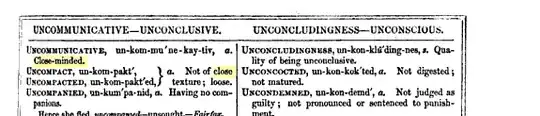
This is also proven by this definition of uncommunicative from John Craig's A New Universal Etymological Technological, and Pronouncing Dictionary of the English Language, 1859:

http://books.google.com/books?id=vMkiCh_mhzAC&pg=PA958&dq=%22close+minded%22&hl=en&ei=yHvuTdqrJNOutwfC8IyuCQ&sa=X&oi=book_result&ct=result&resnum=8&ved=0CE0Q6AEwBzgo#v=onepage&q=close%20minded&f=false

It seems the phrase was once a common description for someone who "kept their own counsel"—usually used as a derogative, but sometimes as a compliment.

However, I did find this earlier use of close-minded specifically to mean the opposite of open-minded from an 1898 issue of The Outlook:

http://books.google.com/books?id=kD4BAg1ngJYC&pg=PA977&dq=%22close+minded%22&hl=en&ei=j4HuTcWNN8-ctweqkIW5CQ&sa=X&oi=book_result&ct=result&resnum=2&ved=0CDIQ6AEwATgU#v=onepage&q=%22close%20minded%22&f=false

I also found evidence of a shift towards this sense of close-minded in other writings by the early 1900s. So, to conclude, I think the only thing new about the confusion evident by the 1960s was the frequency of the two terms in print. I realize this may not ultimately answer the question, which is correct, but the timeline seems significant to me.

Callithumpian
  • 24,764
  • 1
    But which is correct? – Kit Z. Fox Jun 07 '11 at 17:51
  • 2
    I think that NGram may be a bit misleading simply because of the time-frame. Neither variant really existed until the underlying concept suddenly shot to prominence in the mid-60's ("flower-power" and all that). Graphing just 1960-2000 makes it easier to see that initially 'specialist writing' massively favoured closed-minded as the more 'accurate, formal' term. I imagine over following decades less sophisticated speakers are progressively steering things towards close-minded because the doubled-up past tense sounds awkward to a layman. – FumbleFingers Jun 07 '11 at 17:58
  • 4
    ...also, it's not really true that close-minded was first. I think all occurences before the 60's will relate to close as in guarded, not outgoing, reticent, rather than not open to new ideas, which is the meaning we're discuussing. – FumbleFingers Jun 07 '11 at 18:01
  • @Fumble: So you think my first clip would be close as in 'Close to the chest' or 'Close to the vest'? – Callithumpian Jun 07 '11 at 18:31
  • I do. Not so sure about the second one, but with a term like this that's 'relatively' transparent in meaning, I wouldn't place undue emphasis on a very small number of usages which might be somewhat idiosyncratic in the first place. – FumbleFingers Jun 07 '11 at 18:37
  • @Calli Wow, thanks for all this information. I hesitate to ask, but do you think this older usage parallels with "close mouthed," which also means reticent? – Kit Z. Fox Jun 08 '11 at 11:23
  • @Kit: You're welcome. Great question. I do think the older usage parallels close-mouthed (close-lipped, and even close-fisted), but the more I look into it, the more I think this gets down to the etymology of close |klōz| vs. close |kloʊs| and might deserve its own question. . . – Callithumpian Jun 08 '11 at 11:50
  • @Calli I'd been thinking of a separate question, but wasn't sure about it. Why don't you ask? – Kit Z. Fox Jun 08 '11 at 11:52
  • @Kit: I will, but later today (if no one else does first). – Callithumpian Jun 08 '11 at 11:55
  • Thanks for all your research on this. I'm sorry it took me so long to accept; I forgot I hadn't yet. If you can think of a good question for close |klōz| vs. close |kloʊs|, I would like to see it! – Kit Z. Fox Jun 18 '11 at 00:25
  • 1
7

I understand closed-minded to be a description of mentality, without reference to any past or future changes in mentality. That is, in contrast to the argument made in the question, I think the mind is open or the mind is closed. If your mind is closed, you can open it, and then it will be open. Conversely, if your mind is open, your dealings with the interminable idiocy of modern life may close it, and then it will be closed.

I would understand close-minded to be a minor mistake or valid but uncommon* variant on closed-minded. So unless the context made me re-evaluate it I would simply assume the intended meaning was the same.

If I wished to refer to a change in mentality I would use a more explicit form.

Having said all that, I think your argument for close-minded makes perfect sense; I just don't hold to its central premise. We may have a different understanding of the terms themselves, but I think it's at least as likely that we simply have a different understanding of the mind.

(*) Note that there seems to be a difference in frequency of use between British and American English—as a Brit I rarely, if ever, see close-minded.

  • Thanks for posting this answer, @John. It is sound reasoning. While this difference may well be rooted in differences between BrE and AmE, it looks as though not only am I on the wrong side of usage, but may also (gulp!) be on the wrong side semantically as well. – Kit Z. Fox Jun 08 '11 at 11:17
  • Close-minded makes no syntactical sense because it is used as in "He won't go along, he's too closed-minded." He is not he does. – Wayne Jun 08 '11 at 16:18
  • The difference in Google NGrams between American and British bears this our strikingly. There are no hits for 'close minded' in BrE. – Mitch Jun 08 '11 at 16:32
4

I'm not sure it makes too much sense to ask which version is 'correct' here, but let's just have a closer look at what's going on...

First, here's my NGramlink

There are a very few earlier uses, but they're mostly for close-minded in the sense of reticent, unforthcoming, rather than unreceptive to new ideas which we're interested in here.

The new usage suddenly started appearing in the mid-60's, when psychologists and 'pop science' authors in the "flower power" era had more need to reference this newly-interesting phenomenon.

It's my opinion that closed-minded was the original term used by those specialists and fellow-travellers, because semantically it fitted the bill better - and avoided confusion with the rare earlier usage. But over decades the term has spread to more general use, and laymen instinctively don't much like the repetition of past-tense suffixes.

I also suspect that psychologists in general may tend to have abandonned the term in favour of more abstruse 'medicalese', which would account for the rather odd graph shape. Closed-minded will probably die off in future decades, but it will stagger on for a while on the back of a few closed-minded psychologists, and a few laymen still reading old books.

TLDR - If you want to ride the wave of the populist future, go for close-minded. If you want to be accurate, buy a medical/psychiatric dictionary and use whatever words they do now.

Callithumpian
  • 24,764
FumbleFingers
  • 140,184
  • 45
  • 294
  • 517
  • @Callithumpian: Thanks for that edit! My very first attempt to use TLDR having only recently discovered it, and I can't even spell it right! Perhaps I should change my handle to Eponymous :-) – FumbleFingers Jun 07 '11 at 19:13
  • @Fumble: No problem. I've yet to use it myself, but I'm working on an edit to my answer that will warrant it! – Callithumpian Jun 07 '11 at 20:08
  • I'd like to note that I am a definitely a layman in this context, but I would always prefer the semantic accuracy of 'closed-minded'. Also, 'closed-minded' seems to be increasing in use at a similar rate to 'close-minded' in the last 15-20 years of your graph, so I wouldn't be so sure it'll be overtaken. – John Bartholomew Jun 07 '11 at 21:46
  • @John Bartholomew: But we also need to explain the dramatic fall in popularity of closed-minded in the late 70's, which is clearly not mirrored by any switch to the alternative. I still believe this is because the professionals (who I think only ever used the semantically accurate form) dumped it in favour of some more obscure psychiatric terminology we don't know (or can't call to mind). – FumbleFingers Jun 07 '11 at 21:56
  • @FumbleFingers: Just had a little play with ngrams myself (which I haven't really touched before). Two things I note: firstly, the smoothing value makes a massive difference to the shape of the result, and I'm not sure my signal-processing-fu is strong enough to properly interpret the results given that. Second, the British English corpus gives no hits for 'close-minded' at all, which may explain why I find it odd (being British myself). – John Bartholomew Jun 07 '11 at 22:19
  • @John Bartholomew: I'm betting that - as so often - US usage leads the way in bringing 'specialist medical terminology' into the mainstream, and while they were about it they dropped that awkward 'd'. The smoothing is pretty weird, I agree. Made worse because there aren't that many hits to work with in the first place. Also note that (as with Google itself), the number of hits listed on the first page is usually boll**ks for these narrow searches. If you start paging through them all you usually reach the end way before you've seen as many as it originally claimed. – FumbleFingers Jun 07 '11 at 22:33
  • @FumbleFingers: Sorry, my use of 'hits' was misleading. I mean it has zero usage according to the ngrams search (or at least it's below the 40-book minimum that ngrams applies). I would imagine these counts are not subject to the same types of errors as the Google search hit-count estimate (though they are subject to different sources of error). – John Bartholomew Jun 07 '11 at 22:51
  • @John I'm not convinced that "closed-minded" is semantically correct (cf. my rationale for using "close-minded"). If you want to post an answer arguing this point of view, I would be happy to read it. – Kit Z. Fox Jun 08 '11 at 00:53
  • @John: Interesting about the British corpus. This means the earlier sense of close-minded as uncommunicative was chiefly, if not exclusively, American. – Callithumpian Jun 08 '11 at 01:04
  • 1
    @John: You can always bypass that 40-book minimum by just selecting "[more->]books" from the standard Google screen. No graphs, but at least it'll find even a single occurrence if it's in their corpus. – FumbleFingers Jun 08 '11 at 01:19
  • @Callithumpian: I think what it shows is that close-minded was always an unremarkable but fairly uncommon term for "reticent". Its usage in recent times to mean "intellectually unadventurous" is an almost exclusively American bowlderisation of closed-minded. – FumbleFingers Jun 08 '11 at 01:32
  • @Fumble: I think my answer shows that it wasn't always used as a term for "reticent" pre-1960s. I also think it (the "reticent" sense) was more commonly understood than you give it credit. Google Books gives it over 300 hits in print pre-1960 with many of them being in very mainstream publications. That said, I do think your observation about the "reticent" meaning is the key to understanding the actual history of these phrases. – Callithumpian Jun 08 '11 at 02:15
  • @Callithumpian: I don't really understand. I get about 90 NGram 'English' hits for close minded over 1700-1959, and I can see at a glance that many of them are duplicates of the very same text, so the real number of occurences may be nearer 50. NGrams lies through its teeth though - first it says 83 hits for 1847-1896, but as I actually scroll through pages it keep reducing the number until it finally admits there are only 55. Many of which are simply the same article/essay appearing in multiple publications. – FumbleFingers Jun 08 '11 at 02:38
  • @Fumble: I think this explains what is happening. New to me. Don't know whether or not to trust the automated "collapsing." If it's accurate, then I should say there are 213 non-duplicate hits of close-minded from 1/1/1500 to 12/31/1959. Either way, I prefer to do my main searches directly through Google Books rather than via Ngram, as you suggested to @John above. – Callithumpian Jun 08 '11 at 03:15
  • @Callithumpian: There are at least two levels of 'duplicate' - the ones where Google just bungles its own estimate of how many hits it will have to show you, and the ones where the same text is in multiple publications. I didn't even realise I could search before 1700 (the default start date), but I don't see how it would make that much difference. I actually count 92 entries 1700-1959 if I go thru NGrams and force it to show me every page. And at a rough guess 20-25 of those 92 are the same text appearing in multiple publications. – FumbleFingers Jun 08 '11 at 03:35
  • @Fumble: Not sure what we're doing differently. If I follow your process and then enter a "custom range" in Books of 1700-1959, I still get the 213 number (more when "sorted by date" for some reason) after jumping to the end of 22 pages of results. – Callithumpian Jun 08 '11 at 04:02
  • 1
    I thought it was tl;dr :) – mplungjan Jun 08 '11 at 05:39
  • @Callithumpian: I can see one day soon I need to learn how to use .se 'chat'. We prolly shouldn't drag this one out here because the system will be flagging it up to mods as an 'extended discussion'. – FumbleFingers Jun 08 '11 at 12:53
2

Being that hyphens break Google nGrams, I did a lookup for close minded and closed minded and found the following:

Google nGram

Closed minded in this case seems more popular; however, a simple Google search for close- and closed-minded shows twice as many results for close-minded. The free dictionary indicates close-minded and closed-minded are variants/synonyms of one another (and both correct).

I'd suggest using either close-minded (which seems more popular with the hyphen) or closed minded (which appears more popular sans hyphen).

snumpy
  • 7,372
  • Unfortunate the limits on Ngrams. So we can't trust the graphs, because we really want to compare -with- the dash. – Mitch Jun 07 '11 at 19:43
  • 1
    NGrams ignores the '-', but that means it is catching 'close minded' and 'close-minded' together and similarly for 'closed'. So even though I though Ngrams was counting things badly before, I think it is actually pretty accurate (unless I'm missing a great number of sentences that end in closed and start with 'minded'. So I think 'closed-minded' looks like its winning the popularity fight. – Mitch Jun 07 '11 at 19:52
  • @Mitch: Except you can't easily use NGrams as a 'beauty contest' judge in this particular case because of confusion between close=near and close=shut. – FumbleFingers Jun 07 '11 at 21:47
  • @Fumble: oh. Didn't think of that. And that would result in 'less' hits for 'close'. However, I don't feel there would be many hits for the 'nearness' interpretation, it doesn't sound plausible to me that that interpretation would ever be meant. But that it is plausible to others may mean that 'close' is not the intuitively popular choice for the intended meaning of narrow minded. – Mitch Jun 07 '11 at 22:27
  • @Mitch: Well Callithumpian & I agree that most/all of the early instances of close are in fact for the 'near' sense when we read them in context. And of course he has got that 1859 dictionary reference actually defining 'uncommunicative' as 'close-minded'. – FumbleFingers Jun 07 '11 at 22:43
  • @snumpy, They're hyphens, not dashes! – TRiG Jun 08 '11 at 13:13
1
  • there is a distinction between reticent and not open to new ideas. We are only considering the latter meaning here.

  • so 'close' /kləʊs/, (klōs) as in near is never intended

  • for 'proper' standard English, the noun corresponding to the modifier would be 'closed mind'. "What kind of person has a closed mind? They are a X-minded person." This shows that it should be in standard writing:

closed minded.

  • as to which it is in practice, there are all sorts of corpus/ngram searches that have been done showing some variation 'closed-minded' being somewhat more popular than 'close-minded' but less so as time goes on.

  • Outside of news announcers and actors, in speech it is almost always

close minded.

The more formal alternative gives a three-consonant cluster that is difficult in English and is hardly ever fully articulated in normal speech patterns, similar to 'wasps/masts/casks' (all tend to drop the stop). And so writing 'close minded' reflects the pronunciation. It is not so immediately recognized as a solecism (like 'probly' or 'anser') because 'close' itself doesn't look like a wrong spelling.

Mitch
  • 71,423
  • There’s a swarm of ∗was in the room? That would be unfathomable; nobody says that. – tchrist Aug 08 '12 at 14:08
  • @tchrist: I don't have papers available for reference, but there are alternate confirming answers here (i.e. not just from me). Don't let orthography rule your ear in listening. You may pronounce them 'properly', just like actors and newscasters, but that's not how everyday people do it. – Mitch Aug 08 '12 at 14:34