15

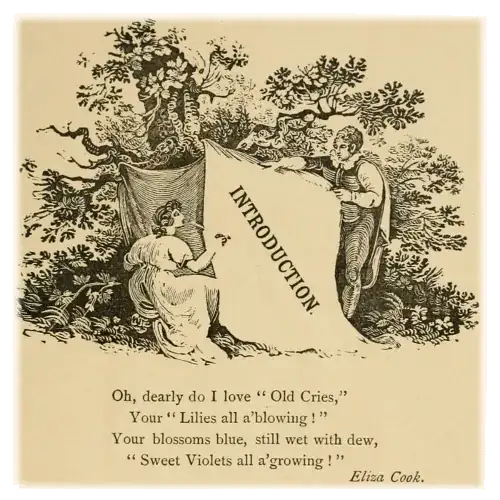
Quotation from A History of the Cries of London: Ancient and Modern

Oh, dearly do I love “Old Cries,”
 Your “Lilies all a’blowing!”
Your blossoms blue, still wet wih dew,
 “Sweet Violets all a’growing!”
image

MetaEd
  • 28,488
user25049
  • 1,094

2 Answers2

6

Entries in the OED suggest that in both words the a- prefix is derived ultimately from the preposition on, which is used, as in your examples, before the -ing forms of verbs to give the sense of ‘engaged in’. The OED has, for example, this citation from 1883:

Now let us run out and look at the flowers and the trees all agrowing and ablowing.

One of the meanings of blow, which it clearly has here, is ‘to burst into flower; to blossom, bloom’.

The OED’s earliest record of agrowing is dated 1605. Ablowing is found in Old English, but with the medical sense of ‘swelling’ or ‘distension’.

Barrie England
  • 140,205
3

Wikipedia says the a- prefix is used to form a predicative adjective with progressive aspect.

OED gives a dozen or more origins/meanings for the a- prefix, but I must admit I can't see any there that really correspond to OP's examples except #11, where it says the force of the prefix is so little apparent, that the derivatives in a- hardly differ in sense (in respect of, say, rise/arise, wake/awake).

So I think in OP's particular examples, the a- prefix either means nothing at all (effectively OED's take), or it can be seen as replicating/emphasising the progressive aspect of the verb (which is also being done by the -ing "suffix" anyway).

The apostrophe in OP's case is arbitrary (you could replace it with a hyphen, or nothing at all).

FumbleFingers
  • 140,184
  • 45
  • 294
  • 517
  • Look at senses 12 and 13 of OED a- prep 1. Or see the chatlog from earlier today. – tchrist Oct 05 '12 at 17:49
  • I wonder if we’re looking at the same OED. Definition 11 in the first entry for the prefix in the online OED http://www.oed.com/view/Entry/8#eid2874815 has ‘Expressing action, with a verbal noun or gerund taken actively. Now arch. and regional’. 11a has ‘After "be" (or occasionally another verb expressing state) and before a verbal noun: engaged in (some activity).’ – Barrie England Oct 05 '12 at 17:58
  • @Barrie: They won't be the same - my OED is a "bent" electronic copy from a few years back, but obviously you have access to latest edition (I can't follow your link because I'm an unexpectedly impecunious pensioner who can't afford the subscription). But really, how much could OED's understanding of this prefix change in 2-3 decades? – FumbleFingers Oct 05 '12 at 18:37
  • @FumbleFingers: I, too, am an imp. pen., if not an unex. one, but if you have a UK public library card you can get a free subscription. – Barrie England Oct 05 '12 at 18:42
  • @Barrie: I didn't know that! I just assumed "Institutional subscribers" meant people coat-tailing whatever school/college they worked at. I'm ashamed to say I didn't get a new library card when I moved a few years ago, but my lodger is always telling me I should. I'll follow that one up, thanks. – FumbleFingers Oct 05 '12 at 20:24
  • ...incidentally, looking more closely at a- prefix in my OED, it gives different "origins" for 14 out of 15 entries. The only one where it doesn't is #11 as quoted from above. I still think it's relatively meaningless in OP's two examples, where it doesn't really add anything that's not already implicit in the -ing verb form. And whereas afloat, atremble, for example, seem unexceptional to me even without -ing, I can't easily persuade myself that ablow, agrow are "reasonable words". – FumbleFingers Oct 05 '12 at 20:36