S-r-G-m-P-d-N-S
Revered as the foremost raga of Lord Shiva, the morning Bhairav takes its name from Kala Bhairava (‘Bhaya-Rava’: ‘the one who roars fear’) – an apocalyptic manifestation of the deity fabled to have cut off one of Brahma’s five heads to silence his arrogance. Renditions reflect the gravity of these ancient tales, depicting Shiva’s resulting tandav (‘dance of destruction’) with wide-roving motions and dense andolan on re and dha, with patient melodic explorations often concluding in an idiosyncratic G\rS phrase. Dhrupad vocalist Wasifuddin Dagar recounts that “in the Dagar family, the initiation to music starts with Bhairav” – and, as per Parrikar, “Bhairav is so fundamental that its impact on India’s musical soul can never be overstated…verily, it falls to the lot of the noblest of ragas, deserving of renewal and reflection every single day”. Prakriti with the core forms of Kalingada and Gauri – and also see other ragas of the wide-branching Bhairav family, including Ahir Bhairav, Nat Bhairav, Rati Bhairav, and Saurashtra Bhairav.
• Raga Megalist (365+) •
राग भैरव

Search | Glossary | Tags
• Hindustani Raga Index •


Context | Melodics | Classifiers | Listenings | More
Aroha: SrGmPdNS
Avroh: SNdPmGrS
Chalan: e.g. S(G)r; (G)rS; (N)dNS; NSGm; Gm(G)rS; SrGmP; PGm(N)d; dP; PGmPGm(G)r; rS; Gm(N)d; dP; GmPdNS; rSNS(N)d; dP (Parrikar)

• Support open-access, ad-free raga musicology by joining my brand-new PATREON (launched mid-2024). And if you’re seeking to learn raga on non-standard instruments…get started with online lessons!
–Rupak Kulkarni (2019)–
“Bhairav is Shiva is Bhairav. In the Dagar family, the initiation to music starts with Bhairav. My father and uncle; their presentation of the composition used to shake the world for me; things around me would vibrate. At that time, I was not aware of the word ‘tandav’…Here, the poet sees everything in Shiva: His existence is everywhere…His restlessness can shake the universe…I pray his blessings remain with the Dagars until the Doomsday, the Pralaya, the Qayamat, the End…” (Wasifuddin Dagar)

—Context—
Origins, myths, quirks, & more
[COMING SOON: click here to hasten the project’s expansion, so all 365+ raga pages can eventually look more like these]

• Ragmalas •
Historic miniature paintings (learn more)

“Bhairava as Shiva, opaque watercolour on paper” (Nurpur, c.1690)
—Phraseologies—
Melodies, movements, characteristics…
[coming soon]
—Amir Khan’s riyaz (~1960s)—
“This is a rare recording of Amir Khan during riyaz. Despite the noise from the road outside, learners and experts alike can hear the great Ustad‘s extraordinary breathing techniques, and how he hits each note with precision and perfection. He explains how he uses the syllables ‘Aa’ and ‘Laa’ from the word ‘Allah’, as well as the word ‘Om’ instead of the Dhrupad-like ‘Nom’ or ‘Naa’, in order to avoid nasality creeping into his voice production. I got this recording from a secondary source, and don’t know who recorded it…” (n.b. somehow, this is one of only two known clips of Khan singing Bhairav: with the other being a short excerpt of the ‘Karim Rahim Bande Nawaz‘ bandish sung in an interview with Hafiz Ali Khan)
—Listen—
A brief selection of superb renditions
–Bismillah Khan (1964)–
- Dumaron shehnai (22m): undoubtedly one of the reed master’s finest recordings, and a longtime favourite of All India Radio’s morning broadcasts – as per Aneesh Pradhan, “Khan’s presentations are always marked by their close resemblance to vocal music: not only does he incorporate [vocalistic] ornamentations, but he also dwells greatly on the pukaar: the literal and figurative ‘calling out’ or ‘yearning’ best represented by great vocalists; likening raga music to a prayer to the divine” (for me, the track’s twists and turns evoke vivid recollections of watching the Varanasi sunrise before sitar classes, not far from the house Bismillah lived and practiced in for over 70 years):
[refrain, e.g. 12:57] Gm G\r(S)S, S/P(m)G (G)rSS, S S S; Gm G\r(S)S, S/P(m)G (G)rSS, S…
–Uday Bhawalkar (2015)–
- Dagarvani Dhrupad (90m): from a 2015 Diwali show in Mumbai, backed by pakhawaj from Pratap Awad and vocal support from Prassanna Viswanathan and Chintan Upadhyay – built around his unique command of mandra saptak (e.g. 28:30) and long sustains on taar Sa (e.g. 38:50: in the words of one commenter, “my spirit has been feeling broken, and this exquisite performance is drawing the poison out of my soul…”):
[refrain, e.g. 65:27] P\Gm (S)m/d, d d, P, (d)P/d (m)P, m, (P)mP P\Gm, (S)m/d, d d P, (d)P/d (m)P, m…
–Further Recordings–
- Padma Talwalkar (10m): an AUTRIM pitch-graph (the lyrics implore Lord Krishna to awake, as the sun has now risen)
- Shahid Parvez Khan (14m): a concise Imdadkhani sitar take (“the bhava from the tanpura is extremely meaningful”)
- Bhimsen Joshi (33m): “the sombre gravity of the alap sets the tone” (bandish: Balamva More Saiyan & Hamse Karat Tum)
- D.R. Parvatikar (39m): expounded by ‘Veena Baba‘, who for decades lived as a sanyasi monk in a Himalayan Temple
- Venkatesh Kumar (45m): filmed at an all-night Bagalkot show, with Sudhanshu Kulkarni’s harmonium and Keshav Joshi’s tabla
- Rashid Khan (54m): from his Song of Shiva album, supported by Ramesh Mishra on sarangi and Yogesh Samsi on tabla
- Sayeeduddin Dagar (61m): another Dhrupad rendition which demonstrates the Dagarvani’s deep connections with the raga
- Ulhas Kashalkar (68m): as per Rohit Dharap, “ma is used as a connecting swara, creating the sombreness of the morning“
• Classifiers •
Explore hidden inter-raga connections: swara geometries, melodic features, murchana sets, ragangas, & more (also see the Full Tag List):
Swaras: -4 | 5 | 6 | 7 | 8 | 9 | 10+
Sapta: Audav | Shadav | Sampurna
Poorvang: SRGM | SRG | SRM | SGM
Uttarang: PDNS | PDS | PNS | DNS
Varjit: Re | Ga | Ma | Pa | Dha | Ni
Double: rR | gG | mM | dD | nN
Thaat: 10 | 32 | Enclosed | Inexact
Chal: All-shuddha | All-komal | Ma-tivra
Gaps: Anh. | Hemi. | 3-row | 4-row | 5-row
Symmetries: Mirror | Rotation | Palindr.
Aroha: Audav | Shadav | Sampurna
Avroh: Audav | Shadav | Sampurna
Jati: Equal | Balanced | Av.+1 | Av.+2
Samay: Morning | Aftern. | Eve. | Night
Murchana: Bhup. | Bihag | Bilaw. | Charu.
Raganga: Bhairav | Malhar | Kan. | Todi
Construction: Jod | Mishra | Oddball
Origin: Ancient | Carnatic | Modern
Dominance: Poorvang | Uttarang
Prevalence: A-list | Prachalit | Aprach.
• Prakriti: Bhairav thaat, Kalingada, Gauri
–Proximate Forms–
Nat Bhairav = ‘Bhairav shuddha Re‘
Bhatiyari Bhairav = ‘Bhairav shuddha Dha‘
Basant Mukhari = ‘Bhairav komal ni‘
Shree = ‘Bhairav tivra Ma‘
Poorvi = ‘Bhairav double Ma‘
(n.b. these are just ‘scalar similarities’, with nothing particular implied about phraseological overlap)
–Swara Geometries–
• Core form: S–r–G–m–P–d–N–S
• Reverse: SrGmPdNS (=itself)
• Negative: 4-1-3-3-1 (e.g. Bibhas)
• Imperfect: 3 (Pa, dha, Ni)
• Detached: none
• Symmetries: mirror (S—M)
• Murchanas: Bhairav set
• Quirks: ‘palindromic‘ (same intervals forwards & backwards) • ‘centred‘ (constellation balances at the wheel’s centrepoint)
–Global Translations–
• Carnatic: ~Mayamalavagowla
S-R1-G3-M1-P-D1-N3-S
• Jazz: Double Harmonic
1-b2-3-4-5-b6-7-8
• Pitch classes (‘fret-jumps’):
0-1-4-5-7-8-11-0
(1–3–1–2–1–3–1)
o o • • o o • o o • • o o

–Around the World–
CONGRUENTS (rough):
- Maqam Hijazkar (oud)
- Misirlou: Rebetiko (other) (article)
- Gates of Babylon (Rainbow)
- Samson et Dalila: Bacchanale (Saint-Saens: at the start)
- La Soirée Dans Grenade (Debussy: as a ‘Moorish indicator’)
- IVm(maj7,add9) = James Bond chord!
—Misirlou (USA/Mediterranean)—
(Dick Dale, 1962)
“Most people are familiar with the tune from the opening scene of Pulp Fiction – however, most are probably unaware of the tune’s origins. The term Misirlou [‘Egyptian Girl’] originates from the Arabic word ‘miṣr’ [‘Egypt’]. The Greek lyrics to the song describe the love between a Greek Christian man and an Egyptian Muslim woman. The exact origins of the tune are unknown: however, it is likely that it originated in Turkey or Egypt” (Misirlou: The Song Made Famous by a Greek Genocide Survivor)
• Tanpura: Sa-Pa (+dha)
• Names: Bhairav, Bhairava, Bhairau, Bhairab, Bhairon (not Bhairavi)
• Transliterations: Hindi (भैरव); Bengali (ভৈরব); Kannada (ಭೈರವ್)
—More—
Further info: links, listenings, learnings, etc
- Raag Bhairav: [coming soon]
- Header audio: Alap by Maihar bansuriya Rupak Kulkarni (2019)
- Header image: ‘Bhairava Raga: Folio from a Ragamala’, Datia, Madhya Pradesh (c.1650)
• Get started with learning raga! •
Share these ragas! My site is 100% reliant on organic visitors (and none of your donations go to ad agencies…) – share this with fellow sonic searchers!
[Join my PATREON!]
Like everything on my site, the Raga Index will always remain open-access & ad-free: however, anti-corporate musicology doesn’t pay the bills! I put as much into these resources as time and finances allow – so, to hasten the project’s expansion, you can:
• Support the Raga Index! •
—Riyaz-focused notations & bandish—
—Resurrecting rare and ancient ragas—
—Further melodic & geometric analysis—
—Engaging with Hindustani performers—
—Ensuring that high-quality raga knowledge will remain open to all, at no cost: free from commercial motive!—

—Hindustani Raga Index—
An open-ended project seeking to bring North Indian raga closer to all who approach with open ears. Combines direct input from dozens of leading Hindustani artists with in-depth insights from music history, global theory, performance practice, cognitive science, and much more besides!
–Megalist (365+ ragas)–
• Search: Find your new favourite •
• Tags: Classifying the ragascape •
• Glossary: Raga jargon demystified •
• Murchanas: Swara-set rotations •
• Thaat: Bhatkhande’s base scales •
• Ragatable: Analytical connections •
• Tanpuras: Divine overtonal drones •
• Quotes: Musings from raga artists •
• Talas: Hindustani rhythm cycles •
• Instruments: Singing sculptures •
Sa | Re | Ga | Ma | Pa | Dha | Ni
[Random Raga]
—Search the Raga Index—
• Feedback / Contact •
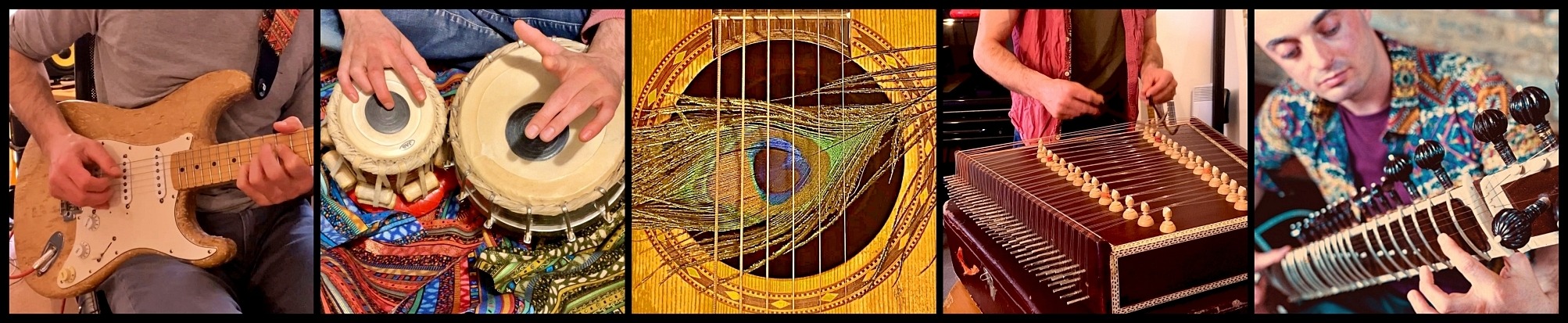
George Howlett is a London-based musician, writer, and teacher (guitars, sitar, tabla, & santoor). Above all I seek to enthuse fellow sonic searchers, interconnecting fresh vibrations with the voices, cultures, and passions behind them. See Homepage for more, and hit me up for Lessons!
• Projects & articles: full list •
[Join the Patreon!]