S-R-G-m-P-D-nN-S
A seldom-heard neighbour of Khambavati, distinguished (often very subtly) by stronger use of shuddha ma, and sometimes involving a Gm\S catchphrase. Both ni swaras are used, with the komal introduced via vakra avroh motions (e.g. SRn). Named after a huge evergreen tree species with fragrant yellow-orange flowers, used in perfumery and featured in myths and legends from Indian history (including a famous tale of a dishonest champak: “Narada went back to the tree and cursed it for lying. He said that its flowers must never again be used in the worship of Shiva…and cursed the Brahmin, saying that he would be reborn as a demon…”).
• Raga Megalist (365+) •
राग चंपक

Search | Glossary | Tags
• Hindustani Raga Index •

—Narayanrao Vyas (~1960s)—
[refrain, e.g. 0:01] PmGS Rm, m(Gm)PD m(Gm)G, PmGS Rm, m(P)G (R)S, S(nDnDP)S, SRG(RS), SRG RGm m(PmP)G(R), PmGS Rm…

• Support open-access, ad-free raga musicology by joining my brand-new PATREON (launched mid-2024). And if you’re seeking to learn raga on non-standard instruments…get started with online lessons!

• More •
Histories, melodies, mythologies, etc…
—Imagery: Champak flowers—

“These beautiful trees have many common names: champak, champaca, michelia, golden champa, joy perfume tree, banana shrub, white sandalwood, and white jade flower. The derivation of ‘shampoo’ is the Hindi word ‘champo’ (to massage), from the Sanskrit ‘champa’ – as the tree was traditionally used to make fragrant hair and massage oils. It yields finely textured, dark brown and olive-colored wood, and certain groves are considered sacred. The white champaca hybrid (magnolia-alba) is prized for its pure white flowers, which are floated in water bowls as Buddhist temple offerings…” (Matt Ritter)
• Classifiers •
Explore hidden inter-raga connections: swara geometries, melodic features, murchana sets, ragangas, & more (also see the Full Tag List):
Swaras: -4 | 5 | 6 | 7 | 8 | 9 | 10+
Sapta: Audav | Shadav | Sampurna
Poorvang: SRGM | SRG | SRM | SGM
Uttarang: PDNS | PDS | PNS | DNS
Varjit: Re | Ga | Ma | Pa | Dha | Ni
Double: rR | gG | mM | dD | nN
Thaat: 10 | 32 | Enclosed | Inexact
Chal: All-shuddha | All-komal | Ma-tivra
Gaps: Anh. | Hemi. | 3-row | 4-row | 5-row
Symmetries: Mirror | Rotation | Palindr.
Aroha: Audav | Shadav | Sampurna
Avroh: Audav | Shadav | Sampurna
Jati: Equal | Balanced | Av.+1 | Av.+2
Samay: Morning | Aftern. | Eve. | Night
Murchana: Bhup. | Bihag | Bilaw. | Charu.
Raganga: Bhairav | Malhar | Kan. | Todi
Construction: Jod | Mishra | Oddball
Origin: Ancient | Carnatic | Modern
Dominance: Poorvang | Uttarang
Prevalence: A-list | Prachalit | Aprach.
• Prakriti: Desh, Des Malhar, Alhaiya Bilawal, Devgiri Bilawal, Kukubh Bilawal, Bihagara, Bihagda, Nat Kamod, Gaud Malhar, Sorath, Arun Malhar, Tilak Malhar
–Proximate Forms–
Khamaj = ‘Champak only ni‘
Bilawal = ‘Champak only Ni‘
Miyan ki Malhar = ‘Champak komal ga‘
Shankara Karan = ‘Champak tivra Ma‘
(n.b. these are just ‘scalar similarities’, with nothing particular implied about phraseological overlap)

–Swara Geometries–
• Core form: S–R–G–m–P–D–nN–S
• Reverse: SrRgmPdnS (=Gandhari)
• Negative: 5-2-3-2
• Imperfect: 1 (Ni)
• Detached: none
• Symmetries: mirror (Gm—nN)
• Murchanas: Bihag set
• Quirks: ‘maximal‘ (swaras are optimally ‘spread out’)
–Global Translations–
• Carnatic: ~Balahamsa
S-R2-G3-M1-P-D2-N2-N3-S
• Jazz: Bebop Dominant
1-2-3-4-5-6-b7-7-8
• Pitch classes (‘fret-jumps’):
0-2-4-5-7-9-10-11-0
(2–2–1–2–2–1–1–1)
o • o • o o • o • o o o o

• Tanpura: Sa–Pa
• Names: Champak, Campak
• Transliterations: Hindi (चंपक)
—Roshan & Ghulam Abbas Khan (2021)—
• Get started with learning raga! •
Share these ragas! My site is 100% reliant on organic visitors (and none of your donations go to ad agencies…) – share this with fellow sonic searchers!
[Join my PATREON!]
Like everything on my site, the Raga Index will always remain open-access & ad-free: however, anti-corporate musicology doesn’t pay the bills! I put as much into these resources as time and finances allow – so, to hasten the project’s expansion, you can:
• Support the Raga Index! •
—Riyaz-focused notations & bandish—
—Resurrecting rare and ancient ragas—
—Further melodic & geometric analysis—
—Engaging with Hindustani performers—
—Ensuring that high-quality raga knowledge will remain open to all, at no cost: free from commercial motive!—

—Hindustani Raga Index—
An open-ended project seeking to bring North Indian raga closer to all who approach with open ears. Combines direct input from dozens of leading Hindustani artists with in-depth insights from music history, global theory, performance practice, cognitive science, and much more besides!
–Megalist (365+ ragas)–
• Search: Find your new favourite •
• Tags: Classifying the ragascape •
• Glossary: Raga jargon demystified •
• Murchanas: Swara-set rotations •
• Thaat: Bhatkhande’s base scales •
• Ragatable: Analytical connections •
• Tanpuras: Divine overtonal drones •
• Quotes: Musings from raga artists •
• Talas: Hindustani rhythm cycles •
• Instruments: Singing sculptures •
Sa | Re | Ga | Ma | Pa | Dha | Ni
[Random Raga]
—Search the Raga Index—
• Feedback / Contact •
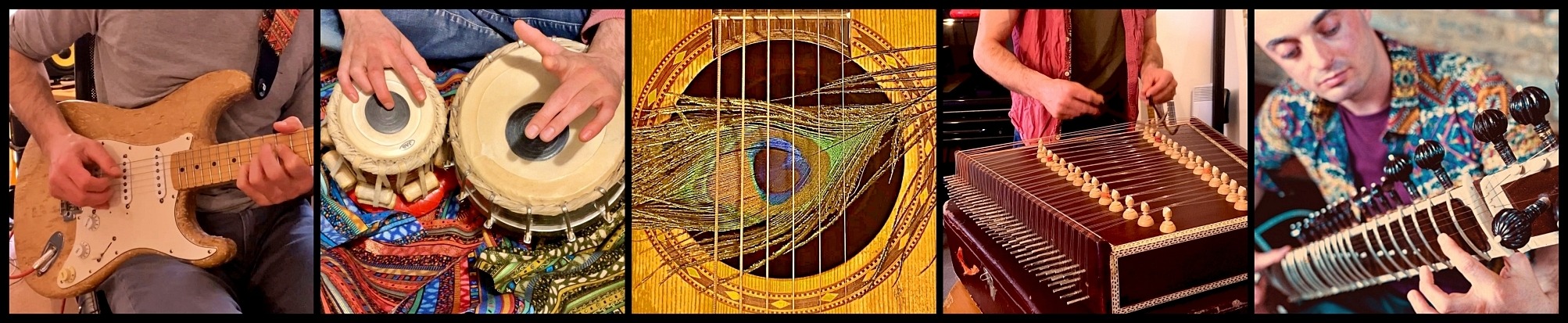
George Howlett is a London-based musician, writer, and teacher (guitars, sitar, tabla, & santoor). Above all I seek to enthuse fellow sonic searchers, interconnecting fresh vibrations with the voices, cultures, and passions behind them. See Homepage for more, and hit me up for Lessons!
• Projects & articles: full list •
[Join the Patreon!]