S-R-gG-m-P-d-nN-S
Invented by sitarist Vilayat Khan as a tribute to his father, legendary innovator Enayet Khan (although when the raga first surfaced, circa 1981, he was calling it ‘Vilayat Khani Kanada’ instead…). As per fellow Imdadkhani sitarist-scholar Deepak Raja’s excellent analysis, the raga runs along the lines of “Darbari with the addition of two ‘alien swaras’ in the ascent [shuddha Ga & Ni]…Phrases with the alien swaras are always sandwiched between typical Darbari phrases, and blend into the new melodic entity with a distinctive emotional flavour”. He also details how Darbari’s character “is preserved by keeping the raga firmly anchored in the lower half of the melodic canvas, with very sparing development in the upper tetrachord and higher octave”. Khan’s most prominent recording is laden with long meend, which occasionally render the adjacent ni–Ni positions consecutively. Seemingly unperformed by anyone besides its creator (also see his other inventions, e.g. Madhuvanti, Sanjh Saravali, and Pancham se Pilu).
• Raga Megalist (365+) •
राग इनायतखानी कानडा

Search | Glossary | Tags
• Hindustani Raga Index •

—Vilayat Khan (2001)—
[gat, e.g. 47:43] SR (m)g/m R, n(RnSn) n\d n\d, P, mPn\d, NNS, R(SR) G, (m)g/m R(S), SR (m)g/m RS, R\d(nd) n\d n\d…

• Support open-access, ad-free raga musicology by joining my brand-new PATREON (launched mid-2024). And if you’re seeking to learn raga on non-standard instruments…get started with online lessons!

• More •
Histories, melodies, mythologies, etc…
—Imagery: Enayet Khan (1894-1938)—

“In Ustad Enayet Khan‘s style, one is stuck by a introspective, devotional undercurrent. He learned from dhrupadiyas Allabande & Zakiruddin Khan, adding a contemplative quality to his own romantic personality. In alap, we discern pleasing khayal-type murkis, and in gat, he added swift sapat taans. He introduced khandarbani gamaks, peshkars, and tihais on the sitar, and on surbahar we notice elongated meend covering an entire octave. No other artist of his time had such depth, mastery, and knowledge, and the ability to organize and systematize the instrumental style…”
• Classifiers •
Explore hidden inter-raga connections: swara geometries, melodic features, murchana sets, ragangas, & more (also see the Full Tag List):
Swaras: -4 | 5 | 6 | 7 | 8 | 9 | 10+
Sapta: Audav | Shadav | Sampurna
Poorvang: SRGM | SRG | SRM | SGM
Uttarang: PDNS | PDS | PNS | DNS
Varjit: Re | Ga | Ma | Pa | Dha | Ni
Double: rR | gG | mM | dD | nN
Thaat: 10 | 32 | Enclosed | Inexact
Chal: All-shuddha | All-komal | Ma-tivra
Gaps: Anh. | Hemi. | 3-row | 4-row | 5-row
Symmetries: Mirror | Rotation | Palindr.
Aroha: Audav | Shadav | Sampurna
Avroh: Audav | Shadav | Sampurna
Jati: Equal | Balanced | Av.+1 | Av.+2
Samay: Morning | Aftern. | Eve. | Night
Murchana: Bhup. | Bihag | Bilaw. | Charu.
Raganga: Bhairav | Malhar | Kan. | Todi
Construction: Jod | Mishra | Oddball
Origin: Ancient | Carnatic | Modern
Dominance: Poorvang | Uttarang
Prevalence: A-list | Prachalit | Aprach.
• Prakriti: Chandranandan
–Proximate Forms–
Gunji Kanada = ‘Enayetkhani. only ni‘
Jaijaiwanti = ‘Enayetkhani. shuddha Dha‘
Shivmat Bhairav = ‘Enayetkhani. komal re‘
Chandrakaushiki = ‘Enayetkhani. only Ga‘
Darbari = ‘Enayetkhani. only ga/ni‘
(n.b. these are just ‘scalar similarities’, with nothing particular implied about phraseological overlap)

–Swara Geometries–
• Core form: S–R–gG–m–P–d–nN–S
• Reverse: SrRGmPdDnS
• Negative: 4-5-3
• Imperfect: 2 (Re, Ni)
• Detached: none
• Symmetries: none
• Murchanas: Rang Malhar (on ma)
–Global Translations–
• Carnatic: (~Amrithavahini)
S-R2-G2-G3-M1-P-D1-N2-N3-S
• Jazz: Aeolian (dbl. 3rd/7th)
1-2-b3-3-4-5-b6-b7-7-8
• Pitch classes (‘fret-jumps’):
0-2-3-4-5-7-8-10-11-0
(2–1–1–1–2–1–2–1–1)
o • o o o o • o o • o o o

• Tanpura: Sa–Pa (or none)
• Names: Enayetkhani Kanada, Enayet Khani Kannada (originally ‘Vilayat Khani Kanada’)
• Transliterations: Hindi (इनायतखानी कानडा)
—Vilayat Khan (1981)—
• Get started with learning raga! •
Share these ragas! My site is 100% reliant on organic visitors (and none of your donations go to ad agencies…) – share this with fellow sonic searchers!
[Join my PATREON!]
Like everything on my site, the Raga Index will always remain open-access & ad-free: however, anti-corporate musicology doesn’t pay the bills! I put as much into these resources as time and finances allow – so, to hasten the project’s expansion, you can:
• Support the Raga Index! •
—Riyaz-focused notations & bandish—
—Resurrecting rare and ancient ragas—
—Further melodic & geometric analysis—
—Engaging with Hindustani performers—
—Ensuring that high-quality raga knowledge will remain open to all, at no cost: free from commercial motive!—

—Hindustani Raga Index—
An open-ended project seeking to bring North Indian raga closer to all who approach with open ears. Combines direct input from dozens of leading Hindustani artists with in-depth insights from music history, global theory, performance practice, cognitive science, and much more besides!
–Megalist (365+ ragas)–
• Search: Find your new favourite •
• Tags: Classifying the ragascape •
• Glossary: Raga jargon demystified •
• Murchanas: Swara-set rotations •
• Thaat: Bhatkhande’s base scales •
• Ragatable: Analytical connections •
• Tanpuras: Divine overtonal drones •
• Quotes: Musings from raga artists •
• Talas: Hindustani rhythm cycles •
• Instruments: Singing sculptures •
Sa | Re | Ga | Ma | Pa | Dha | Ni
[Random Raga]
—Search the Raga Index—
• Feedback / Contact •
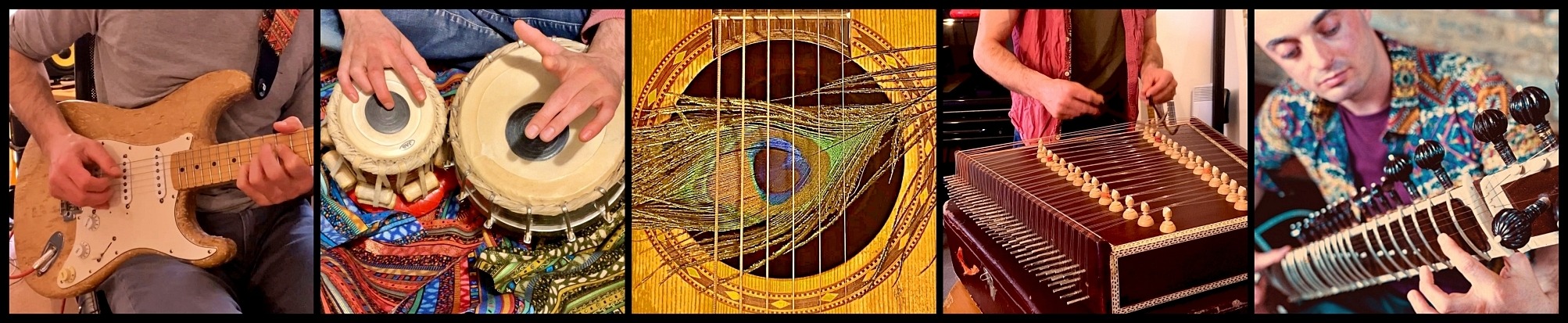
George Howlett is a London-based musician, writer, and teacher (guitars, sitar, tabla, & santoor). Above all I seek to enthuse fellow sonic searchers, interconnecting fresh vibrations with the voices, cultures, and passions behind them. See Homepage for more, and hit me up for Lessons!
• Projects & articles: full list •
[Join the Patreon!]