S-R-G-P-N-S
Hansadhwani translates to ‘Call of Swans’ – a creature with rich cultural associations in the Subcontinent (Saraswati, goddess of music and learning, is often depicted atop a swan: said to symbolise purity, discernment, and the process of breathing). Originally imported from a Carnatic ragam, the raga’s pentatonic simplicity invites the listener towards the calm of nature, with a strong vadi-samvadi pairing of Sa–Pa retaining a central reassurance amidst what Jairazbhoy describes as “an inherently unbalanced scale”. As per a moving account sent in by psychologist and sound practitioner Vinod Mudliar in early 2024, listening to Vijay Kannan’s solo bansuri renditions of Hansadhwani helped him to cope during the strains of his cancer treatment in 2010 (Mudliar now “intends to conduct experiments studying brain waves, to see the effect of certain ragas on patients who are undergoing chemotherapy and radiotherapy…”). Refer to further performances by Parveen Sultana (alap transcribed below), Shivkumar Sharma, and Hariprasad Chaurasia, as well as a special 2008 concert involving 1000 sitarists. Compare to related forms including Shankara (add Dha), Bhupali (swap Ni for Dha), and the ultra-rare Veenavadini (komal ni instead) – as well as compounds such as Pannalal Ghosh’s Hansa Narayani, and other ragas linked to the same goddess (e.g. Saraswati and Ambika Sarang).
• Raga Megalist (365+) •
राग हंसध्वनी

Search | Glossary | Tags
• Hindustani Raga Index •


Aroha: SRGPNS
Avroh: SNPGRS
Chalan: e.g. PNS(G)R; RGP(G)R; (S)RG; RSR; GP; GPN; PNS; PNSGR; (R)G(R)S; NPGP(G)R; (R)G(R)S (Bor/Vyas)
—Parveen Sultana (2018)—
[alap phrases, e.g. 0:56] (N)P/SN(SN), P/S(NSPGSNRSN), (NP)SN(SN)S, (N)S S(NPGPNRS), N(PSN)GR, NRSNPG, PGPS NRS, PS, PG, S…

• Support open-access, ad-free raga musicology by joining my brand-new PATREON (launched mid-2024). And if you’re seeking to learn raga on non-standard instruments…get started with online lessons!

• Carnatic Origins •
—Ragam Hamsadhwani—
(T.M. Krishna)
[All ragas of Carnatic origin]
• Classifiers •
Explore hidden inter-raga connections: swara geometries, melodic features, murchana sets, ragangas, & more (also see the Full Tag List):
Swaras: -4 | 5 | 6 | 7 | 8 | 9 | 10+
Sapta: Audav | Shadav | Sampurna
Poorvang: SRGM | SRG | SRM | SGM
Uttarang: PDNS | PDS | PNS | DNS
Varjit: Re | Ga | Ma | Pa | Dha | Ni
Double: rR | gG | mM | dD | nN
Thaat: 10 | 32 | Enclosed | Inexact
Chal: All-shuddha | All-komal | Ma-tivra
Gaps: Anh. | Hemi. | 3-row | 4-row | 5-row
Symmetries: Mirror | Rotation | Palindr.
Aroha: Audav | Shadav | Sampurna
Avroh: Audav | Shadav | Sampurna
Jati: Equal | Balanced | Av.+1 | Av.+2
Samay: Morning | Aftern. | Eve. | Night
Murchana: Bhup. | Bihag | Bilaw. | Charu.
Raganga: Bhairav | Malhar | Kan. | Todi
Construction: Jod | Mishra | Oddball
Origin: Ancient | Carnatic | Modern
Dominance: Poorvang | Uttarang
Prevalence: A-list | Prachalit | Aprach.
• Prakriti: (none found)

–Swara Geometries–
• Core form: S–R–G–P–N–S
• Reverse: SrmdnS
• Negative: 3-2-2-1-2-1-1
• Imperfect: 2 (Re, Ni)
• Detached: none
• Symmetries: none
• Murchanas: none
• Quirks: ‘atritonal‘ (no available tritones)
–Global Translations–
• Carnatic: Hamsadhwani
S-R2-G3-P-N3-S
• Jazz: Ionian (no 4th/6th)
1-2-3-5-7-8
• Pitch classes (‘fret-jumps’):
0-2-4-7-11-0
(2–2–3–4–1)
o • o • o • • o • • • o o

• Tanpura: Sa–Pa (+Ni)
• Names: Hansadhwani, Hamsadhwani, Haunsadhwani, Hans Dhwani
• Transliterations: Hindi (हंसध्वनी); Kannada (ಹಂಸಧ್ವನಿ); Malayalam (ഹംസധ്വനി); Telugu (హంసధ్వని); Tamil (ஹம்சத்வனி)
—Hariprasad Chaurasia (~2000s)—
• Get started with learning raga! •
Share these ragas! My site is 100% reliant on organic visitors (and none of your donations go to ad agencies…) – share this with fellow sonic searchers!
[Join my PATREON!]
Like everything on my site, the Raga Index will always remain open-access & ad-free: however, anti-corporate musicology doesn’t pay the bills! I put as much into these resources as time and finances allow – so, to hasten the project’s expansion, you can:
• Support the Raga Index! •
—Riyaz-focused notations & bandish—
—Resurrecting rare and ancient ragas—
—Further melodic & geometric analysis—
—Engaging with Hindustani performers—
—Ensuring that high-quality raga knowledge will remain open to all, at no cost: free from commercial motive!—

—Hindustani Raga Index—
An open-ended project seeking to bring North Indian raga closer to all who approach with open ears. Combines direct input from dozens of leading Hindustani artists with in-depth insights from music history, global theory, performance practice, cognitive science, and much more besides!
–Megalist (365+ ragas)–
• Search: Find your new favourite •
• Tags: Classifying the ragascape •
• Glossary: Raga jargon demystified •
• Murchanas: Swara-set rotations •
• Thaat: Bhatkhande’s base scales •
• Ragatable: Analytical connections •
• Tanpuras: Divine overtonal drones •
• Quotes: Musings from raga artists •
• Talas: Hindustani rhythm cycles •
• Instruments: Singing sculptures •
Sa | Re | Ga | Ma | Pa | Dha | Ni
[Random Raga]
—Search the Raga Index—
• Feedback / Contact •
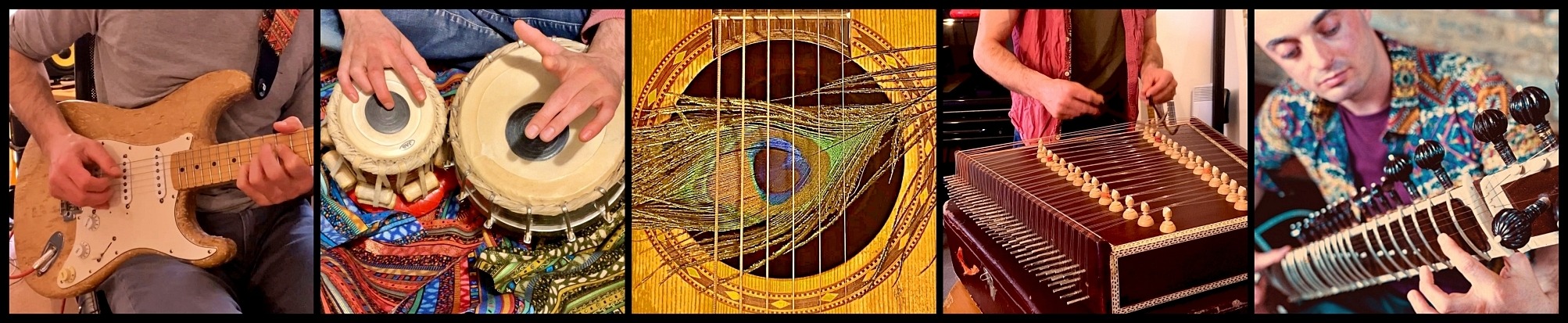
George Howlett is a London-based musician, writer, and teacher (guitars, sitar, tabla, & santoor). Above all I seek to enthuse fellow sonic searchers, interconnecting fresh vibrations with the voices, cultures, and passions behind them. See Homepage for more, and hit me up for Lessons!
• Projects & articles: full list •
[Join the Patreon!]