S-g-m-d-n-S
Among the most revered ragas in the Hindustani pantheon, Malkauns (‘He who wears serpents as garlands’) combines structural simplicity with a nuanced mythological ethos. Said to have been composed by the goddess Parvati to soothe Lord Shiva’s murderous rage, in turn inspired by his wife Sati’s fiery death, its ‘all-komal‘ swara set is associated with states of ‘severe tranquility’, calling on artists to approach with solemnity and trepidation. Given this austere reputation, no other raga shares the same scale – although Malkauns has given rise to countless new forms over the ages (e.g. Jogkauns, Nandkauns, & Kaunsi Kanada). Also see other ‘generic Sa-Ga-Ma-Dha-Ni‘ ragas including Chandrakauns (SgmdNS), Tivrakauns (SgMdnS), Harikauns (SgMDnS), and Hindol (SGMDNS: which, given that Malkauns’ Carnatic congruent is known as ‘Hindolam‘, is thought to have arisen via ‘lowering the Sa of Malkauns’: i.e. SGMDNS = ‘SgmdnS with Sa one semitone lower’).
• Raga Megalist (365+) •
राग मालकौन्स

Search | Glossary | Tags
• Hindustani Raga Index •


Context | Melodics | Classifiers | Listenings | More
Aroha: nSgm, dnS
Avroh: SndmgS, dnS
Chalan: e.g. Sdn/S; dnS(m)gm; m\gS; Sgmd\m; gmdn; d\m; mdndnS; nSgnS(n)d; gmdm; Sgmgn/S (Bor/Chaurasia)

• Support open-access, ad-free raga musicology by joining my brand-new PATREON (launched mid-2024). And if you’re seeking to learn raga on non-standard instruments…get started with online lessons!
–Nikhil Banerjee (1982)–
“If you’re not in a serious mood, then don’t play or sing Malkauns. You must take extra care with this raga. It is a favourite raag of the djinns [spirits], you see. If you can charm them – if they like the way you are playing it – they will do anything for you. If they don’t, they will kill you.” (Ali Akbar Khan)

—Context—
Origins, myths, quirks, & more
Malkauns, an ancient form, is often said to evoke a state of ‘severe tranquility‘. Artists who turn to it seek to open an austere realm of contemplation – the mood is mournful yet always stable, as if searching for resolution whilst meditating on some great loss. Despite its pentatonic simplicity, few ragas are more instantly recognisable.
Hindu lore tells of how it was composed to soothe Lord Shiva’s rage. His mortal-born wife, Princess Sati, had renounced the trappings of the material world for Shiva’s love, displeasing her father, King Daksha – who eventually fell into a fit of fury, insulting his daughter and berating Shiva’s character (“a vagrant, who has neither commitments nor a sense of values in life…one who roams about in dreadful cemeteries, attended by hosts of ghosts and sprites; like a madman, naked, with disheveled hair, wearing a garland of skulls and ornaments of bones…the lowest of the gods”).
Sati, in turn, became consumed by her own anger, taking on the form of the supreme goddess Adi Parashakti. Storms broke as her earthly body burst into flames, disintegrating under the weight of the deity’s infinite power. On learning of his wife’s death, Shiva was distraught, and flew into a wild rage – placing Sati’s charred corpse on his shoulders and throwing two locks of hair to the ground, which sprung up to form the Manibhadra: many-armed warrior spirits who wielded swords, tridents, and cleavers in their murderous quest. They became lost in an unending tandav (‘destruction dance’) – decapitating the king, slaughtering his entourage, and roaming the globe in search of further vengeance.
Shiva’s unrelenting fury disturbed his fellow gods, who implored Vishnu (the ‘preserver’) to help. Quickly persuaded by the unfolding destruction, Vishnu decided to send Sati’s spirit back to earth – reincarnating her as Parvati (Sanskrit: ‘Daughter of the Mountain’). She sought out Shiva, purifying her soul by chanting and meditating naked in the harsh outdoors – and eventually finding him in the depths of the forest. It is said that Parvati first unveiled the raga’s melodic turns as they wandered in the mountains, naming it Mal-Kaushik (‘he who wears serpents as garlands’: in reference to a notorious habit of Shiva’s).
The music calmed his mind, succeeding where all else had failed – and soon after, the couple reinstated their eternal marital bonds. At the behest of his wife, Shiva took mercy on his vanquished foes, resurrecting those who he had slain and even reinstating the King to his throne (…albeit while replacing his de-severed head with that of a sacrificial goat).

(Shiva bears Sati’s charred corpse)
While the raga’s non-mythic history is less clear, scholars theorise that its name may also have arisen via some combination of Malavas (an ancient Punjabi tribe) and kaisiki (a posited microtone of the ni swara). The scale also appears to have undergone significant transformation over the centuries: its precursor ‘Malav-Kaushik‘ is listed in Locana’s 15th-century Raga Tarangini as belonging to ‘Karnata Mela’ (equivalent to today’s Khamaj thaat), while Pundarika Vitthala’s Raga Manjari, published a century or so later, files it under Kafi instead: indicating a long-term trend towards lowering its swara positions.
Whatever its precise historial path may be, Malkauns is now inseparable from its darkly mythic reputation. Many musicians still fear its supernatural powers, believing it can attract evil spirits if not handled correctly – as if the shadows of Shiva’s tandav are still buried within the raga, waiting to escape. A prominent critic recently told me that she would rather miss a deadline than review a Malkauns CD before midnight.
Ali Akbar Khan (who used Malkauns as the foundation for his own Chandranandan) cautioned his students against entering its realm with the wrong mindset: “If you’re not in a serious mood, then don’t play or sing Malkauns. You must take extra care with this raga. It is a favourite of the djinns [spirits], you see. If you can charm them – if they like the way you are playing it – they will do anything for you. If they don’t, they will kill you”. The performer must remain patient, finding a balance that will keep Pandora’s box closed. The devil should not be found in the detail (spare a thought for superstitious performers: I sometimes get nervous on stage, but never feel that missing a modulation will curse the audience…).

(assorted depictions of Lord Shiva)
It can certainly provokes all manner of reactions. Ayurvedic healers have long cited its ability to relieve headaches and stomach pain (“the nabhi chakra [solar plexus] is cleansed by Malkauns, Abhogi, and Bhimpalasi, aiding with digestion and bringing about inner transformation, helping to give up vices”) – and listeners from outside the Subcontinent find themselves similary intoxicated (Alexander Keefe: “like a powerful narcotic, replacing clock-time with another temporality altogether: do not attempt to operate a motor vehicle under its influence”). Others have reportedly used it to conduct curious experiments on farm animals (“The cows in their shelters listened to Malkauns, but did not give extra milk. However, the animals became more active…”).
Perhaps the cows’ large ears were piqued by Malkauns’ structural simplicity. Either way, the underlying scale certainly harks back to nature – drawing on the prehistoric, transcultural ‘pentatonic sequence‘ in multivariate fashion. This transcendent shape turns up in virtually every human civilisation, underpinning genres from American blues and Balinese gamelan to Japanese court music and West African percussion. Mammoth-tusk flutes from 40,000 years ago are tuned close to the scale – and even non-musicians intuitively know how it goes.
Most notably, Malkauns matches the same underlying ‘2-2-3-2-3‘ interval pattern – albeit in a less common root position than its more famous variants: the Major and Minor Pentatonics (equivalent to Bhupali and Dhani). As well as being an exact murchana of both these scales (see Bhupali set), it also lies just a single swara-shift away from each: Dhani can be produced by trading dha for Pa (SgmdnS > SgmPnS), and Bhupali’s shape is equivalent to ‘raising Malkauns’ Sa by a semitone’ (SgmdnS > SRGPDS: also see Hindol, thought to have resulted from shifting Sa in the other direction instead: i.e. SGMDNS = ‘Malkauns with Sa lowered a semitone’).

(serpent idols at Vetticode Nagaraja Temple)
All swaras can be used as starting or resting tones, summoning a tense, inescapable balance. You are pulled in all directions at once, suspended within the scale’s symmetric pentagram, contemplating the world from a distance. Traditionally associated with veera (‘essence of courage’), the raga’s motions are consequently imbued with grave determination, eschewing surface-level flamboyance and infatuation. If there is heroism here, then it is that of the post-battlefield return to camp, filled with relief, longing, and mourning.
Musicians describe Malkauns solemnly, as if they must sacrifice part of themselves to fully learn it. Likewise, Parvati is renowned for her severe feats of self-discipline, renouncing civilisation and withdrawing to nature. But while for some the raga is a call towards ascetic isolation, to others, its mythic signifiers point the other way: after all, Parvati used it to ground Shiva’s mind, helping him to re-engage with reality rather than to continue running from his grief. Similar ambiguities are found in Malkauns’ ragmala paintings (below), medieval artworks which depict ragas as characters, colours, and shapes.
Historian Klaus Ebeling describes it as “generally the most difficult to identify among all the ragas”: with depictions including a meditating yogi, a passionate lover, a nobleman intoxicated with betel nut, and a warrior-king holding a severed head while listening to distant music. While these disparate figures at first glance seem to have little in common, they all share an immediate contact with some other realm, bridging worlds with a charged stillness. Dedicated musicians know this feeling – we often traverse mundane life reluctantly, half-locked in abstract inner worlds of rhythm and melody.

(“A scarf round his neck, and fanned by the fair-hipped one; A golden seat has been made for the handsome Shri Malav, King of the Gandharvas…”)
It seems the raga has a particular pull for musical obsessives. Many have become lost in it: notably including khayal greats such as Bhimsen Joshi and Amir Khan, who placed it at the centre of their repertoire. Kirana exponent Pran Nath spent a lifetime working on it, even retreating to live in the mountain caves of Dehradun for years at a time, singing Malkauns to passing birds and substituting a tanpura drone for the sounds of running streams (Nath’s extreme ascetism even resembles Shiva and Parvati’s fabled forest routines…).
Whatever the setting, Malkauns draws the listener away from impulse and delusion, inviting them towards a realm of austere contemplation. It balances tranquility with severity, calming Shiva’s dance of destruction and turning him to reflect on the suffering he had caused. Unique in its ambiguities, it will continue to captivate for centuries to come.

• Ragmalas •
Historic miniature paintings (learn more)

“Malkosa Raga, opaque watercolor on paper with gold and silver” (Bikaner, c.1710) / “Malkos: from the Edwin Binney Collection” (unknown, c.1700)
—Phraseologies—
Melodies, movements, characteristics…
Despite having relatively few rules, and no prakriti competitors, Malkauns is nonetheless regarded as among the hardest ragas to truly master. While the basic SgmdnS form is simple to define, its characteristic phrase patterns are quixotic, with artists seeking inspiration from the raga’s auspicious origin tale as much as its inherent scalar geometries.
Typically placed in Bhairavi thaat, all swaras are set to their lowest specific position (i.e. ‘rgmdn vs. RGMDN‘: see more in my ‘all-komal‘ category) – with shuddha ma exerting the strongest melodic gravity, and komal ni serving as a prominent melodic launchpoint (e.g. nSgm). The dnS uttarang axis is often used in symmetric motions (e.g. Snd; dnS), and glides are prominent in descent (e.g. n\d; d\m; m\g) – although most ornaments are restrained in scope, in keeping with the raga’s austere sentiments.
Suggested pakad include mg; mdnd; mg; mgS (Sharda), dnSgm; gmndm; dnS; gSnd (Tanarang), and SdnS; ng\S; Sgmg\S; gmdn; mdnS (Parrikar) – while Joep Bor and Hariprasad Chaurasia offer a melodic outline of Sdn/S; dnS(m)gm; m\gS; Sgmd\m; gmdn; d\m; mdndnS; nSgnS(n)d; gmdm; Sgmgn/S (hear Hariprasad’s recordings below). Also refer to a lesson collection from the Ali Akbar College, an excellent article by Stephen Jones, and Moumita Mitra’s crystal-clear taan demo (e.g. mmgmSnS; dnSgmgSn; SgmSmg nSggS; SgSgmdgm ddmgmgSnS).
—Shivkumar Sharma demo (1993)—
“Sharma encouraged the audience to interrogate themselves about the feelings music provokes, saying that ‘Indian music goes beyond entertainment’. Rasikas felt the full potency of that maxim as Pandit-ji rendered Malkauns: a raga that stands at the farthest end of human accomplishment. The raga’s notations do not form a clear map: they suggest only premonitions, moods, and shadowy incantations…” (Kannan Somasundaram)
—Listen—
A brief selection of superb renditions
–Shivkumar Sharma (1993)–
- ‘Shivkumari’ santoor (10m): Sharma, born in the Himalayan border city of Jammu, customised the design of his 93-string instrument over time, drawing inspiration from the icy textures of the surrounding mountains. Hear how he uses its crisp shimmer to jump and glide through the wide leaps and defined spaces of Malkauns’ scale – bringing an architectural solidity and a fine-lens focus (perhaps akin to staring at the crisp detail of a glacier across the valley…). To me, there is a steady, unforgiving beauty, as if humbled by the power of some great natural process:
[jor motifs, e.g. 0:15] dm(S)d, mg(S)m, gS(S)gn; nd(S)n, dm(S)d, mg(S)m, gS(S)gn; Sn(S)S, nd(S)n, dm(S)d, mg(S)m, gS(S)gn…
–Hariprasad Chaurasia (1993)–
- Maihar bansuri (22m): the triad-tuned tanpura (Sa–ma–dha) is prominent, adding cascading sparkle and accentuating the bamboo flute’s smooth timbres in a divine alap–jor–jhalla, which sets agile melodic motions into a mathematical structure (also hear him play the full raga with Zakir Hussain, with ni added to the drone-palette):
[jhalla motifs, e.g. 14:31] Sgmn, dmSn, (n)Sgmd, mgSn\d d, dn(Sn) nSgmdm(gm), n\d n\dnS, SS(nd); n\d (S)nS, SSS…
–Further Recordings–
- Bhimsen Joshi & Pandit Jasraj (4m): an absolute gem of a jugalbandi from the pioneering pair, rarely recorded together
- Abhisek Lahiri (4m): “a melody of empathy and seething rage, imploring another to accept and to repurpose the anger within”
- Bundu Khan (11m): recoloured by the sarangiya’s idiosyncratic trick of omitting the tanpura‘s Sa, bringing chayas of Dhani
- Abida Parveen (14m): an enchanting Sufi-inclined interpretation, leaning towards the scale’s soothing possibilities
- Sangeeta Shankar (16m): the Benares violinist‘s sliding lines are somewhat reminiscent of Hindolam, the Carnatic equivalent
- Amir Khan (23m): among the raga’s most revered renditions, set to a timeless bandish (Jinke Man Ram Biraje Drut)
- Ramesh Narayan (26m): exploring an impassioned pair of compositions (Kanha Bajaye Bansuri & Pratham Naad Sur Sadhe)
- Abdul Latif Khan (27m): filmed at the fabled 1989 Sarangi Mela in Bhopal (still the largest ever gathering of sarangiyas)
- Ali Akbar Khan (30m): despite Chandranandan, the sarodiya rarely played it (reportedly due to the sarod’s open ‘Pa‘ string)
- Amjad Ali Khan (45m): from the 2017 Tansen Sangeet, backed by a double-drum duo of Sanju Sahai and Tanmoy Bose
- Rashid Khan (46m): from the 1994 Dover Lane Conference, supported by late tabla maestro Ananda Gopal Bandopadhyay
- Pran Nath (61m): aided by La Monte Young (“those four simple syllables – Go Vin Da Ram – are the names of God…”)
- Bhimsen Joshi (64m): a priceless video of the Kirana master in full flight (his body language reveals his melodic emphasis…)
- Zia Mohiuddin & Zia Fariduddin Dagar (69m): a fine balance of rudra veena and voice, recorded at the Dagar home in 1968
• Classifiers •
Explore hidden inter-raga connections: swara geometries, melodic features, murchana sets, ragangas, & more (also see the Full Tag List):
Swaras: -4 | 5 | 6 | 7 | 8 | 9 | 10+
Sapta: Audav | Shadav | Sampurna
Poorvang: SRGM | SRG | SRM | SGM
Uttarang: PDNS | PDS | PNS | DNS
Varjit: Re | Ga | Ma | Pa | Dha | Ni
Double: rR | gG | mM | dD | nN
Thaat: 10 | 32 | Enclosed | Inexact
Chal: All-shuddha | All-komal | Ma-tivra
Gaps: Anh. | Hemi. | 3-row | 4-row | 5-row
Symmetries: Mirror | Rotation | Palindr.
Aroha: Audav | Shadav | Sampurna
Avroh: Audav | Shadav | Sampurna
Jati: Equal | Balanced | Av.+1 | Av.+2
Samay: Morning | Aftern. | Eve. | Night
Murchana: Bhup. | Bihag | Bilaw. | Charu.
Raganga: Bhairav | Malhar | Kan. | Todi
Construction: Jod | Mishra | Oddball
Origin: Ancient | Carnatic | Modern
Dominance: Poorvang | Uttarang
Prevalence: A-list | Prachalit | Aprach.
• Prakriti: (none found)
–Proximate Forms–
Chandrakauns = ‘Malkauns shuddha Ni‘
Malkauns Pancham = ‘Malkauns add Pa‘
Sundarkauns = ‘Malkauns shuddha Dha‘
Mohankauns = ‘Malkauns double Ga‘
Tulsikauns = ‘Malkauns double Ni‘
Tivrakauns = ‘Malkauns tivra Ma‘
(n.b. these are just ‘scalar similarities’, with nothing particular implied about phraseological overlap)
–Swara Geometries–
• Core form: S–g–m–d–n–S
• Reverse: SRGPDS (=Bhupali)
• Negative: 2-1-2-2-1-2-2 (e.g. Darbari)
• Imperfect: 1 (Sa)
• Detached: none
• Symmetries: mirror (G—n)
• Murchanas: Bhupali set
• Quirks: ‘atritonal‘ (no available tritones) • ‘maximal‘ (swaras are optimally ‘spread out’)
–Global Translations–
• Carnatic: ~Hindolam
S-G2-M1-D1-N2-S
• Jazz: Phrygian Pentatonic
1-b3-4-b6-b7-8
• Pitch classes (‘fret-jumps’):
0-3-5-8-10-0
(3–2–3–2–2)
o • • o • o • • o • o • o

–Around the World–
As discussed, Malkauns’ underlying ‘pentatonic scale‘ interval structure is a truly transcultural sonic artefact, turning up across the world of music. However, most examples are set to its more common rotations, the ‘Major’ and ‘Minor’ (SRGPDS & SgmPnS: see Bhupali & Dhani for respective global congruents) – likely due to Malkauns’ ‘fifth-less‘ format.
Its exact pattern does, however, turn up in its own right across a variety of cultures, as well as being hinted at in many more – especially those which treat the concept of ‘root‘ with more flexibility than Indian raga or Western classical (i.e. if no tone is a clear root, any pentatonic piece can resemble Malkauns). Aside from South India‘s historically-overlapping Hindolam, analogues of the sequence can be found in Ethiopia (referred to as ‘Shegaye Kinit‘), China (below, on the guzheng: a ‘heterochordal half-tube zither’), and Cambodia (a haunting solo by a khloy reedist: “the Khmer Rouge spared his life for his musicianship, and his son claims to have seen an elephant cry from hearing his music…”).
—Fisherman’s Dusk Song (China)—
(Qian Jun, 2013)
“The oldest known guzheng, found in a Jiangsu tomb, was fashioned over 2,600 years ago. The instrument’s ornate components take poetic names: lóngtóu [‘dragon head’: right side], fèng wěi [‘phoenix tail’: left side], yuèshān [‘high mountains’: fixed string-bridges], tiānchí [‘celestial pond’: central soundhole], yàn zhù [‘wild goose pillars’: moveable string-bridges], miànbǎn [‘face-board’: soundboard], and yǐn jiān [‘hidden chamber’: inner space]…” (from my article on ‘double-bridge‘ instruments)
• Tanpura: Sa–ma (+dha)
• Names: Malkauns, Malkosh, Malkos, Malkaus, Malakosh, Malavakauns, Malawa Kosh, Mal-Kaushik
• Transliterations: Hindi (मालकौन्स); Urdu (مالکونس); Bengali (মালকোষ); Malayalam (മാൽകൗൺസ്); Kannada (ಮಲ್ಕೌನ್ಸ್)
—More—
Further info: links, listenings, learnings, etc
- Raag Malkauns: For a longer version of the raga’s auspicious origin myth, see Sreenivas Rao’s excellent site (“The mighty Mahadeva created out of his mouth a most magnificent and frightening being, glowing like the fire of fate; a divine being with a thousand heads, and a thousand eyes, wielding a thousand clubs; bearing a blazing bow and battle axe; clothed in tigerskin; dripping with blood; and decorated with a crescent moon; shining with luster and dreadful splendour, like the final-fire of destruction that consumes all existence…”). And for more ragmala paintings, see two examples from Rajasthan, as well as Reis Flora’s rundown of ragmala-inspired poetry (“Four raginis of Malkos are named in the first line, [followed] by an imperative form: the Hindi verb pachana (‘to recognise’). The second line, about Kukubh, the remaining ragini, sets up a quick turn of phrase in the next five syllables…”).
- Header audio: Sitar alap by Nikhil Banerjee (1985)
- Header image: ‘Shiva in His most powerful form: the four-armed wrathful Virabhadra’, silver repoussé plaque, Maharashtra or Karnataka (19th century)
• Get started with learning raga! •
Share these ragas! My site is 100% reliant on organic visitors (and none of your donations go to ad agencies…) – share this with fellow sonic searchers!
[Join my PATREON!]
Like everything on my site, the Raga Index will always remain open-access & ad-free: however, anti-corporate musicology doesn’t pay the bills! I put as much into these resources as time and finances allow – so, to hasten the project’s expansion, you can:
• Support the Raga Index! •
—Riyaz-focused notations & bandish—
—Resurrecting rare and ancient ragas—
—Further melodic & geometric analysis—
—Engaging with Hindustani performers—
—Ensuring that high-quality raga knowledge will remain open to all, at no cost: free from commercial motive!—

—Hindustani Raga Index—
An open-ended project seeking to bring North Indian raga closer to all who approach with open ears. Combines direct input from dozens of leading Hindustani artists with in-depth insights from music history, global theory, performance practice, cognitive science, and much more besides!
–Megalist (365+ ragas)–
• Search: Find your new favourite •
• Tags: Classifying the ragascape •
• Glossary: Raga jargon demystified •
• Murchanas: Swara-set rotations •
• Thaat: Bhatkhande’s base scales •
• Ragatable: Analytical connections •
• Tanpuras: Divine overtonal drones •
• Quotes: Musings from raga artists •
• Talas: Hindustani rhythm cycles •
• Instruments: Singing sculptures •
Sa | Re | Ga | Ma | Pa | Dha | Ni
[Random Raga]
—Search the Raga Index—
• Feedback / Contact •
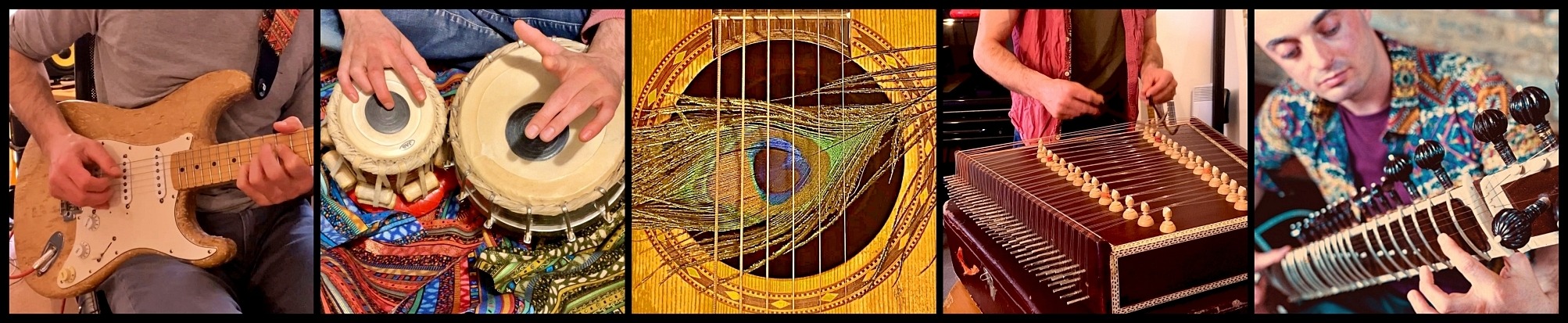
George Howlett is a London-based musician, writer, and teacher (guitars, sitar, tabla, & santoor). Above all I seek to enthuse fellow sonic searchers, interconnecting fresh vibrations with the voices, cultures, and passions behind them. See Homepage for more, and hit me up for Lessons!
• Projects & articles: full list •
[Join the Patreon!]