S-R-G-M-d-n-S
Among the strangest of raga scales, Sehera’s six swaras are all spaced out in two-semitone jumps (akin to the Western Whole-Tone scale and the Carnatic Gopriya). The resulting symmetries summon a curious, centreless mood (also famous as the ‘dream sequence‘ of countless soundtracks) – best explored by sarangiya Sultan Khan, who described Sehera as “the forbidden scale”, and, after pre-recording it for All India Radio, reportedly requested that his session “should not be aired…it is too sad”. Thankfully, he did cut a haunting ghazal with Mehdi Hassan, manipulating a GMdS refrain over ambiguous harmonium drones (…what would you even tune a tanpura to?). The origins of name ‘Sehera/Sehra’ are unclear, but may relate to an Arabic term for ‘Desert’ (صحراء), perhaps hinting at the raga’s geographic origins. Also see a handful of curious prakritis below – and compare to Imratkauns (the same scale with shuddha ma instead).
• Raga Megalist (365+) •
राग सेहरा

Search | Glossary | Tags
• Hindustani Raga Index •


Aroha: SRGMdnS
Avroh: SndMGRS
Chalan: (uncodified)
—Mehdi Hassan & Sultan Khan (1977)—
[refrain, e.g. 4:58] MGRS, dnSG, GMdMGMd, MGRS…

• Support open-access, ad-free raga musicology by joining my brand-new PATREON (launched mid-2024). And if you’re seeking to learn raga on non-standard instruments…get started with online lessons!
• More •
Histories, melodies, mythologies, etc…
—Further SRGMdnS forms—
After the release of this page in late 2023, I’ve encountered several other Hindustani forms which match the same ‘whole-tone’ scale. Notable examples include Dhyan Kalyan: which, as per rare raga explorer Abhirang, was created by late Kirana vocalist Mani Prasad ‘Dhyanrang’ via omitting Pa from Rishabhapriya, the 62nd Carnatic melakarta (he adds that Re is omitted in ascent, and that “the GMR sangati takes priority”: also evident in Ramesh Jule‘s crystal-clear rendition).
Multi-instrumentalist Ashish Dha also got in touch to discuss his own intriguing invention entitled ‘Trishanku‘ – currently existing as a pair of microtonally-tuned keyboard demos, each of which takes slightly different srutis in the upper scale [‘Trishanku #1‘ has Ma–dha–ni ratios of ‘10:7; 100:63; 25:14‘, whereas ‘Trishanku #2‘ has ‘25:18; 25:16; 225:128‘: equating to cent values of ‘617-800-1003‘ vs. ‘569-773-977‘]. The name ‘Trishanku’ refers to a mythical King of the Suryavamsha (‘Solar Dynasty’) featured in the Ramayana and other ancient epics, fabled for becoming suspended between Heaven and Earth after being cast out of the former.
—Dhyan Kalyan (Ramesh Jule)—
• Classifiers •
Explore hidden inter-raga connections: swara geometries, melodic features, murchana sets, ragangas, & more (also see the Full Tag List):
Swaras: -4 | 5 | 6 | 7 | 8 | 9 | 10+
Sapta: Audav | Shadav | Sampurna
Poorvang: SRGM | SRG | SRM | SGM
Uttarang: PDNS | PDS | PNS | DNS
Varjit: Re | Ga | Ma | Pa | Dha | Ni
Double: rR | gG | mM | dD | nN
Thaat: 10 | 32 | Enclosed | Inexact
Chal: All-shuddha | All-komal | Ma-tivra
Gaps: Anh. | Hemi. | 3-row | 4-row | 5-row
Symmetries: Mirror | Rotation | Palindr.
Aroha: Audav | Shadav | Sampurna
Avroh: Audav | Shadav | Sampurna
Jati: Equal | Balanced | Av.+1 | Av.+2
Samay: Morning | Aftern. | Eve. | Night
Murchana: Bhup. | Bihag | Bilaw. | Charu.
Raganga: Bhairav | Malhar | Kan. | Todi
Construction: Jod | Mishra | Oddball
Origin: Ancient | Carnatic | Modern
Dominance: Poorvang | Uttarang
Prevalence: A-list | Prachalit | Aprach.
• Prakriti: (none found)

–Swara Geometries–
• Core form: S–R–G–M–d–n–S
• Reverse: SRGMdnS (=itself)
• Negative: 2-2-2-2-2-2 (=itself)
• Imperfect: 6 (Sa, Re, Ga, Ma, dha, ni)
• Detached: 6 (Sa, Re, Ga, Ma, dha, ni)
• Symmetries: mirror (x6)
• Murchanas: itself (x5)
• Quirks: ‘self-murchana‘ (rotationally symmetric) • ‘self-shadowing‘ (negative form=core form) • ‘fully fragmented‘ (6/6 detached) • ‘tivra Ma, komal ni‘ (rarest pairing) • ‘palindromic‘ (same intervals forwards & backwards) • ‘centred‘ (constellation balances at the wheel’s centrepoint) • ‘maximal‘ (swaras are optimally ‘spread out’)
–Global Translations–
• Carnatic: Gopriya
S-R2-G3-M2-D1-N2-S
• Jazz: Whole-Tone Scale
1-2-3-#4-b6-b7-8
• Pitch classes (‘fret-jumps’):
0-2-4-6-8-10-0
(2-2-2-2-2-2)
o • o • o • o • o • o • o

• Tanpura: Sa–??
• Names: Sehera, Sahera, Sehra, (~Gopriya/Dhyan Kalyan/Trishanku)
• Transliterations: Hindi (सेहरा)
—Sayeed Ur Rahman (1996)—
• Get started with learning raga! •
Share these ragas! My site is 100% reliant on organic visitors (and none of your donations go to ad agencies…) – share this with fellow sonic searchers!
[Join my PATREON!]
Like everything on my site, the Raga Index will always remain open-access & ad-free: however, anti-corporate musicology doesn’t pay the bills! I put as much into these resources as time and finances allow – so, to hasten the project’s expansion, you can:
• Support the Raga Index! •
—Riyaz-focused notations & bandish—
—Resurrecting rare and ancient ragas—
—Further melodic & geometric analysis—
—Engaging with Hindustani performers—
—Ensuring that high-quality raga knowledge will remain open to all, at no cost: free from commercial motive!—

—Hindustani Raga Index—
An open-ended project seeking to bring North Indian raga closer to all who approach with open ears. Combines direct input from dozens of leading Hindustani artists with in-depth insights from music history, global theory, performance practice, cognitive science, and much more besides!
–Megalist (365+ ragas)–
• Search: Find your new favourite •
• Tags: Classifying the ragascape •
• Glossary: Raga jargon demystified •
• Murchanas: Swara-set rotations •
• Thaat: Bhatkhande’s base scales •
• Ragatable: Analytical connections •
• Tanpuras: Divine overtonal drones •
• Quotes: Musings from raga artists •
• Talas: Hindustani rhythm cycles •
• Instruments: Singing sculptures •
Sa | Re | Ga | Ma | Pa | Dha | Ni
[Random Raga]
—Search the Raga Index—
• Feedback / Contact •
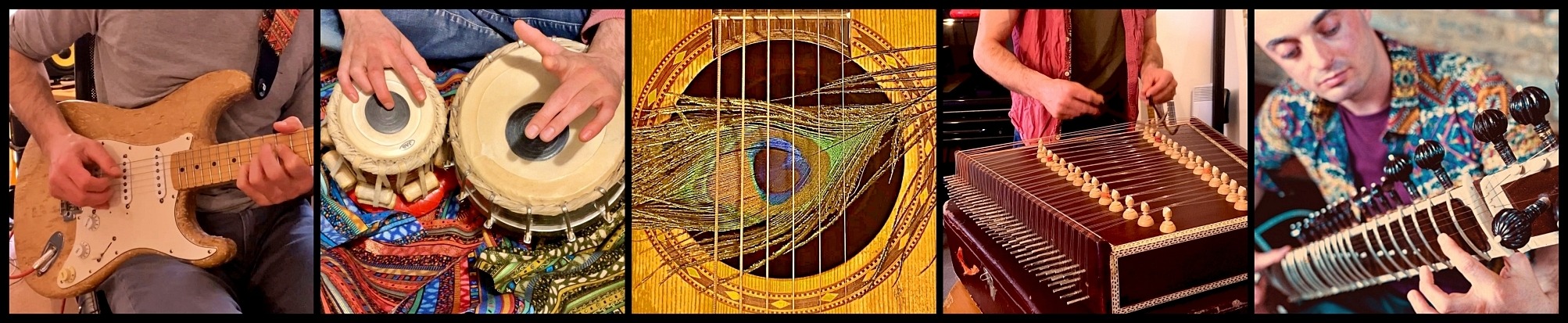
George Howlett is a London-based musician, writer, and teacher (guitars, sitar, tabla, & santoor). Above all I seek to enthuse fellow sonic searchers, interconnecting fresh vibrations with the voices, cultures, and passions behind them. See Homepage for more, and hit me up for Lessons!
• Projects & articles: full list •
[Join the Patreon!]