S-R-G-M-P-D-N-S
Among the first-learned and most-performed ragas, Yaman’s influence on modern Hindustani music is impossible to overstate. Linked to the early night hours (‘when lanterns are lit’), the disbalancing effects of tivra Ma – the only non-shuddha swara on offer – allow for a kaleidoscopic emotional range, with Sa and Pa often being skipped in aroha to accentuate these yearning tensions (e.g. DNR; GMD). Variously described by listeners in terms such as ‘serene and haunting’, ‘graceful and full of bhakti‘, and ‘an expression of the deep, complex mood of dusk‘ – with Debasmita Bhattacharya considering it to represent “Devi, the divine feminine: I must nurture her”, and Parrikar noting that the raga has become “a touchstone among musicians in calibrating a peer’s quality and depth”. Shares its seven swaras with the related Shuddha Kalyan (‘Bhupali up, Yaman down’) – and also see a swathe of other ‘Kalyanic’ ragas including Puriya Kalyan, Kesari Kalyan, and Sanjh Saravali.
• Raga Megalist (365+) •
राग यमन

Search | Glossary | Tags
• Hindustani Raga Index •


Context | Melodics | Classifiers | Listenings | More
Aroha: NRS, NRGMPDNS
Avroh: SNDPMGRS, NRS
Chalan: S(N)DNRG; RS; GMDN; SNDNDP; M(G)RG; GMP(MG)R; GRS (Parrikar)

• Support open-access, ad-free raga musicology by joining my brand-new PATREON (launched mid-2024). And if you’re seeking to learn raga on non-standard instruments…get started with online lessons!
–Shahid Parvez (2018)–
“Sureshbabu…made me practise Yaman for a whole year. One day I begged him to teach me something else – and he asked if I was fully conversant with Yaman. I could not say ‘yes’. He laughed mischievously! He believed that full command [of] Yaman would simplify the comprehension and appreciation of other ragas…He was right: after Yaman, I had practically no difficulty in learning other ragas…” (Prabha Atre)

—Context—
Origins, myths, quirks, & more
[COMING SOON: click here to hasten the project’s expansion, so all 365+ raga pages can eventually look more like these]

• Ragmalas •
Historic miniature paintings (learn more)

“He looks like Kandarpa, the god of love himself; and he has a voice like a cuckoo and a complete knowledge of musicology. He has a stout figure, and is not called a commoner: this is Kalyan, a king of the poets…” (unknown, c.1750) / “Kalyan Ragini: opaque watercolours with gold” (unknown, c.1690)

“Ragini Kalyan: watercolour on paper” (Hyderabad, c.1830) / “Kalyan, ragini of Deepak: attributed to Jai Kishan” (Rajasthan, c.1756)
—Phraseologies—
Melodies, movements, characteristics…
[coming soon]
—Moumita Mitra demo (2021)—
“Yaman is one of the grand ragas, that has stood the test of time and is popular with vocalists, instrumentalists, beginners, and mature artists. The lower and upper tetrachords are well balanced, and Ga and Ni are important notes, while Pa is a prominent resting point. Its simple structure offers immense possibilities for improvisation – and a thorough knowledge of Yaman gives a foundation for understanding many other ragas…” (AUTRIM)
—Listen—
A brief selection of superb renditions
–Amir Khan (~1970s)–
- Indore khayal (43m): as per an excellent writeup by Aneesh Pradhan: “Persian culture deeply impacted India several centuries ago. One of the more overt influences is the use of Persian poetic texts in various Indian forms including khayal and tarana…Amir Khan sings a Persian text in the khayal form. Though he informs the listeners that the quatrain was written by Amir Khusro (1253-1325), another source mentions Köçek Mustafa Dede (died c.1688) as the composer. The khayal is set to jhoomra: true to his style, Khan elaborates unhurriedly, delving deep into the low octave before moving to higher notes. Later, he shifts to permutations and combinations of sargam patterns sung at different speeds” (compare to another Khan rendition, this time with lyrics by his wife):
[rubai, e.g. 0:47] N(D) NR (GR)GR, (G)RMG (MG)MPM GR(S)S, D(SN) RSN(SNSN)D S(NSND)ND, (SNS)DS (S)N, (NDS)NGR G(R), S(NSD)S, (S)NRGM\G, (GPMP)M G(RGR)G, (GM)G (RG)R, S(NSNSD)R M(RG) G(R)S…
–Bismillah Khan (1970)–
- Dumaron shehnai (18m): in Madan Suvedi’s evocative description: “While listening, I can hear a daughter crying to her mother, a loving husband soothing his bride, a mother cooling her angry son, a poor widow making prayers for her deceased husband. A beggar in the street asking for some money or food, a village woman telling her friend how tired she is from the toll of the farms, or two young girls whispering and giggling…There are voices of joy, anger, love, romance, hatred, pain, and suffering, as if all emotions are oozing out. Other times, I hear a mother-cow and her calf talking, or birds in the treetops…”:
[refrain, e.g. 14:13] S/P, (MGR)GRSR, GGR (SN)SR, (SN)S/P (MG)RSR, GGR S(NS)R (SN)S, S/P…
–Further Recordings–
- Kamala Shankar (4m): a famous masitkhani gat on her self-invented ‘Shankar guitar‘, with Pundlik Bhagwat’s tabla
- Ram Deshpande (6m): with Murad Ali on sarangi, Tanmay Deochake on harmonium, and Vishwanath Shirodkar on tabla
- Uday Bhawalkar (13m): an AUTRIM pitch-graph (“amidst the red and orange of Holi, Lord Krishna enjoys the festivities…”)
- Pravin Godkhindi (16m): a spellbinding refrain gives way to unconventional flourishes, from Darbar’s Ravenna stage in Italy
- Vijay Kannan (23m): as per a moving email from Vinod Mudliar, this solo bansuri take helped him through cancer treatment
- Ravi Shankar (25m): filmed at George Harrison’s 1974 ‘Music from India’ festival in London, with Alla Rakha’s tabla
- Kishori Amonkar (31m): captured at Swar Utsav 2003, seasoned with outstanding vocal support from Nandini Bedekar
- Imrat Khan (34m): the Imdadkhani surbahar master renders an unaccompanied alap–jor–jhalla at a 1974 German show
- Vishwa Mohan Bhatt (41m): the maestro’s modified archtop guitar opens up new dimensions of the raga with fluid glides
- Hariprasad Chaurasia (43m): as per Ramya Sivaramakrishnan: “I imagine the beauty of nature: waterfalls, birds, butterflies…”
- Rajeev Taranath (49m): as suggested by Jaideep Roy: “a very profound raga…Taranath is a god-like universe of knowledge”
- Vilayat Khan (50m): a trio of influential tintal compositions, from a 1968 London concert with Manikrao Popatkar on tabla
- Mallikarjun Mansur (51m): as per Parrikar: “the crowning Jaipur-Atrauli offering: like a hen on a hot girdle, he gets down…”
- Budhaditya Mukherjee (53m): Warren Senders: “a master calligrapher, and simultaneously a poet of surpassing gift…”
- Sultan Khan (63m): one of the finest sarangi–tabla takes on record, with longtime dance partner Zakir Hussain
- Zia Mohiuddin Dagar (70m): “This raga helped me get through a night of personal turmoil, reminding me of the sublime…”
• Classifiers •
Explore hidden inter-raga connections: swara geometries, melodic features, murchana sets, ragangas, & more (also see the Full Tag List):
Swaras: -4 | 5 | 6 | 7 | 8 | 9 | 10+
Sapta: Audav | Shadav | Sampurna
Poorvang: SRGM | SRG | SRM | SGM
Uttarang: PDNS | PDS | PNS | DNS
Varjit: Re | Ga | Ma | Pa | Dha | Ni
Double: rR | gG | mM | dD | nN
Thaat: 10 | 32 | Enclosed | Inexact
Chal: All-shuddha | All-komal | Ma-tivra
Gaps: Anh. | Hemi. | 3-row | 4-row | 5-row
Symmetries: Mirror | Rotation | Palindr.
Aroha: Audav | Shadav | Sampurna
Avroh: Audav | Shadav | Sampurna
Jati: Equal | Balanced | Av.+1 | Av.+2
Samay: Morning | Aftern. | Eve. | Night
Murchana: Bhup. | Bihag | Bilaw. | Charu.
Raganga: Bhairav | Malhar | Kan. | Todi
Construction: Jod | Mishra | Oddball
Origin: Ancient | Carnatic | Modern
Dominance: Poorvang | Uttarang
Prevalence: A-list | Prachalit | Aprach.
• Prakriti: Kalyan thaat, Shuddha Kalyan
–Proximate Forms–
Bilawal = ‘Yaman shuddha ma‘
Vachaspati = ‘Yaman komal ni‘
Bihag = ‘Yaman double Ma‘
Shankara = ‘Yaman no Ma‘
Raj Kalyan = ‘Yaman no Pa‘
(n.b. these are just ‘scalar similarities’, with nothing particular implied about phraseological overlap)
–Swara Geometries–
• Core form: S–R–G–M–P–D–N–S
• Reverse: SrgmMdnS (=Meladalan)
• Negative: 3-2-2-3-2 (e.g. Dhani)
• Imperfect: 1 (Ma)
• Detached: none
• Symmetries: mirror (g—D)
• Murchanas: Bilawal set
• Quirks: ‘maximal‘ (swaras are optimally ‘spread out’)
–Global Translations–
• Carnatic: ~Kalyani
S-R2-G3-M2-P-D2-N3-S
• Jazz: Lydian
1-2-3-#4-5-6-7-8
• Pitch classes (‘fret-jumps’):
0-2-4-6-7-9-11-0
(2–2–2–1–2–2–1)
o • o • o • o o • o • o o

• Tanpura: Sa–Pa (+Ni)
• Names: Yaman, Iman, Eman, Aiman (n.b. Yaman Kalyan is generally considered to be a subtly distinct raga)
• Transliterations: Hindi (यमन); Bengali (ইমন); Punjabi (ਯਮਨ); Kannada (ಯಮನ್); Sinhala (යමන්)
—More—
Further info: links, listenings, learnings, etc
- Raag Yaman: [coming soon]
- Header audio: Santoor gat in madhya tintal by Shivkumar Sharma (1988)
- Header image: ‘Lighting of the lamps at Thiruvegappura Temple’, Palakkad, Kerala (Commons)
• Get started with learning raga! •
Share these ragas! My site is 100% reliant on organic visitors (and none of your donations go to ad agencies…) – share this with fellow sonic searchers!
[Join my PATREON!]
Like everything on my site, the Raga Index will always remain open-access & ad-free: however, anti-corporate musicology doesn’t pay the bills! I put as much into these resources as time and finances allow – so, to hasten the project’s expansion, you can:
• Support the Raga Index! •
—Riyaz-focused notations & bandish—
—Resurrecting rare and ancient ragas—
—Further melodic & geometric analysis—
—Engaging with Hindustani performers—
—Ensuring that high-quality raga knowledge will remain open to all, at no cost: free from commercial motive!—

—Hindustani Raga Index—
An open-ended project seeking to bring North Indian raga closer to all who approach with open ears. Combines direct input from dozens of leading Hindustani artists with in-depth insights from music history, global theory, performance practice, cognitive science, and much more besides!
–Megalist (365+ ragas)–
• Search: Find your new favourite •
• Tags: Classifying the ragascape •
• Glossary: Raga jargon demystified •
• Murchanas: Swara-set rotations •
• Thaat: Bhatkhande’s base scales •
• Ragatable: Analytical connections •
• Tanpuras: Divine overtonal drones •
• Quotes: Musings from raga artists •
• Talas: Hindustani rhythm cycles •
• Instruments: Singing sculptures •
Sa | Re | Ga | Ma | Pa | Dha | Ni
[Random Raga]
—Search the Raga Index—
• Feedback / Contact •
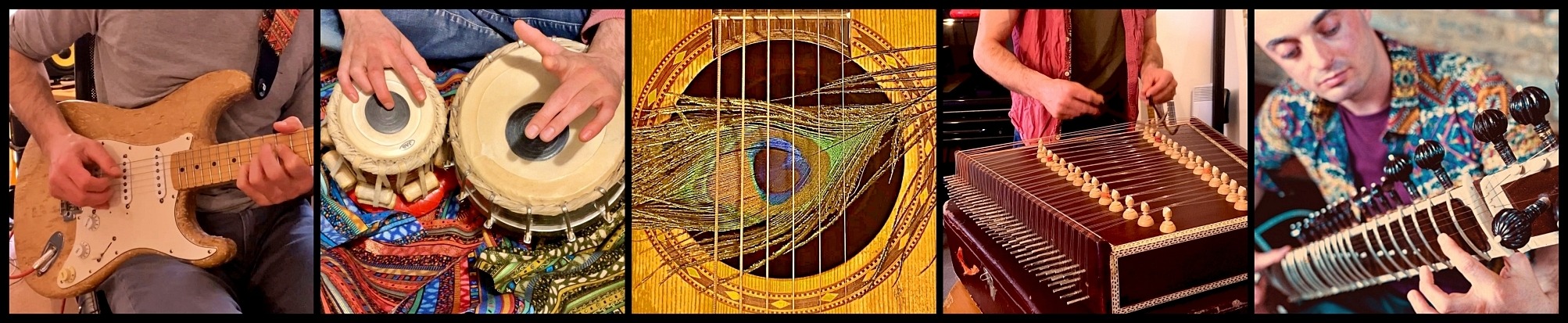
George Howlett is a London-based musician, writer, and teacher (guitars, sitar, tabla, & santoor). Above all I seek to enthuse fellow sonic searchers, interconnecting fresh vibrations with the voices, cultures, and passions behind them. See Homepage for more, and hit me up for Lessons!
• Projects & articles: full list •
[Join the Patreon!]