.
Compiling global examples of music in the Dorian b2 Scale
1-b2-b3-4-5-6-b7
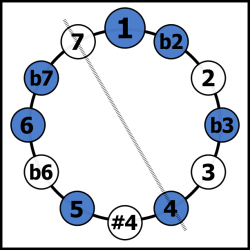
(C-Db-Eb-F-G-A-Bb)
o o • o • o • o • o o • o



—Music in Scales: Home—
A project gathering real-world examples of different musical scales, drawn from diverse global sounds. Support open-access musicology on PATREON!

• Dorian b2: Sounds •
Real-world examples of the scale in action:
- General:
- India: Turns up as the Hindustani Raag Ahiri, a seldom-heard form which nevertheless holds great historic importance (see Ahir Bhairav: ‘Mixolydian b2′) – with possible roots in the folk songs of the Ahir, an ancient cattle-herding tribe. Also matches the rare Prabhateshwari (thought to have been invented by mysterious, reclusive surbahar virtuoso Annapurna Devi), as well as underlying the more famous Parameshwari (‘Dorian b2 no5’: devised by Devi’s ex-husband Ravi Shankar by rotating a scale he had just dreamed up to ease the boredom of a long Bengal car ride). In South India, the shape is known as Ragam Natakapriya (melakarta scale #10) – translating as ‘the one who is dear to theatre’.
—Raag Ahiri (North India)—
Harmeet Virdee & Bhupinder Chaggar (sitar/tabla)
Q

• Support open-access, ad-free musicology by joining my brand-new PATREON (launched mid-2024). And if you’re seeking to incorporate global ideas into your guitar playing…get started with online lessons!
• Dorian b2: More •
Features, classifiers, quirks, etc…
[analysis: coming soon]
—Classifiers & Quirks—
- Modes: Melodic Minor set (Melodic Minor; Dorian b2; Lydian Augmented; Lydian Dominant; Mixolydian b6; Aeolian b5; Superlocrian)
- Quirks: Hemitonic; Maximal; Reflectional sym. (imperfect: b2, ♮5, ♮6; detached: b2, ♮6)
- Names: Dorian b2 (Western); Ahiri (Hindustani), Natakapriya (Carnatic)
n.b. For more detailed geometric and mathematical analysis, refer to this scale’s entry in Ian Ring’s fantastic Exciting Universe of Music Theory project (for which I am an occasional ‘raga consultant’)
—Music in Scales—
Compiling global examples of music in different scales: from the famous to the abstruse, spanning diverse global traditions. Expand your aural horizons with fresh sequences!
• Scales: What even is a ‘scale’? •
• Tags: Multimodal classifications •
• Quotes: Scalar tales & musings •
• Contact: Submit your matches •
• About: Project ethos & goals •
[Random Scale]

George Howlett is a London-based musician, writer, and teacher. Above all I seek to enthuse fellow sonic searchers, interconnecting fresh vibrations with the voices, cultures, and passions behind them. See Homepage for more!
• Projects & articles: full list •
Join the Patreon!
[video showcase]