ABC notation/Piano
Here we describe simple piano sheet music.
Basic Piano Sheet
Piano has usually two set of staves, for right hand and left hand respectively. Here we put an example sheet music names "K545.abc".
X:1
T:K.545 II Andante
C:W.A.Mozart
M:3/4
L:1/4
Q:Andante
K:G
%%staves {V1 V2}
V:V1 clef=treble
V:V2 clef=bass
[V:V1] (B2 [L:1/16]dcBc) | [L:1/4] (d3/4B/4) Gz| \
 (g3/2 [L:1/16] ag fed^c) | [L:1/4] (d3/4B1/4) Gz|
[V:V2]
[L:1/16]
G,DB,D G,DB,D A,DCD | G,DB,D G,DB,D G,DB,D | \
 G,ECE G,ECE G,^C^A,C | G,DB,D G,DB,D G,DB,D|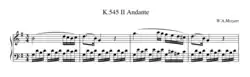
Here the lines below describe whether each stave used treble clef or bass clef.
V:V1 clef=treble
V:V2 clef=bass
polyphony
When you use a few melodies at the same part of a music, voice overlay is one choice to use. The example is below.
X:1
C: J.S.Bach
T:BWV 1030 II Largo e dolce
M:6/8
L:1/8
Q:1/8=56
N:accompaniment
K:D
I:harpsichord
%%MIDI program 7
%%staves {V1 V2}
V:V1 clef=treble
V:V2 clef=bass
[V:V1] [dAF][dBF][d=cA] d[L:1/32]^cedc dcBA & [L:1/8] x3 [BG]AD |
[V:V2] DB,[DF,] DEA, & x3 G,2 F,|
Here we use '&' mark in a bar to make polyphony. 'x' means it neither shows a note nor a rest. The melody "[BG]AD" is at the latter half of the bar, so we pad the former half part of the bar with "x3".
