Analytic Combinatorics/Cauchy-Hadamard theorem
Introduction
In analytic combinatorics we start with a generating function and we want to understand the behaviour of its th coefficient as gets very large.

We first present coefficients as a sequence and discuss the properties of sequences that we want to know, namely its limit superior.
We then present power series representations of our generating function and the concept of convergence.
Finally, we present the Cauchy-Hadamard theorem which shows that the convergence of a power series is directly related to the limit superior of the sequence of its coefficients.
This gives us our first asymptotic estimate of coefficients.
Sequences and limit superior
Sequences
One key concept in analysis is a sequence of numbers. In our case, the sequence of numbers we are interested in are the coefficients of the generating function we are studying. For example, if the generating function is then the sequence is , often written as .



A point of accumulation (or cluster point) of a sequence is a number such that, for any , there are infinitely many such that[1]


- .

A sequence might have more than one point of accumulation (even an infinite number of them). The points of accumulation might not be in the sequence.
Examples:
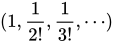
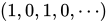
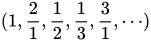
- The coefficients of () have point of accumulation
- The coefficients of () have point of accumulation (note that is not in the sequence of coefficients)
- The coefficients of () have two points of accumulation, and
- The sequence of positive rational numbers () has every positive real number as a point of accumulation.




Limit superior
The least upper bound or supremum of a set of numbers , written , is a number such that


- for all members of
- for any there exists a member of such that .


Note that the least upper bound of a set need not be in the set.
The limit superior of a sequence , written , is the least upper bound of the set of points of accumulation of the sequence.[2]

In our above examples, these would be , , and respectively.

If then, for any ,[3]

- for all but a finite number of
- for an infinite number of .


Note that in our context "for all but a finite number" is stronger than "for an infinite number of". For example, it is true to say of the sequence that "an infinite number" is equal to 1. But, it is also true to say that "an infinite number" is equal to 0. On the other hand, we could only say something is true "for all but a finite number" of a sequence if it is always true after a certain point in the sequence.
In other words, to say means that after a certain point will not exceed , but there could be an infinite number of that are less than .


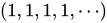
Note also some loss of information when we look only at the limit superior. For example, both the sequences and have the same limit superior, 1.
Power series and convergence
Power series
We should already be familiar with representing generating functions as power series of the form . This is called a Taylor series around the point 0, otherwise known as a Maclaurin series. We will see other types of series later, but for now this is all we are interested in.

Complex numbers
A complex number is a number where and are both real numbers and is the imaginary unit where . is called the real component and the imaginary component (note that is itself a real number).


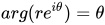
Complex numbers can be expressed in two forms: Cartesian coordinates () or polar coordinates , where is the distance from the origin or modulus and (theta) or (phi) is the angle relative to the positive axis or argument. We write the modulus of as and the argument of as . In other words, , .



Convergence
It turns out if we treat the variable in our power series as a complex number there are lots of theorems and techniques we can use to estimate its coefficients.
But, to use these theorems and techniques, we must make sure that the power series converges.
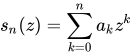
We define the partial sum of a power series as . We say a power series converges for a particular number if there exists a number such that for each there exists an such that for all


- .

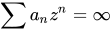
It may fail to converge if:
- as in the case of , whose partial sum .
- The partial sums oscillate between different values, such as , where for odd , for even .


There are various tests for whether or not a series converges and for which values of .
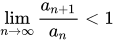
- D'Alembert's ratio test[4]
- the series converges if
- For example, for the ratio is which is only less than as goes to infinity if . Therefore, the series converges for values of less than .



- Comparison test[5]
- Suppose is a convergent series and there exists a such that for all sufficiently large we have . Then the series converges.


It should be noted that if a power series converges for some number then it converges for all numbers . Given that converges then as and therefore we can find a constant such that for all we have . If then for any



The series converges by D'Alembert's ratio test and, therefore, converges by the comparison test.[6]


Similarly, if a power series fails to converge for some number then it fails to converge for all numbers . Because if it did converge for some then we have already proved that this implies it converges for , which is a contradiction.

Therefore, we can talk about a power series having a radius of convergence, a real number such that
- for the power series converges
- for the power series does not converge
- for the power series may or may not converge.


In our example, the radius of convergence of is .
We say a power series converges uniformly to a bounded function on the set if for any there exists an such that for all


- .

Fortunately, if a power series is convergent then it is uniformly convergent. We have seen that converges for all points inside its radius of convergence and possibly also for some points on its circle of convergence. Therefore, for all such , it has a sum to which it converges. For radius of convergence and any , for any


- .

Since we have established that the latter series converges we can make it less than any by making sufficiently high. Since the latter series is independent of we see that can be made to be within of for all for which it converges, meeting the requirements for uniform convergence.[7]


In our example, inside the radius of convergence uniformly.
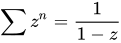
A function which can be represented as a convergent power series is called an analytic function. It should be noted that, for an analytic function , the radius of convergence of its Maclaurin series is equal to the smallest singularity of .[8] We will read about singularities later.

Cauchy-Hadamard theorem
Theorem
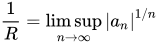
If and its radius of convergence then[9]
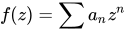

- .
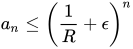
Two consequences of this theorem are, for all [10]
- (for all but finitely many )
- (for infinitely many ).
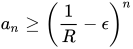
Proof
Proof due to Wilf[11] and Lang.[12]
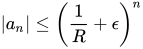
Take , its radius of convergence and . Start with . By definition of limit superior, for all but a finite number of
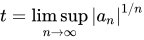

- .

converges if because then for all but a finite number of and so converges by D'Alembert's ratio test. Therefore .

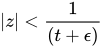
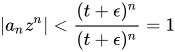

By definition of limit superior, there exist infinitely many

does not converge if , because in this case its nth term does not tend to 0. Therefore .
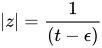

If and then and .

In the case that , then for all but a finite number of . converges if which tends to infinity as tends to 0. Therefore, it converges for any value of and we say .


In the case that , then is unbounded. Therefore, converges for no value of except and we say .


Now, we prove the two consequences of the theorem.
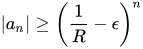
If then, by definition of limit superior, for all but a finite number of
and there exist infinitely many
- .
Notes
- ↑ Lang 1999, pp. 53-54.
- ↑ Lang 1999, pp. 54.
- ↑ Lang 1999, pp. 54. Wilf 2006, pp. 49.
- ↑ Stroud 2001, pp. 765.
- ↑ Lewin and Lewin 1993, pp. 242.
- ↑ Hardy 1921, pp. 429. Titchmarsh 1939, pp. 9.
- ↑ Titchmarsh 1939, pp. 3.
- ↑ Stroud 2003, pp. 916. Wilf 2006, pp. 50-51.
- ↑ Lang 1999, pp. 55.
- ↑ Wilf 2006, pp. 52.
- ↑ Wilf 2006, pp. 48-52.
- ↑ Lang 1999, pp. 55-56.
References
- Hardy, G. H. (1921). A Course of Pure Mathematics (3rd ed.). Cambridge University Press.
- Lang, Serge (1999). Complex Analysis (4th ed.). Springer Science+Business Media, LLC.
- Lewin, Jonathan; Lewin, Myrtle (1993). An Introduction to Mathematical Analysis (2nd ed.). McGraw-Hill, Inc.
- Stroud, K. A. (2003). Advanced Engineering Mathematics (4th ed.). Palgrave Macmillan.
- Stroud, K. A. (2001). Engineering Mathematics (5th ed.). Palgrave Macmillan.
- Titchmarsh, E. C. (1939). The Theory of Functions (2nd ed.). Oxford University Press.
- Wilf, Herbert S. (2006). Generatingfunctionology (PDF) (3rd ed.). A K Peters, Ltd.