Cookbook:Green Bean
| Green Bean | |
|---|---|
 | |
| Category | Vegetables |
Cookbook | Recipes | Ingredients | Equipment | Techniques | Cookbook Disambiguation Pages | Ingredients | Vegetables
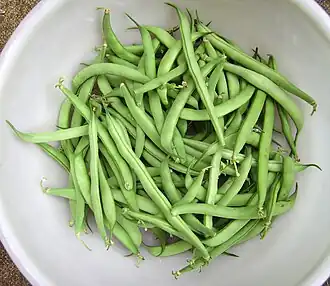
The green bean, also known as the snap bean, string bean, French bean, or haricot vert is a type of common bean that is eaten fresh and undried with the pod.[1][2][3][4] Other types of bean eaten in the pod include the runner bean and the yardlong bean.
Characteristics
In general, green bean pods are thin and several inches/centimeters long, consisting of a stem end and a tail end and containing tiny immature seeds.[5] As the beans age, including after harvest, the pods transfer sugars to the seeds, which stockpile them in the form of starch; as a result, older beans are less sweet.[2] Older beans also tend to be tougher.[6] Some varieties have a tough, fibrous string running down the length of the pods—hence the name "string bean"—though newer varieties have been bred without this string.[2][3] The texture is crisp, and the color is usually green,[5] though this depends on variety.[3] For example, wax beans or haricots beurre have yellow pods,[2][3][5][7] and purple Burgundy beans have purple pods that turn green upon cooking.[1][2][5] The pods can be either rounded and thin or flatter and broader,[2] the latter of which may be called Italian beans.[1] Sometimes, the term haricot vert is applied to especially small and tender green varieties.[1][7]
Seasonality
Fresh green beans are available all year, with a peak season of late spring to early fall.
Selection and storage
Green beans can be purchased fresh, frozen, or canned.[5] The fresh vegetables can be purchased in sealed packages or from loose bins, and in varying levels of preparation. When purchasing fresh green beans, it's often best to buy from loose bins so that you can select the highest quality ones yourself.[4] When selecting, look for green beans with a good green color (assuming a green variety is desired), with no sliminess, browning, bruising, wrinkling, or mushiness.[1][4] The texture should be crisp and firm, and the pods should snap when bent.[1][4] Generally, you don't want to choose pods that have large, bulging seeds,[1] since these will be older and tougher.
Low-fiber, tender green bean varieties do not keep for long after picking, as they tend to wrinkle and become limp.[2] These should be used quickly. More commercial varieties are bred for their keeping quality but may not be as tender or flavorful.[2] Depending on the variety, the unwashed beans will keep for a few days in the refrigerator.[4]
Preparation
The stem ends of green beans are generally tough and removed by cutting or snapping.[1][4][6][7] If the variety you are using has the fibrous string running along the length of its seam, you should pull it off and discard it at this point.[6][7] From there, you can cut the beans into pieces or cook them whole.[7]
Use
Boiling, blanching, steaming, microwaving, roasting, and stir-frying are common methods for preparing green beans.[5] After basic cooking, they may be further prepared, such as by dressing, gratinée, and more.[6]
Substitution
Recipes
References
- ↑ a b c d e f g h Gisslen, Wayne (2014-04-15). Professional Cooking. Wiley. ISBN 978-1-118-63672-5.
- ↑ a b c d e f g h McGee, Harold (2007-03-20). On Food and Cooking: The Science and Lore of the Kitchen. Simon and Schuster. ISBN 978-1-4165-5637-4.
- ↑ a b c d Davidson, Alan (2014-01-01). Jaine, Tom (ed.). The Oxford Companion to Food. Oxford University Press. doi:10.1093/acref/9780199677337.001.0001. ISBN 978-0-19-967733-7.
- ↑ a b c d e f Kipfer, Barbara Ann (2012-04-11). The Culinarian: A Kitchen Desk Reference. Houghton Mifflin Harcourt. ISBN 978-0-544-18603-3.
- ↑ a b c d e f The Culinary Institute of America (CIA) (2011-09-13). The Professional Chef. John Wiley & Sons. ISBN 978-0-470-42135-2.
- ↑ a b c d Larousse; Robuchon, Joël (2001). Larousse Gastronomique: The World's Greatest Culinary Encyclopedia. Clarkson Potter. ISBN 978-0-609-60971-2.
- ↑ a b c d e Labensky, Sarah R.; Hause, Alan M.; Martel, Priscilla (2018-01-18). On Cooking: A Textbook of Culinary Fundamentals. Pearson. ISBN 978-0-13-444190-0.