Cookbook:Modified Food Starch
| Modified Food Starch | |
|---|---|
 | |
| Category | Thickeners and stabilizers |
Cookbook | Recipes | Ingredients | Equipment | Techniques | Cookbook Disambiguation Pages | Ingredients
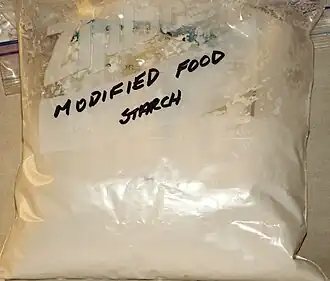
Modified food starches are those starches that have been deliberately treated to modify them and give them certain desirable characteristics for use in cooking.[1][2][3] They stand in contrast to native starches.
Source
Various different native starches can be modified, including corn, potato, etc.[2] Waxy maize, however, is popular for modification due to its clarity, clean flavor, and lower tendency to congealing.[2][4][5]
Characteristics
The precise characteristics of a modified starch will depend on the variety.[3] In general, however, modified starches are formulated for increased stability, such as under heat, acidity, freezing, and mixing.[2][3][5] They can also vary in their speed and temperature of gelatinization,[2] as well as their overall texture.[2] There are several varieties of modified starch, and some common varieties are described below.
Instant
Native starches need to be hydrated and then heated to the gelatinization point in order to provide thickening power.[3] Instant starch (also called pregelatinized or cold-water-swelling starch)[2][3] is made by gelatinizing the starch in advance, then cooling and drying it.[2][3][4][6] After reconstitution with liquid by the cook, the mixture will thicken without needing further heating.[2][3][6] Alternatively, other modifications that result in the same ability to thicken without heat can be used to make instant starch.[2] Instant Clearjel and Ultrasperse 2000 are two brand-name examples of this variety.[2]
This variety is particularly useful for thickening mixtures that would be damaged by heating, such those containing heat-sensitive fruits.[2] It is also useful for last-minute thickening.[2][6] However, the resulting texture will not be identical to that from native starches.[2]
Acid-hydrolyzed
This variety of starch, also called lintnerized, Naegeli, or acid‐thinned starch,[3][7] is made making a slurry of the starch and an acidic solution before heating it below the gelatinization temperature.[7][8] It is then neutralized, washed, and dried.[7][8] This process degrades the starch molecules into smaller segments that retain only their crystalline and not amorphous character, and these smaller segments can associate closely together but disperse easily.[3][7] As a result, the gelatinization temperature increases, the solubility of the starch increases, the viscosity of the pasted starch decreases, and the cooled gel increases in strength.[7][8]
Acid-hydrolyzed starches are particularly useful for some gummy confections,[7][8] which rely on a low viscosity mixture when hot before setting to a firm and stable gel upon cooking.[3]
Substituted
Native starches will eventually retrograde after gelatinization, pasting, and cooling.[3] Substitution refers to a process that binds other chemicals to the starch molecules, making the starch molecules bulkier and less able to bind tightly together.[3][7] This helps reduce starch retrogradation and its negative effects such as excessive gelling, increased opacity, and syneresis.[3][7] This looser binding also lowers the temperature required to gelatinize the starch,[3][7] and substituted starch is also more stable to freezing and thawing.[7]
Cross-linked
This modified starch is made by forming bridges, or cross-links, between the starch molecules.[3][7][8] This inhibits swelling and therefore makes the starch more resistant to gelatinization,[3][7] and it reduces retrogradation.[3][7] The texture is "short" and not gummy or stringy,[3] and it is less vulnerable to shear thinning.[7] These starches are not suitable for low-temperature products.[8]
Stabilized
Stabilized starches, sometimes called "dual-modified", are both substituted and cross-linked.[3] These generally produce clear results that are fairly tolerant to acidity, retrogradation, and freeze-thawing.[3][8]
Oxidized
Oxidizing starches reduces their gelatinization temperature and pasting velocity.[3][7] The resulting product is more fluid and less vulnerable to retrogradation,[7] and the dry product is good at adhering to meat and fish.[3][8]
Use
There is no single use for modified starch, since there are so many varieties with different properties. Generally, they confer stability,[2] however it is desired. Heat-sensitive products benefit from instant starches.[2]
Recipes
References
- ↑ Wolke, Robert L. (2011-01-12). What Einstein Told His Cook 2: The Sequel: Further Adventures in Kitchen Science. W. W. Norton & Company. ISBN 978-0-393-07982-1.
- ↑ a b c d e f g h i j k l m n o p Figoni, Paula (2010-11-09). How Baking Works: Exploring the Fundamentals of Baking Science. John Wiley & Sons. ISBN 978-0-470-39267-6.
- ↑ a b c d e f g h i j k l m n o p q r s t u v Research Chefs Association (2016-02-29). Culinology: The Intersection of Culinary Art and Food Science. John Wiley & Sons. ISBN 978-0-470-48134-9.
- ↑ a b Labensky, Sarah; Martel, Priscilla; Damme, Eddy Van (2015-01-06). On Baking: A Textbook of Baking and Pastry Fundamentals, Updated Edition. Pearson Education. ISBN 978-0-13-388675-7.
- ↑ a b McGee, Harold (2007-03-20). On Food and Cooking: The Science and Lore of the Kitchen. Simon and Schuster. ISBN 978-1-4165-5637-4.
- ↑ a b c Zeece, Michael (2020). Introduction to the chemistry of food. London San Diego Cambridge Oxford: Academic Press. ISBN 978-0-12-809434-1.
- ↑ a b c d e f g h i j k l m n o p Varelis, Peter; Melton, Laurence; Shahidi, Fereidoon, eds. (2019). Encyclopedia of food chemistry. Vol. 1. Vol. 1. Oxford: Elsevier. ISBN 978-0-12-816848-6.
- ↑ a b c d e f g h Velisek, Jan (2014-03-17). The Chemistry of Food. John Wiley & Sons. ISBN 978-1-118-38384-1.