Note on axioms used. In this section we rely only on the ZF axioms: Extensionality, Pairing, Separation (schema), Union, and Power Set. We do not use Replacement, Choice, or Regularity here. (Choice and Regularity will be introduced later and not used until those chapters.)
Ordered pairs
To define relations on sets we must have a concept of an ordered pair, as opposed to the unordered pairs the Axiom of Pairing gives. We want a coding that satisfies  .
.
A standard definition is the Kuratowski pair 
Theorem
Proof
( ) If
) If  and
and  , then the two Kuratowski pairs have the same elements, hence are equal by Extensionality.
( ) Suppose
  . Then
  is one of
  . If
. If  then ; if
  then
then  , hence again . Next,
  is one of ; it cannot equal
  unless
  , otherwise
 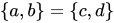 and with we get .
Existence note. The sets and exist by Pairing, and then 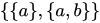 exists by Pairing again; hence every ordered pair exists.
We extend to longer tuples by recursion:  , etc.
Relations
Using ordered pairs we define the Cartesian product and relations.
Definition (Cartesian product). For sets  ,
, 
Existence of  . For any
 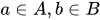 , the Kuratowski pair
  is a subset of
  , hence
  . Therefore
  , and by Separation on that ambient set with the formula “
 ”, the subset exists. (Axioms used: Pairing, Union, Power Set, Separation.)
Definition (relation). A (binary) relation is any set all of whose elements are ordered pairs. If  we say the source is
  and the target is
  ; we write
  or
or  .
.
Domain, range, field. For a relation  define
Existence of domain/range. Since is a set, so are  and
and  (Union twice). Then
  , and both are obtained by Separation inside using “
 ” and “
 ”. Hence the field is a set as well.
Converse. The (relational) converse of is  , a set by Separation on
  .
.
Image and preimage. For  ,
, ![{\displaystyle R[E]=\{y\in \mathrm {ran} \ R:\exists x\in E(x,y)\in R\}}](../_assets_/eb734a37dd21ce173a46342d1cc64c92/c4b18a38dda854797ca66014e4107a2570fd2795.svg) .
For
.
For  ,
, ![{\displaystyle R^{T}[F]=\{x\in \mathrm {dom} \ R:\exists y\in F(x,y)\in R\}}](../_assets_/eb734a37dd21ce173a46342d1cc64c92/df628e4b0d48206eb8709ce0861bee9776c58845.svg) .
Both exist by Separation (on
.
Both exist by Separation (on  and
and  respectively).
Composition. If and  , their composition is
  , a set by Separation on
  .
.
Benchmark relations.
- Identity on :
 (Separation on
  ).
).
- Universal relation on : .
Elementary properties on a set  . A relation
  is: reflexive if
 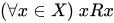 ; symmetric if
  ; antisymmetric if
  ; transitive if
  ; total (on ) if
  .
.
Exercise. Show every relation from to is a subset of and therefore a set (by Separation).
Heterogeneous relations
When and are different sets, the relation is heterogeneous. Relations on a single set (i.e.  ) are homogeneous.
Let  be a universe of discourse. By the Power Set axiom,
  exists. The membership relation
  (with
(with  ) is a frequently used heterogeneous relation with domain and range . Its converse is denoted
  .
.
Functions
Definitions
A relation  is univalent (a partial function from to
  ) if
) if  Equivalently (purely relationally),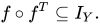
A function  is a univalent relation with total domain, i.e.
  . Here is the domain and the codomain.
For a function and  , the (direct) image is
  . The range is
  . For
. For  , the preimage is
  . (Beware:
  here denotes the preimage operator; an actual inverse function may not exist.)
Existence of the set of all functions
Let  be the set of all relations between and . Then
  is a set by Separation on
  . Thus the collection of all functions
  is a set in ZF (no Replacement or Choice needed).
Composition of functions
If and  , then
  ,
and
,
and  is again a function. (Existence as a set follows from the relational composition above; univalence and totality are routine checks.)
Injective, surjective, bijective
A function is surjective if  . It is injective if
  ; equivalently (relationally),
  . A function is bijective if it is both.
Inverses of functions
For any function , the converse relation  always exists. It is a (total) function
  iff
iff  is bijective; in that case we write for the inverse function.
Exercises.
- If a function has both a left inverse
 (
( ) and a right inverse
  (
( ), show that
  .
.
- Prove that a function is invertible iff it is bijective.