The notion of Compactness appears in a wide variety of contexts. In particular, compactness is a "tameness property" that tells you that the objects you are dealing with are in some sense well-behaved.
Definition
Let  be a topological space and let
A collection  of open sets
  is said to be an Open Cover of
  if
if 
is said to be Compact if and only if every open cover of has a finite subcover. More formally, is compact iff for every open cover of , there exists a finite subset  of that is also an open cover of .
If the set itself is compact, we say that is a Compact Topological Space.
Compactness of topological spaces can also be expressed by one of the following equivalent characterisations:
- Every filter on containing a filter basis of closed sets has a nonempty intersection.
- Every ultrafilter on converges.
Important Properties
- Every closed subset of a compact set is compact
Proof:
Let be a compact set, and let  be a closed subset of . Consider any open cover of . Observe that
  being open, the collection of open sets
 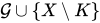 is an open cover of . As is compact, this open cover has a finite subcover
  .
.
Now, consider the collection  . This collection is obviously finite and is also a subcover of . Hence, it is a finite subcover of
- Every compact subset of a Hausdorff space is closed.
Proof:
Let be compact. If the complement  is empty, then is the same as the space; thus closed. Suppose not; that is, there is a point
  . Then for each
  , by the Hausdorff separation axiom we can find
  and
and  disjoint, open and such that
  and
and  . Since is compact and the collection
  covers , we can find a finite number of points
  in such that:

It then follows that:
 . Hence, every
  has an open neighbourhood
  .
.
As can be represented as the union of open sets , is open and is closed.
- Every compact set in a metric space is bounded.
Proof:
Let be a metric space and let  be compact.
Consider the collection of open balls  for some (fixed)
  . We see that is an open cover of . As is compact, it has a finite subcover, say
  . Let
. Let  . We see that
  , and hence, is bounded.
- Heine-Borel Theorem: For any interval
![{\displaystyle [a,b]}](../_assets_/eb734a37dd21ce173a46342d1cc64c92/9c4b788fc5c637e26ee98b45f89a5c08c85f7935.svg) , and for any open cover of that interval, there exists a finite subcover of .
, and for any open cover of that interval, there exists a finite subcover of .
Proof:
Let be the set of all  such that
 ![{\displaystyle [a,x]}](../_assets_/eb734a37dd21ce173a46342d1cc64c92/692f0edd0d40232c8a69ed5de7b142e1e343eff7.svg) has a finite subcover of . is non-empty because
has a finite subcover of . is non-empty because  is within the set. Define
  .
.
Assume if possible,  . Then there is a finite cover of sets within for
 ![{\displaystyle [a,c]}](../_assets_/eb734a37dd21ce173a46342d1cc64c92/70b45aa26fb924cdd37786af1adcf5d58cfe15af.svg) .
.  is within a set
  within the cover . Thus, there exists a
  such that
  . Then
  is also within , contradicting the definition of . Thus,
  . Therefore, has a finite subcover.
Sources differ as to what exactly should be called the 'Heine-Borel Theorem'. It seems that Emile Borel proved the most relevant result, dealing with compact subsets of a Euclidean Space. However, we provide the simpler case, for reals.
- Let
 be topological spaces. If
  is continuous, and
  is compact, then the image of ,
  , is compact.
Proof:
Let be any open cover of . Consider the inverses  where
where  . These inverses are open because
  is continuous. This covers , and thus there is a finite subcover of ,
  . Then the images
  is a finite subcover of .
- If a set is compact and Hausdorff, then it is normal.
Proof:
Let be compact and Hausdorff. Consider two closed subsets and  which are themselves compact by theorem 1 above. For every
  and
and  , there exist two disjoint sets
  and
and  such that
  and
and  . The union of all such for a fixed is a cover for , and thus it has a finite subcover, say,
  and let
  be the union of its members.
Let  , and let
 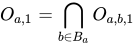 . Observe that
  being finite,
  is open. The union
  covers , and therefore it has a finite subcover
  . Let
. Let  be the union of all members of this subcover.
Let  denote the set of all elements such that
  . Take the intersection
 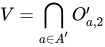 , which is open.
Then is an open superset of ,  is an open superset of , and they are disjoint. Thus, is normal.
- In a compact metric space X, a function from X to Y is uniformly continuous if and only if it is continuous.
Proof:
- If two topological spaces are compact, then their product space is also compact.
Proof:
Let X1 and X2 be two compact spaces. Let S be a cover of X1×X2. Let x be an element of X1. Consider the sets Ax,y within S that contain (x,y) for each y in X2. 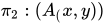 forms a cover for X2, with a finite subcover {Ax,yi}. Let Bx be the intersection of
  within {Ayi}, which is open. Thus, {Bx} forms an open cover, which has a finite subcover, {Bxi}. The corresponding sets {Axi,yi} is finite, and forms an open subcover of the set.
- All closed and bounded sets in the Euclidean Space are compact.
Proof:
Let S by any bounded closed set in  . Then since S is bounded, it is contained in some "box" of the products of closed intervals of R. Since those closed intervals are compact, their product is also compact. Therefore, S is a closed set in a compact set, and is therefore also compact.
Tychonoff's Theorem
The more general result on the compactness of product spaces is called Tychonoff's Theorem. Unlike the compactness of the product of two spaces, however, Tychonoff's Theorem requires Zorn's Lemma. (In fact, it is equivalent to Axiom of Choice.)
Theorem: Let  , and let each
  be compact. Then the X is also compact.
Proof: The proof is in terms of nets. Recall the following facts:
Lemma 1 - A net  in
in  converges to
 if and only if each coordinate
  converges to
  .
.
Lemma 2 - A topological space is compact if and only if every net in has a convergent subnet.
Lemma 3 - Every net has a universal subnet.
Lemma 4 - A universal net in a compact space is convergent.
We now prove Tychonoff's theorem.
Let be a net in .
Using Lemma 3 we can find a universal subnet  of .
of .
It is easily seen that each coordinate net  is a universal net in .
Using Lemma 4 we see that each coordinate net converges, because is compact.
Using Lemma 1 we see that the whole net converges in .
We conclude that every net in has a convergent subnet, so, by Lemma 2, must be compact. 
Relative Compactness
Relative compactness is another property of interest.
Definition: A subset S of a topological space X is relative compact when the closure Cl(x) is compact.
Note that relative compactness does not carry over to topological subspaces. For example, the open interval (0,1) is relatively compact in R with the usual topology, but is not relatively compact in itself.
Local Compactness
The idea of local compactness is based on the idea of relative compactness.
If, in a topological space X, every element has a neighborhood that is relatively compact, then X is locally compact.
It can be shown that all compact sets are locally compact, but not conversely.
Lebesgue number lemma
Distance from a point to a set
Definition. Let  be a metric space and let be nonempty. For , define the *distance from
  to * by

(If one ever needs the empty set, the standard convention is 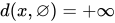 ; we will not use this case below.)
Fact (1-Lipschitz continuity of the distance-to-a-set map).
Fix  . The function
  is continuous and, in fact,

Proof. For any , the triangle inequality gives

Taking the infimum over on the right yields

Interchanging and  gives
gives  . Combining the two inequalities yields the desired absolute-value bound, hence continuity.
Notation. For and , the open  -ball is

Definition (diameter). If  is bounded, its diameter is

Statement and proof
Lemma (Lebesgue number lemma).
Let  be an open cover of a metric space . If is compact, then there exists
  such that for **every** subset with
 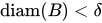 , there exists some
  with
with  . Any such
  is called a *Lebesgue number* for .
Proof. We proceed in explicit steps.
Step 0 (trivial case). If  , then *every* works (because every is contained in ). So assume
  .
.
Step 1 (finite subcover). By compactness of , choose a finite subcover
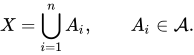
For each  , set the closed complement
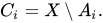
(Each  is closed because
  is open.)
- Step 2 (build a strictly positive continuous function).** Define

Each map 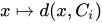 is continuous by the 1-Lipschitz fact above (we did **not** use that is closed to get continuity), so is continuous as a finite average of continuous functions.
We now show  for **every** .
Fix . Since  covers , choose with
  . Because is open, there exists such that
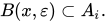
We claim  . Indeed, if some
  satisfied
  , then
  , contradicting
  . Thus every has
  , hence

Therefore

Since was arbitrary, on .
Step 3 (take a positive minimum). Compactness of and continuity of imply that attains a minimum:

By Step 2, everywhere; hence the minimum satisfies .
Step 4 (verify the Lebesgue property). Let have . Pick any  . Then for every
  ,
,

Among the finitely many real numbers 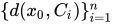 , choose an index
  realizing the maximum:

(Here we used the basic inequality 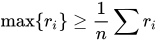 for finitely many real numbers.)
We claim  . It suffices to show
  because
 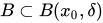 by the diameter bound.
So let  . Suppose, aiming for a contradiction, that
  . Then, by definition of distance to a set,

contradicting 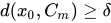 . Hence no point of
  lies in
  ; equivalently,

Since , we conclude 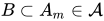 , as required.
This proves that is a Lebesgue number for .
Exercises
- It is not true in general for a metric space that a closed and bounded set is compact. Take the following metric on a set X:
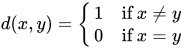
a) Show that this is a metric
b) Which subspaces of X are compact
c) Show that if Y is a subspace of X and Y is compact, then Y is closed and bounded
d) Show that for any metric space, compact sets are always closed and bounded
e) Show that with this particular metric, closed and bounded sets need not be compact