Conditioned disjunction
In logic, conditioned disjunction (sometimes called conditional disjunction) is a ternary logical connective introduced by Church.[1][2] Given operands p, q, and r, which represent truth-valued propositions, the meaning of the conditioned disjunction [p, q, r] is given by
![{\displaystyle [p,q,r]\Leftrightarrow (q\to p)\land (\neg q\to r).}](../I/4a8d857efcade3330c68c4784c50eba8c9c208cd.svg)
| Definition | |
|---|---|
| Truth table | |
| Normal forms | |
| Disjunctive | |
| Conjunctive | |
| Zhegalkin polynomial | |
| Post's lattices | |
| 0-preserving | yes |
| 1-preserving | yes |
| Monotone | no |
| Affine | no |



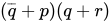

In words, [p, q, r] is equivalent to: "if q, then p, else r", or "p or r, according as q or not q". This may also be stated as "q implies p, and not q implies r". So, for any values of p, q, and r, the value of [p, q, r] is the value of p when q is true, and is the value of r otherwise.
The conditioned disjunction is also equivalent to

and has the same truth table as the ternary conditional operator ?: in many programming languages (with being equivalent to a ? b : c). In electronic logic terms, it may also be viewed as a single-bit multiplexer.
![{\displaystyle [b,a,c]}](../I/2d031e5471c64a4b5d499fa00315b3377b304d20.svg)
In conjunction with truth constants denoting each truth-value, conditioned disjunction is truth-functionally complete for classical logic.[3] There are other truth-functionally complete ternary connectives.
Truth table
The truth table for :
![{\displaystyle [p,q,r]}](../I/a68bad51d5f90ec58cdac1b8db2a71511b468930.svg)
| True | True | True | True |
| True | True | False | True |
| True | False | True | True |
| True | False | False | False |
| False | True | True | False |
| False | True | False | False |
| False | False | True | True |
| False | False | False | False |


References
- Church, Alonzo (1956). Introduction to Mathematical Logic. Princeton University Press.
- Church, Alonzo (1948). "Conditioned disjunction as a primitive connective for the propositional calculus". Portugaliae Mathematica. 7: 87–90.
- Wesselkamper, T. C. (1975). "A sole sufficient operator". Notre Dame Journal of Formal Logic. XVI (1): 86–88. doi:10.1305/ndjfl/1093891614.