Epidendrum conopseum
Epidendrum conopseum, synonym Epidendrum magnoliae,[1] sometimes called the green-fly orchid, is a species of orchid in the genus Epidendrum.
| Epidendrum conopseum | |
|---|---|
| Scientific classification | |
| Kingdom: | Plantae |
| Clade: | Tracheophytes |
| Clade: | Angiosperms |
| Clade: | Monocots |
| Order: | Asparagales |
| Family: | Orchidaceae |
| Subfamily: | Epidendroideae |
| Genus: | Epidendrum |
| Subgenus: | Epidendrum subg. Epidendrum |
| Section: | Epidendrum sect. Planifolia |
| Subsection: | Epidendrum subsect. Racemosa |
| Species: | E. conopseum |
| Binomial name | |
| Epidendrum conopseum | |
| Synonyms[1] | |
| |
Description
It has robust roots that cling to tree bark and short, often pendulous cane-shaped stems wrapped in tubular leaf sheaths. Each stem carries two or three leathery, elliptical leaves with acute or subacute tips.[2] Leaves are broadly elliptical, up to 10 cm (3.9 in) long, thick and almost leathery. Flowering typically occurs from late autumn to spring, producing a terminal, racemose, erect, loose inflorescence about 16 cm long with a few flowers.One plant will produce 6-14 flowers that are a bit over 2 cm in diameter, pale green to bronze-colored.[3] Sepals and petals are oblanceolate, the lip is three lobed at the apex.[4]
The diploid chromosome number of E. conopseum has been determined as 2n = 40, the haploid chromosome number as n = 20.[5]
Distribution
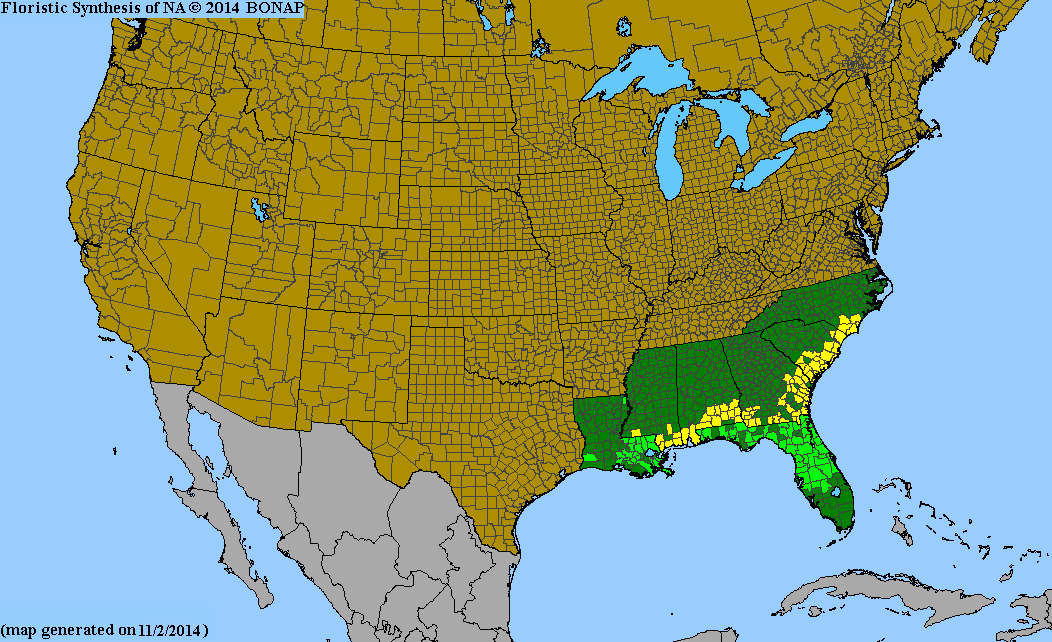
It is the most northern-growing epiphytic orchid in North America, being found wild in the southeastern United States in Alabama, Florida, Georgia, Louisiana, Mississippi, North Carolina and South Carolina and also in northeastern Mexico (Nuevo León, San Luis Potosí, Tamaulipas).[3][6][7] Epidendrum conopseum grows on the branches of evergreen and deciduous trees such as Magnolia grandiflora, Quercus virginiana, Taxodium distichum, Swamp Black Gum, or American beech, at low elevations less than 100 m (330 ft) above sea level.[4] It is found growing in association with the fern Pleopeltis polypodioides
- Epidendrum conopseum growing in Withlacoochee River Park
References
- "Epidendrum conopseum R.Br." Plants of the World Online. Royal Botanic Gardens, Kew. Retrieved 2023-05-26.
- "IOSPE PHOTOS". Internet Orchid Species Photo Encyclopedia. Retrieved 2024-06-15.
- Flora of North America, Epidendrum magnoliae Muhlenberg, 1813. Green-fly orchid
- "Epidendrum conopseum". APA: Alabama Plant Atlas. 1998-07-12. Retrieved 2024-06-14.
- page 251 of Leonardo P. Felix and Marcelo Guerra: "Variation in chromosome number and the basic number of subfamily Epidendroideae (Orchidaceae)" Botanical Journal of the Linnean Society 163(2010)234-278. The Linnean Society of London. downloaded October 2010
- Biota of North America Program 2014 county distribution map, Epidendrum conopseum
- Hágsater, E. & G. A. Salazar. 1990. Orchids of Mexico, pt. 1. Icones Orchidacearum (Mexico) 1: plates 1–100.
External links
- Media related to Epidendrum conopseum at Wikimedia Commons
- Data related to Epidendrum conopseum at Wikispecies
- Discover Life
- H. G. Reichenbach "ORCHIDES" in Müller, Carl, Ed. Walpers Annales Botanices Systematicae 6(1861)408. Berlin. Described as E. conopseum
- Epidendrum conopseum - Wildlife Resources Division, From: Patrick, Allison and Krakow (1995), Protected Plants of Georgia, Georgia Department of Natural Resources drawing, description, ecological information
- IOSPE photos photo
- Greenfly Orchids (Epidendrum magnoliae) in situ. video showing Epidendrum magnoliae in the wild in Florida
- Lady Bird Johnson Wildflower Center, University of Texas
- Atlas of Florida Vascular Plants, Epidendrum conopseum