Frattini's argument
In group theory, a branch of mathematics, Frattini's argument is an important lemma in the structure theory of finite groups. It is named after Giovanni Frattini, who used it in a paper from 1885 when defining the Frattini subgroup of a group. The argument was taken by Frattini, as he himself admits, from a paper of Alfredo Capelli dated 1884.[1]
Frattini's argument
Statement
If is a finite group with normal subgroup , and if is a Sylow p-subgroup of , then



where denotes the normalizer of in , and means the product of group subsets.


Proof
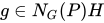
The group is a Sylow -subgroup of , so every Sylow -subgroup of is an -conjugate of , that is, it is of the form for some (see Sylow theorems). Let be any element of . Since is normal in , the subgroup is contained in . This means that is a Sylow -subgroup of . Then, by the above, it must be -conjugate to : that is, for some



and so

Thus
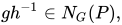
and therefore . But was arbitrary, and so


Applications
- Frattini's argument can be used as part of a proof that any finite nilpotent group is a direct product of its Sylow subgroups.
- By applying Frattini's argument to , it can be shown that whenever is a finite group and is a Sylow -subgroup of .
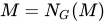
- More generally, if a subgroup contains for some Sylow -subgroup of Failed to parse (SVG (MathML can be enabled via browser plugin): Invalid response ("Math extension cannot connect to Restbase.") from server "http://localhost:6011/en.wikipedia.org/v1/":): {\displaystyle G} , then is self-normalizing, i.e. .




External links
References
- M. Brescia, F. de Giovanni, M. Trombetti, "The True Story Behind Frattini’s Argument", Advances in Group Theory and Applications 3, doi:10.4399/97888255036928
- Hall, Marshall (1959). The theory of groups. New York, N.Y.: Macmillan. (See Chapter 10, especially Section 10.4.)