Helly's selection theorem
In mathematics, Helly's selection theorem (also called the Helly selection principle) states that a uniformly bounded sequence of monotone real functions admits a convergent subsequence. In other words, it is a sequential compactness theorem for the space of uniformly bounded monotone functions. It is named for the Austrian mathematician Eduard Helly. A more general version of the theorem asserts compactness of the space BVloc of functions locally of bounded total variation that are uniformly bounded at a point.
The theorem has applications throughout mathematical analysis. In probability theory, the result implies compactness of a tight family of measures.
Statement of the theorem
Let (fn)n ∈ N be a sequence of increasing functions mapping the real line R into itself, and suppose that it is uniformly bounded: there are a,b ∈ R such that a ≤ fn ≤ b for every n ∈ N. Then the sequence (fn)n ∈ N admits a pointwise convergent subsequence.
Generalisation to BVloc
Let U be an open subset of the real line and let fn : U → R, n ∈ N, be a sequence of functions. Suppose that (fn) has uniformly bounded total variation on any W that is compactly embedded in U. That is, for all sets W ⊆ U with compact closure W̄ ⊆ U,
- where the derivative is taken in the sense of tempered distributions.

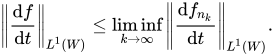
Then, there exists a subsequence fnk, k ∈ N, of fn and a function f : U → R, locally of bounded variation, such that
- fnk converges to f pointwise almost everywhere;
- and fnk converges to f locally in L1 (see locally integrable function), i.e., for all W compactly embedded in U,
- [1]: 132

- and, for W compactly embedded in U,
- [1]: 122
Further generalizations
There are many generalizations and refinements of Helly's theorem. The following theorem, for BV functions taking values in Banach spaces, is due to Barbu and Precupanu:
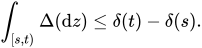
Let X be a reflexive, separable Hilbert space and let E be a closed, convex subset of X. Let Δ : X → [0, +∞) be positive-definite and homogeneous of degree one. Suppose that zn is a uniformly bounded sequence in BV([0, T]; X) with zn(t) ∈ E for all n ∈ N and t ∈ [0, T]. Then there exists a subsequence znk and functions δ, z ∈ BV([0, T]; X) such that
- for all t ∈ [0, T],
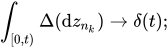
- and, for all t ∈ [0, T],

- and, for all 0 ≤ s < t ≤ T,
References
- Ambrosio, Luigi; Fusco, Nicola; Pallara, Diego (2000). Functions of Bounded Variation and Free Discontinuity Problems. Oxford University Press. ISBN 9780198502456.
- Rudin, W. (1976). Principles of Mathematical Analysis. International Series in Pure and Applied Mathematics (Third ed.). New York: McGraw-Hill. 167. ISBN 978-0070542358.