Noise-equivalent flux density
In optics the noise-equivalent flux density (NEFD) or noise-equivalent irradiance (NEI) of a system is the level of flux density required to be equivalent to the noise present in the system.[1] It is a measure used by astronomers in determining the accuracy of observations.[2]
The NEFD can be related to a light detector's noise-equivalent power for a collection area A and a photon bandwidth by:

,
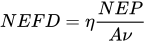
where a factor (often 2, in the case of switching between measuring a source and measuring off-source) accounts for the photon statistics for the mode of operation.

See also
References
- Malacara, Daniel (1988). Physical Optics and Light Measurements. Academic Press. p. 247. ISBN 9780124759718.
- Benford, D. J.; Hunter, T. R.; Phillips, T. G. (1998). "Noise Equivalent Power of Background Limited Thermal Detectors at Submillimeter Wavelengths". International Journal of Infrared and Millimeter Waves. 19 (7): 931. Bibcode:1998IJIMW..19..931B. doi:10.1023/A:1022671223858. S2CID 9196659.
This article is issued from Wikipedia. The text is licensed under Creative Commons - Attribution - Sharealike. Additional terms may apply for the media files.