Nilpotent operator
In operator theory, a bounded operator T on a Banach space is said to be nilpotent if Tn = 0 for some positive integer n.[1] It is said to be quasinilpotent or topologically nilpotent if its spectrum σ(T) = {0}.
Examples
In the finite-dimensional case, i.e. when T is a square matrix (Nilpotent matrix) with complex entries, σ(T) = {0} if and only if T is similar to a matrix whose only nonzero entries are on the superdiagonal[2](this fact is used to prove the existence of Jordan canonical form). In turn this is equivalent to Tn = 0 for some n. Therefore, for matrices, quasinilpotency coincides with nilpotency.
This is not true when H is infinite-dimensional. Consider the Volterra operator, defined as follows: consider the unit square X = [0,1] × [0,1] ⊂ R2, with the Lebesgue measure m. On X, define the kernel function K by
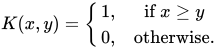
The Volterra operator is the corresponding integral operator T on the Hilbert space L2(0,1) given by

The operator T is not nilpotent: take f to be the function that is 1 everywhere and direct calculation shows that Tn f ≠ 0 (in the sense of L2) for all n. However, T is quasinilpotent. First notice that K is in L2(X, m), therefore T is compact. By the spectral properties of compact operators, any nonzero λ in σ(T) is an eigenvalue. But it can be shown that T has no nonzero eigenvalues, therefore T is quasinilpotent.
References
- Kreyszig, Erwin (1989). "Spectral Theory in Normed Spaces 7.5 Use of Complex Analysis in Spectral Theory, Problem 1. (Nilpotent operator)". Introductory Functional Analysis with Applications. Wiley. p. 393.
- Axler, Sheldon. "Nilpotent Operator" (PDF). Linear Algebra Done Right.