Sellmeier equation
The Sellmeier equation is an empirical relationship between refractive index and wavelength for a particular transparent medium. The equation is used to determine the dispersion of light in the medium.
It was first proposed in 1872 by Wolfgang Sellmeier and was a development of the work of Augustin Cauchy on Cauchy's equation for modelling dispersion.[1]
The equation
In its original and the most general form, the Sellmeier equation is given as
- ,
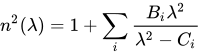
where n is the refractive index, λ is the wavelength, and Bi and Ci are experimentally determined Sellmeier coefficients. These coefficients are usually quoted for λ in micrometres. Note that this λ is the vacuum wavelength, not that in the material itself, which is λ/n. A different form of the equation is sometimes used for certain types of materials, e.g. crystals.
Each term of the sum representing an absorption resonance of strength Bi at a wavelength √Ci. For example, the coefficients for BK7 below correspond to two absorption resonances in the ultraviolet, and one in the mid-infrared region. Close to each absorption peak, the equation gives non-physical values of n2 = ±∞, and in these wavelength regions a more precise model of dispersion such as Helmholtz's must be used.
If all terms are specified for a material, at long wavelengths far from the absorption peaks the value of n tends to

where εr is the relative permittivity of the medium.
For characterization of glasses the equation consisting of three terms is commonly used:[2][3]

As an example, the coefficients for a common borosilicate crown glass known as BK7 are shown below:
| Coefficient | Value |
|---|---|
| B1 | 1.03961212 |
| B2 | 0.231792344 |
| B3 | 1.01046945 |
| C1 | 6.00069867×10⁻³ μm2 |
| C2 | 2.00179144×10⁻² μm2 |
| C3 | 1.03560653×102 μm2 |
For common optical glasses, the refractive index calculated with the three-term Sellmeier equation deviates from the actual refractive index by less than 5×10⁻⁶ over the wavelengths' range[4] of 365 nm to 2.3 μm, which is of the order of the homogeneity of a glass sample.[5] Additional terms are sometimes added to make the calculation even more precise.
Sometimes the Sellmeier equation is used in two-term form:[6]

Here the coefficient A is an approximation of the short-wavelength (e.g., ultraviolet) absorption contributions to the refractive index at longer wavelengths. Other variants of the Sellmeier equation exist that can account for a material's refractive index change due to temperature, pressure, and other parameters.
Coefficients
| Material | B1 | B2 | B3 | C1, μm2 | C2, μm2 | C3, μm2 |
|---|---|---|---|---|---|---|
| borosilicate crown glass (known as BK7) | 1.03961212 | 0.231792344 | 1.01046945 | 6.00069867×10⁻³ | 2.00179144×10⁻² | 103.560653 |
| sapphire (for ordinary wave) | 1.43134930 | 0.65054713 | 5.3414021 | 5.2799261×10⁻³ | 1.42382647×10⁻² | 325.017834 |
| sapphire (for extraordinary wave) | 1.5039759 | 0.55069141 | 6.5927379 | 5.48041129×10⁻³ | 1.47994281×10⁻² | 402.89514 |
| fused silica | 0.696166300 | 0.407942600 | 0.897479400 | 4.67914826×10⁻³ | 1.35120631×10⁻² | 97.9340025 |
| Magnesium fluoride | 0.48755108 | 0.39875031 | 2.3120353 | 0.001882178 | 0.008951888 | 566.13559 |
See also
References
- Sellmeier, W. (1872). "Ueber die durch die Aetherschwingungen erregten Mitschwingungen der Körpertheilchen und deren Rückwirkung auf die ersteren, besonders zur Erklärung der Dispersion und ihrer Anomalien (II. Theil)". Annalen der Physik und Chemie. 223 (11): 386–403. doi:10.1002/andp.18722231105.
- Refractive index and dispersion. Schott technical information document TIE-29 (2007).
- Paschotta, Dr. Rüdiger. "Encyclopedia of Laser Physics and Technology - Sellmeier formula, refractive index, Sellmeier equation, dispersion formula". www.rp-photonics.com. Retrieved 2018-09-14.
- "Optical Properties".
- "Guarantee of Quality".
- Ghosh, Gorachand (1997). "Sellmeier Coefficients and Dispersion of Thermo-Optic coefficients for some optical glasses". Applied Optics. 36 (7): 1540–6. Bibcode:1997ApOpt..36.1540G. doi:10.1364/AO.36.001540. PMID 18250832.
- "Archived copy". Archived from the original on 2015-10-11. Retrieved 2015-01-16.
{{cite web}}: CS1 maint: archived copy as title (link)
Internal links
- RefractiveIndex.INFO Refractive index database featuring Sellmeier coefficients for many hundreds of materials.
- A browser-based calculator giving refractive index from Sellmeier coefficients.
- Annalen der Physik - free Access, digitized by the French national library
- Sellmeier coefficients for 356 glasses from Ohara, Hoya, and Schott