Dissipation stress-energy tensor
Dissipation stress-energy tensor is a symmetric tensor of the second valence (rank), which describes the density and flux of energy of dissipation field in matter. This tensor in the covariant theory of gravitation is included in the equation for determining the metric along with the gravitational stress-energy tensor, the acceleration stress-energy tensor, the pressure stress-energy tensor and the stress-energy tensor of electromagnetic field. The covariant derivative of the dissipation stress-energy tensor specifies the density of dissipation force acting in substance and slowing down the movement of matter flows relative to each other.
The dissipation stress-energy tensor is relativistic generalization of the three-dimensional viscous stress tensor used in fluid mechanics.
Fluid mechanics
For relativistic description of the equations of motion of viscous and heat-conducting medium in the book [1] is used the four-dimensional viscous stress tensor:

where is the coefficient of common (shear) viscosity, is the four-velocity with contravariant index, is the four-velocity with covariant index, is the coefficient of bulk viscosity (or "second viscosity"), is the metric tensor, is the speed of light.


The form of the tensor is determined from the requirements imposed by the law of entropy increase. This tensor is defined such that in a reference frame in which the moving element of matter is at rest, tensor components and vanish. This means that the energy of the element of matter in the comoving frame must be calculated by other physical variables that are not related to the viscosity as in the absence of dissipative processes. As a result, the condition is superimposed at the tensor:


The tensor is a part of energy-momentum tensor of matter with pressure and it takes into account the viscosity:



here , is the energy density of matter without pressure.


The equation of motion of matter with pressure and viscosity is obtained from the vanishing of the covariant derivative of the energy-momentum tensor of matter:

A significant drawback of the tensor is that it is not derived from the principle of least action, and therefore can not be used, for example, to calculate the metrics in the system. In addition, in the general case the tensor components and can not zeroed in the comoving frame, because the environment is moving relative to the element of matter and energy dissipation process is not terminated.
Covariant theory of gravitation
Definition
In covariant theory of gravitation (CTG) dissipation field is considered as four-vector field consisting of scalar and 3-vector components, and is a component of general field. Therefore in CTG the dissipation stress-energy tensor is defined by the dissipation field tensor and the metric tensor by the principle of least action: [2]



where is a constant having its own value in each task. The constant is not uniquely defined, and it is a consequence of the fact that the dissipation in liquid medium may have been caused by any reasons and both internal and external forces.

Components of the dissipation stress-energy tensor
In the weak field limit, when the space-time metric becomes the Minkowski metric of special relativity, the metric tensor becomes the tensor , consisting of the numbers 0, 1, –1. In this case the form of the dissipation stress-energy tensor is greatly simplified and can be expressed in terms of the components of the dissipation field tensor, i.e. the dissipation field strength and solenoidal dissipation vector :


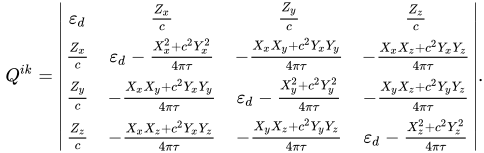
The time-like components of the tensor contain:
1) The volumetric energy density of dissipation field

2) The vector of energy flux density of dissipation field
![{\displaystyle ~\mathbf {Z} ={\frac {c^{2}}{4\pi \tau }}[\mathbf {X} \times \mathbf {Y} ].}](./_assets_/eb734a37dd21ce173a46342d1cc64c92/d0683f9e20186dad546b662467bc0c8001f2c55b.svg)
The components of the vector are part of corresponding tensor components , and due to the symmetry of the tensor indices .

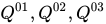

The space-like components of the tensor form a submatrix 3 x 3, which is the 3-dimensional stress tensor, taken with a minus sign. The stress tensor can be written as

where the components the Kronecker delta equals 1 if and equals 0 if



Three-dimensional divergence of the stress tensor of dissipation field gives:
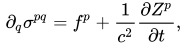
where denote the components of the three-dimensional dissipation force density, – the components of the vector of energy flux density of dissipation field.


Dissipation force and dissipation field equations
The principle of least action implies that the four-vector of dissipation force density can be found through the dissipation stress-energy tensor, either through the product of dissipation field tensor and mass four-current:


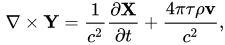
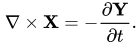
Equation (1) is closely related with the dissipation field equations:

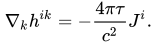
In the special theory of relativity, according to (1) for the components of the dissipation four-force density can be written:
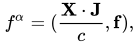
where is the 3-vector of the dissipation force density, is the density of the moving matter, is the 3-vector of the mass current density, is the 3-vector of velocity of the matter unit.
![{\displaystyle ~\mathbf {f} =\rho \mathbf {X} +[\mathbf {J} \times \mathbf {Y} ]}](./_assets_/eb734a37dd21ce173a46342d1cc64c92/8e9ef890bf3e8e1d2ab8fc36d0fa7271a691f616.svg)


In Minkowski space, the field equations are transformed into 4 equations for the dissipation field strength and solenoidal dissipation vector :


Equation for the metric
In the covariant theory of gravitation the dissipation stress-energy tensor in accordance with the principles of metric theory of relativity is one of the tensors defining metrics inside the bodies by the equation for the metric:

where is the coefficient to be determined, , , , , are the stress-energy tensors of the acceleration field, pressure field, gravitational and electromagnetic fields, dissipation field, respectively, is the gravitational constant.


Equation of motion
The equation of motion of a point particle inside or outside matter can be represented in tensor form, with dissipation stress-energy tensor or dissipation field tensor :



where is the acceleration tensor, is the gravitational tensor , is the electromagnetic tensor, is the pressure field tensor, is the dissipation field tensor, is the charge four-current, is the density of electric charge of the matter unit in the comoving reference frame, is the four-velociry.


Time-like component of the equation (2) at describes the change in the energy and spatial component at connects the acceleration with the total force density.


Conservation laws
Time-like component in (2) can be considered as the local law of conservation of energy and energy flux. In the limit of special relativity, when the covariant derivative becomes the four-gradient, and the Christoffel symbols vanish, this conservation law takes the simple form: [3] [4]

where is the vector of the acceleration field energy flux density, is the Heaviside vector, is the Poynting vector, is the vector of the pressure field energy flux density, is the vector of the dissipation field energy flux density.


According to this law, the work of the field to accelerate the masses and charges is compensated by the work of the matter to create the field. As a result, the change in time of the sum of tensor components with energy density in a certain volume is possible only due to the inflow of energy fluxes into this volume.
The integral form of the law of conservation of energy and energy flux is obtained by integrating (2) over the four-volume to accommodate the energy and energy flux of gravitational and electromagnetic fields, extending far beyond the physical system. By the Gauss's formula the integral of the four-divergence of some tensor over the four-space can be replaced by the integral of time-like tensor components over 3-volume. As a result, in Lorentz coordinates the integral vector equal to zero may be obtained:

Vanishing of the integral vector allows us to explain the 4/3 problem, according to which the mass-energy of field in the energy flux of field of the moving system in 4/3 more than in the field energy of fixed system. On the other hand, according to, [4] the generalized Poynting theorem and the integral vector should be considered differently inside matter and beyond its limits. As a result, the occurrence of the 4/3 problem is associated with the fact that the time components of the stress-energy tensors do not form four-vectors, and therefore they cannot define the same mass in the fields’ energy and energy flux in principle.
See also
- Gravitational stress-energy tensor
- Electromagnetic stress-energy tensor
- Acceleration stress-energy tensor
- Pressure stress-energy tensor
- Dissipation field tensor
- Viscous stress tensor
- General field
- Dissipation field
- Acceleration field
- Pressure field
References
- ↑ L.D. Landau, E.M. Lifshitz (1987). Fluid Mechanics. Vol. 6 (2nd ed.). Butterworth-Heinemann. ISBN 978-0-08-033933-7.
- ↑ Fedosin S.G. Four-Dimensional Equation of Motion for Viscous Compressible and Charged Fluid with Regard to the Acceleration Field, Pressure Field and Dissipation Field. International Journal of Thermodynamics. Vol. 18 (No. 1), pp. 13-24 (2015). http://dx.doi.org/10.5541/ijot.5000034003.
- ↑ Fedosin S.G. The Integral Energy-Momentum 4-Vector and Analysis of 4/3 Problem Based on the Pressure Field and Acceleration Field. American Journal of Modern Physics. Vol. 3, No. 4, pp. 152-167 (2014). http://dx.doi.org/10.11648/j.ajmp.20140304.12.
- ↑ 4.0 4.1 Fedosin S.G. The generalized Poynting theorem for the general field and solution of the 4/3 problem. International Frontier Science Letters, Vol. 14, pp. 19-40 (2019). https://doi.org/10.18052/www.scipress.com/IFSL.14.19.