I know both words share the same meaning and pronunciation, but I wonder about their comparative usage in modern English.
Asked
Active
Viewed 2.8k times
15


-
1Or as I like to call it, 'the slammer' ;-) – Sep 11 '14 at 13:37
4 Answers
19
Google Ngram Viewer (for the "British English" corpus) shows that gaol was more popular than jail until the mid-19th century, that the two words were used with broadly similar frequency from then until the mid-20th century, and that now jail is the most common spelling.
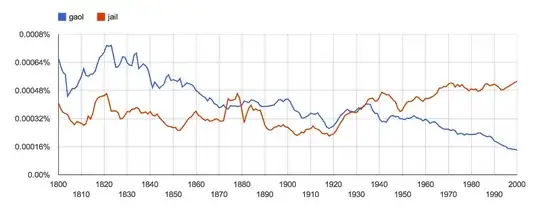
However, if you look at the actual citations you'll see that recent uses of gaol are largely in historical contexts (for example, historical studies of gaol records, or reprints of works like The Ballad of Reading Gaol) so that Ngram Viewer underestimates the modern dominance of jail.

Gareth Rees
- 4,050
-
6+1 for making the point that even such recent citations as do exist would mainly be historical references anyway. You'd virtually never rarely see "gaol" in a newspaper today, for example. – FumbleFingers Jan 19 '13 at 22:53
-
3It's worth adding, that some prisons in Britain and Ireland have "gaol" in their name, and if they are not still in use, are much more likely to be called by that name than re-spelling it to jail. Kilmainham Gaol for example, would almost never be called "Kilmainham Jail". Those in current use are mostly renamed by the British or Irish government though. Reading Gaol, as mentioned in the answer is now HM Prison Reading, while as an Irish example Mountjoy Gaol is now Mountjoy Prison. – Jon Hanna Jan 19 '13 at 23:24
-
2Actually, for that matter, it's perhaps worth pointing out that the distinction between "prison" and "jail" that exists in the US doesn't in the UK (and nor in Ireland), where the words were once used more of less synonymously, and now prison is the only term used officially. – Jon Hanna Jan 19 '13 at 23:34
-
Stieg Larsson's The Girl with the Dragon Tattoo contains the word "gaol". I had never seen it before, so I considered it a typo. Only when I came across it several more times during the novel did I realise that it is a real word. – Perleone Jan 20 '13 at 00:02
-
@JonHanna Stephen Fry explains at length in his autobiography that jail is for when you haven’t been sentenced yet, and that prison is for afterwards. (Not so in America, BTW.) But it has been some 30 years since he was himself sentenced, so perhaps matters have changed since then. – tchrist Jan 20 '13 at 02:07
-
1@tchrist I could be wrong of course, but I suspect that's another Fry-ism. People remanded in custody are put in the same places, which officially are called prisons. Jail and gaol are indeed still used in unofficial speech for prisons, and sometimes also for police custody. There's a tendency to use jail more often for remand prisoners, but there's no consensus. Historically, jail/goal was used, but then it definitely included prisons, and sometimes debtors' prison. The above is true for Ireland too, except with the term "garda custody" instead of "police custody". – Jon Hanna Jan 20 '13 at 02:23
-
-
-
1The British National Corpus shows a preference in contemporary British English for jail by nearly 5 to 1. Treat with suspicion anything that Stephen Fry says about language. Better still, ignore it. The OED defines jail/gaol as 'a place or building for the confinement of persons accused or convicted of a crime or offence; a prison.' – Barrie England Jan 20 '13 at 08:44
-
1@Lucas and so perhaps was Fry, but lots of people weren't, hence it's a tendency, not a consensus. I wonder if those who distinguish them that way were influenced by American usage where they are distinct (though not quite as per Fry). Unfortunately language is one of the topics on which the differences between the smart person he plays on TV and those in real life are the greatest (though it pales compared to listening to him on the topic of TCP/IP). – Jon Hanna Jan 20 '13 at 10:07
-
@Lucas in fact, thinking about it, tchrist did say above that he wrote about it "at length". That in itself suggests that it's a case where there's a distinction made by some, but not all, speakers of the dialect, that Fry is claiming is "the correct" view, since it's one of the favourites of his and the other writers behind his dumb-person's-idea-of-a-smart-person persona. – Jon Hanna Jan 20 '13 at 10:23
-
-
1@JonHanna we have a dedicated question for the difference between prison and jail. You are welcome to weigh in with your knowledge there. Here in this comment thread, I urge everybody to stay on-topic. – RegDwigнt Jan 20 '13 at 15:53
-
I'm aware of one gaol in the United States, viz., in Historical Williamsburg. Williamsburg was the capital of the colony of Virginia in pre-Revolution America, and a large number of buildings from that era have been restored as a Living Museum with costumed performers recreating colonial life for hordes of schoolchildren and tourists. – Andrew Lazarus Jan 23 '13 at 03:28
6
I am an official court reporter whose job it is to transcribe court cases from the Crown Court. I always use the word gaol and NEVER jail as Jail is the American spelling and for the life of me I do not see why English has to be corrupted by their spellings.

-
2I don't even know how to respond to this, but I love it! Corrupting the language we are, indeed! – Mike Apr 28 '14 at 19:37
-
"Jail" improves on "Gaol", so think of the American spelling as an evolution rather than a corruption. "G" has an ambiguous sound, and "Jail" rhymes with "sail" and "tail". – Jon May 16 '19 at 09:01
2
It might be interesting to know that the British spelling shows the French origin of the word; gaol is derived from French la geôle. I would not say the American spelling is a corruption, it is a logic simplification of a very difficult spelling and renders the pronunciation. That may be the cause that jail is slowly gaining ground over the historical, but difficult spelling gaol.

rogermue
- 13,878
1
British don't really use the word jail, jailed for 20 years can be used in text or news paper but to be sent to jail is a rare thing to say in the UK

Ron
- 11