3

Growing up I had a friend whose family would constantly say "Are you going with?" or similar. It always annoyed me. Fast forward 20 years and now I have a coworker who does the same.

"I'm going to lunch, do you want to come with?"

It annoys me, but is it wrong?

p.s. Sorry if this is a duplicate. It was a difficult thing to search.

  • 2
    Sounds like simple ellipsis to me. – TRiG Jul 09 '13 at 20:36
  • Interesting map: http://www4.uwm.edu/FLL/linguistics/dialect/staticmaps/q_51.html – THE JOATMON Jul 09 '13 at 21:23
  • 1
    This is completely normal in many places. I have heard it proposed that it may be related to German immigrants saying “Kommst du mit?”, but I have no actual data to back up that theory. It is certainly common (to the point of being wholly unremarkable) in southeastern Wisconsin, which has seen no small influx of German immigration in times past. – tchrist Jul 09 '13 at 21:44
  • 1
    possible duplicate of Can you grammatically end a sentence with "with"?. The SO search facility is useless for search terms like "come with". But I knew it was there, and a Google site search finds it easily. – FumbleFingers Jul 10 '13 at 02:36
  • When a Minnesotan asks "coming with?" he means to ask "coming along?" as can be easily understood; it's the local dialect. However, until it is documented and recorded as a dialectical idiom, it is incorrect in formal writing (except when quoting verbatim). – Kris Jul 10 '13 at 12:50
  • @FumbleFingers: I did lots of google searches and lots of SE searches but I don't think I did a site:stackexchange.com search. Oops! :) – THE JOATMON Jul 10 '13 at 16:28
  • 2
    @ Scott: Don't feel bad about it. In fact even though I think it's definitely a duplicate, I'm upvoting your question because you at least tried to find the info here or elsewhere. And I'm upvoting @Avner's answer 'cos I like pretty pictures! :) – FumbleFingers Jul 10 '13 at 17:02
  • @tchrist That's interesting. My initial thought on this question was that I'd first and most often heard this used by the Pennsylvania Dutch when we moved from MD to PA when I was a kid. – sarah Jul 12 '13 at 07:45
  • Consider that if you ask for coffee in a restaurant, the server may ask "With or without?", meaning "with or without cream". Simple ellipsis. Of course, the style is not good for formal writing/speaking, but is perfectly valid in conversation. – Hot Licks Dec 09 '15 at 01:57
  • I agree with @tchrist - It must be parallel to German "Kommst du mit?" – rogermue Dec 09 '15 at 08:15
  • MY four-year old grandson uses "with" without the pronoun. I thought he just had not learned the correct usage, but in the last half year I have heard it being used this way by native Engish speakers here in Southern California. –  Dec 09 '15 at 01:22
  • I moved from FL to WI and the first time I heard “go with” without “me” i thought that person accidentally left it out. I didn’t even hear the remainder of the conversation as I was still back on that phrase. I am a grammar fanatic and that phrase drives me crazy!! – Susan Aug 26 '18 at 12:40

2 Answers2

10

There is a fascinating site for dialect maps made by one Joshua Katz of NC State University, based on a linguistic survey by the University of Cambridge. It shows variations in dialects across the USA in a variety of topics, one of them is this "do you want to come with" that seems to annoy you.
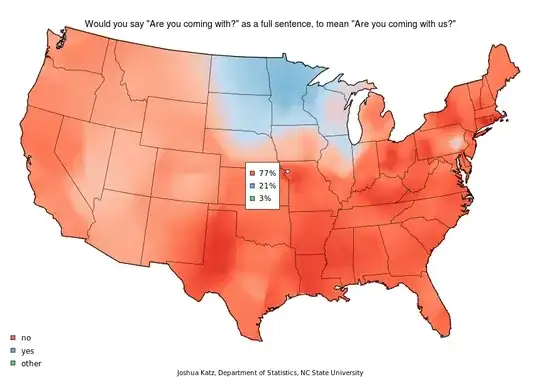
enter image description here

Looking at this map, you can see that "coming with" is distincly common in Minnesota and the surrounding states, but rather rare elsewhere. I suggest following the link above and choosing Question 51 in the drop-down menu to see a full-sized map, as well as geographical distribution of specific answers to this question.

Such distinct usage in a specific dialect strongly hints that while it's not a formal usage that would pass copy editing for a paper or national newspaper, it's certainly not wrong for the dialects it's used in, and it's not an individual idiosyncracy of your coworker trying to annoy you. :)

  • Avner, so you are saying that, other than the direct object "me", one can drop, too, the particle "with"; so that "do you want to come" is almost always acceptable English when used in the place of "do you want to come with me"? –  Jul 09 '13 at 21:34
  • Nope, that's not what I'm saying at all. – Avner Shahar-Kashtan Jul 09 '13 at 21:35
  • Avner, then, what are you saying? I don't understand the answer as it stands! –  Jul 09 '13 at 21:37
  • 3
    The OP asked if this usage is wrong. I showed that this usage is dialectical, and therefore probably not wrong (in context). I made no claims about lingustic rules or when one can drop anything. – Avner Shahar-Kashtan Jul 09 '13 at 21:38
  • Avner, thank you; since I was confused, now it is more clear. –  Jul 09 '13 at 21:41
  • Enlightening map, Avner! Now I know why that phrase doesn't sound odd to me - I'm from the blue part of northern Illinois! – Kristina Lopez Jul 09 '13 at 22:16
  • I actually posted a similar map as a comment a couple hours before you posted this. I like yours much better though, thanks! – THE JOATMON Jul 10 '13 at 02:11
-3

This language is acceptable in informal speech, net prose, polyphonic prose and informal familiar emails; but when it comes to standard conversational speech, it is in error, as the direct object (me) is not used. It is an unknown antecedent, and it should not be left out when people do not know to whom or what the person is referring, and should only be used when the antecedent is evident from the context of the situation.

Billybong
  • 122
  • So you're saying the examples I gave are acceptable in daily conversation because it's obvious who they mean? "Do you want to go with me?" etc.

    I guess there's gray area, but it seems that changing the rules for understood implication opens up the door for saying "you go with?" is acceptable because people understand the meaning.

    – THE JOATMON Jul 09 '13 at 21:01
  • Billy, so you are saying that it exists a tendency to remove direct objects in the case they are 'me', 'you', etcetera? –  Jul 09 '13 at 21:14
  • No, it's not an "unknown antecedent," whatever that is. The antecedent is an elided "me" or "us"—which one, should be clear from context. It's not "incorrect" but a regional dialectical usage as the map in Avner's answer makes clear. – dodgethesteamroller Jul 10 '13 at 01:41