I met a ligature "og" in one of the manuscripts. It is hard to see this ligature there (look at the word "logicae". Have you met anything similar? Is there a better manuscript with this ligature or it's just a particular handwriting? 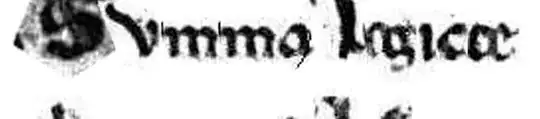
Asked
Active
Viewed 519 times
6

tchrist
- 134,759

Clever Masha
- 891
-
7That doesn’t look like a deliberate ligature to me, just a case of two letters accidentally ending up a bit too close to one another. – Janus Bahs Jacquet Sep 08 '13 at 12:35
-
Is it like "æ"? Have you got other examples with "og"? – Clever Masha Sep 08 '13 at 12:58
-
3I agree with @JanusBahsJacquet. Note the scrunched-up L, too. It looks to me like the scribe got too generous with his spacing and flourishes in Summa and then was worried about getting all of Logicae in. – StoneyB on hiatus Sep 08 '13 at 13:07
-
1This question appears to be off-topic because it is about a Latin text. – MetaEd Sep 08 '13 at 13:39
-
@MετάEd:it's like Yahoo! Answers but for grad students. I feel like there should be room for it here, despite it being both off-topic and seemingly too local. – Mitch Sep 08 '13 at 15:23
-
1@JanusBahsJacquet: I assure you, this is not accidental, and it is commonly considered a ligature in palaeography (see below). – Cerberus - Reinstate Monica Sep 08 '13 at 22:12
-
If and only if every occurrence of that word in that 'document' contains the exact same pattern can we suspect that there's a "ligature". Looks more like an accident to me, but could be a great discovery as well. – Kris Sep 10 '13 at 07:11
-
@Kris: Pre- and early modern scribes were rarely consistent when it comes to letter shapes; look at any random manuscript and you'll see. So a lack of uniformity proves nothing: they liked to vary their letter shapes and connections, often even within the same word. I promise you that the above is no accident. Consult a handbook on palaeography. – Cerberus - Reinstate Monica Sep 10 '13 at 15:33
1 Answers
12
That is indeed a ligature and so called in palaeography. It is completely normal in many Mediaeval and Early-Modern scripts. The ligature æ is of the same type. From the Wikipedia article on ligature:
In writing and typography, a ligature occurs where two or more graphemes or letters are joined as a single glyph. Ligatures usually replace consecutive characters sharing common components ...
Medieval scribes, writing in Latin, increased writing speed by combining characters and by introduction of scribal abbreviation. For example, in blackletter, letters with right-facing bowls (b, o, and p) and those with left-facing bowls (c, e, o, d, g and q) were written with the facing edges of the bowls superimposed.
Perhaps some will think a ligature has to be more complex or different from the original shapes of the letters, but this is not so, at least not in palaeography. Ligature is not originally a term intended for post-quill handwriting, but rather for scripts where most letters are normally written separately, where each letter often even consists of several strokes. Perhaps the best criterion is this:
Could you cut the paper or parchment such that you have two intact letters left on either piece? If not, it's a ligature.
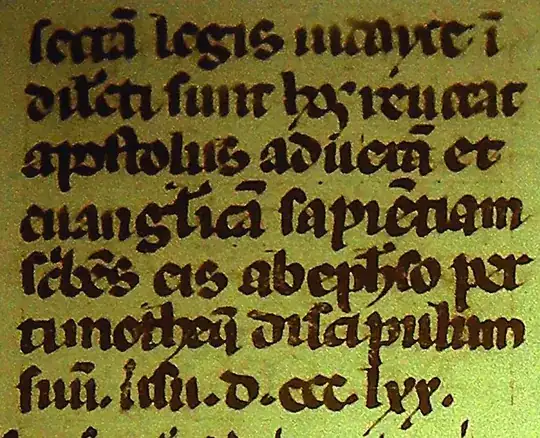
Even this is not entirely satisfactory as a definition or criterion: the concept of ligature is not as strictly defined as one might like. Basically any two letters could and would be written attached depending on the scribe, if the shapes allowed it. Compare the attached po in apostolus in this manuscript, first word of the third line (there are also many other simple ligatures in this manuscript):


Cerberus - Reinstate Monica
- 61,585
-
2But so wide a definition basically removes any usefulness the term ‘ligature’ has—if any glyphs that appear next to each other are to be seen as ligatures, then absolutely everything is a ligature. An entire page of text can be said to be a single ligature. I agree that any adjoining glyphs can be made to be ligatures; but I do think there is the difference that a ligature is more than (or rather, different from) simply the sum of its constituents. – Janus Bahs Jacquet Sep 08 '13 at 17:04
-
2@Janus: I understand your point, and I have thought about this myself. But this is definitely called a ligature in palaeography. The main definition I have heard says that a ligature is any combination of letters where at least part of a stroke that is part of the essential body of a letter is shared by another letter. So, in this case, part of the essential body of the o is shared by the essential body of the g. Then there is the question of overlap: it is hard to tell whether they share a stroke or the strokes just overlap. But in both cases it would be considered a ligature. – Cerberus - Reinstate Monica Sep 08 '13 at 17:39
-
2Of course there are ligatures where one letter (or both letters) has lost some part of its essential body in a ligature without its body being shared with the other letter at all: of course that also counts. Perhaps the best criterion is, can you cut the paper/parchment such that you have two intact letters left on either piece? If not, it's a ligature. It's still not entirely satisfying, I know. It's not a perfectly demarcated concept. – Cerberus - Reinstate Monica Sep 08 '13 at 17:43
-
1@Cerberus: According to your standards, English cursive writing is just one long series of ligatures. – Vector Sep 08 '13 at 21:16
-
@Vector: Well, first of all this sense of ligature is not a term intended for post-quill writing, but rather for scripts where most letters are normally written separately. Secondly, have you read the "paper cut" criterion in my comment? Perhaps I should add that to my answer. – Cerberus - Reinstate Monica Sep 08 '13 at 21:40
-
OK - I am not an expert in this field at all. My observation is the same as the first comment by JBJ. – Vector Sep 08 '13 at 22:07
-
-
This appears to be a legitimate use of the term, similar to the use of FF, FL, FT, CT, and ST ligatures in modern typography. While some ligatures like AE and OE are phonetically meaningful, most are simply aesthetic conventions like this. – Bradd Szonye Sep 08 '13 at 22:25
-
1@BraddSzonye: Aesthetics may be part of it, but the primary function of ligatures is to save the scribe some strokes and/or space. – Cerberus - Reinstate Monica Sep 09 '13 at 00:25
-
1@BraddSzonye Typographic ligatures like ff, fi, fl, ffl, ffi, st, ſt are certainly extremely different from lexical ligatures like æ and œ. See this answer. Then you have things that started out as ligatures or scribal abbreviations, but which are now seldom regarded as such, like & and ß. Also there are curious cases like ꝛ, U+A75B LATIN SMALL LETTER R ROTUNDA, and the related combining characters and such, which were used in blackletter scripts. There are incredibly many of these in the old manuscripts. – tchrist Sep 09 '13 at 00:32
-