0
  1. They live the quiet life on farms
  2. They live the quiet life in farms

Which is correct?

choster
  • 43,403

4 Answers4

1

It depends on what they are. If they're people I would say, "they live on farms", but I can imagine using "in farms" when talking about insects.

  • You are correct. Conventional farms consist mainly of open fields with some buildings so talking about the people who occupy a farm the word on is more appropriate, however most of them will live in a farmhouse situated on the farm. We still tend to use on when talking about intensive livestock farms, probably because the farmhouse and livestock houses are separated. However farmed fish live in fish farms but, if the proprietor or manager lives next to the ponds, we'd probably say that he live on a fish farm. Otherwise we'd imply that he lived underwater. – BoldBen Nov 08 '16 at 12:32
0

This isn't really a matter of "grammatically correct". They're both valid, but on is more common...
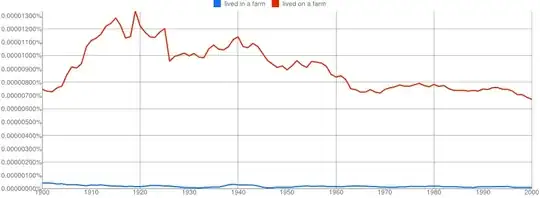
enter image description here

FumbleFingers
  • 140,184
  • 45
  • 294
  • 517
0

While I suppose that one could say they lived in a farm, it strikes me as being incorrect. It's extremely uncommon in American English; I've never seen nor heard that before today.

If you say that they live in a farm, it suggests that they live inside of the farm. Using in as the preposition, it would be much more common to say they lived in a farmhouse or they lived in a house on a farm.

In is generally used to mean inside, within, or into.

Giambattista
  • 1,737
  • Prepositions can be troublesome, especially, when one moves from one language to another, it seems to be more a question of idiom rather than grammar. One stands on line to buy a ticket in London while he stands in line to buy the same ticket in New York. Unless, of course he queues up to buy a ticket, a case I mention only to support that what we are talking about is idiom, not grammar. In support requests for a stronger context, I can image a situation where in might work, but "farm" would be a name of a set, and not an agricultural undertaking. – Michael Owen Sartin Oct 02 '13 at 01:03
  • @MichaelOwenSartin I agree with you regarding prepositions. In British English, it's considered correct to say at the weekend, while most Americans consider that to be incorrrect and would instead say on the weekend. I did acknowledge that it may be considered acceptable to some. I disagree with you, however, that this is an example of idiomatic usage; and even if it were, it's extremely uncommon. I was hesitant to label it as entirely incorrect, but I do believe that most would regard it to be incorrect. The ngram posted by another user indicates it is rare. – Giambattista Oct 02 '13 at 01:19
0

And now a voice from west of the pond.

We never say in a farm. One lives on a farm. I can't think of a usage for in relative to farm; even when we want to say that some object or building exists within the confines of Farmer Brown's farm, we say (for example) "that tractor is on Farmer Brown's farm." Not in.

We never say on the weekend. We say this weekend, next weekend, last weekend, or various other structures that do not involve prepositions, as in I'm going to the beach the weekend after next.

As it happens, many of us do say wait on line, just as you say Londoners do; it's becoming more common over here, although wait in line still seems to be the standard usage over here.

And just for good measure, we would never imagine anyone lives a quiet life on an American farm. These days farms, generally speaking, are work intensive places which, for the most part, are on the brink of financial disaster, and are bustling with activity and filled with the sounds of numerous large animals, heavy equipment, and many people hard at work from long before the sun is up until long after the sun goes down.

  • Londoners don't wait on a line unless someone has painted one on the ground. They wait in line. Actually, more often than that, they queue. – Andrew Leach Oct 03 '13 at 09:47