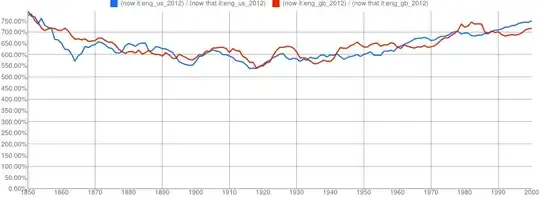
BE version of two examples:
- Now the temperature's dropped, we've been using the fireplace more often.
- Now I'm finished painting the front door I can rest.
AE version of two examples:
- Now that the temperature's dropped, we've been using the fireplace more often.
- Now that I'm finished painting the front door I can rest.
In your examples, the occurrence of "that" is that of a marker: a marker of clausal subordination. It helps to indicate that a following clause is subordinate, that it isn't a main clause. (This type of marker is sometimes mandatory, sometimes optional, sometimes not allowed. It depends on the construction and the matrix verb.)
In your "AmE" examples, the marker "that" is being used to help the reader parse the sentence while the reader is reading it -- the "that" tells the reader that the stuff after it is a subordinate clause, not the main clause. In your two "BrE" examples, the reader might misinterpret the leading subordinate clause to be the main clause as the reader is reading.
Your two "AmE" versions are grammatical. But the grammaticality of your two "BrE" versions are probably questionable -- to my AmE ear, at first blush, I'd mark the "BrE" examples as ungrammatical. (Though, I'd prefer the expression "I've finished" over "I'm finished" for your examples.)
.
EDITED: In light of a recent comment, here's some related info from the 2002 reference grammar by Huddleston and Pullum et al., The Cambridge Grammar of the English Language (CGEL), page 952:
Conditions under which that is obligatory
(a) When the content clause is subject or otherwise precedes the matrix predicator
[3]
Compare these with It is now quite obvious [(that) they were lying], where the content clause is in extraposed subject position, and But I still can't believe [(that) he really intended to cheat us], where it is in post-verbal complement position. What distinguishes [3] from these is that in [3] that is needed to signal the start of a subordinate clause: if [i] began with They were lying this would be perceived initially as a main clause, whereas in the extraposed subject construction the matrix It is now quite obvious prepares the ground for a subordinate clause, and the marker of subordination does not therefore have the essential role that it does in [i]. The same applies in [ii], where we have a further contrast between [ii] itself and He really intended to cheat us, I believe. The absence of that in the latter indicates that he really intended to cheat us is indeed a main clause, and I believe is a parenthetical: we have here two main clauses in a supplementation relation, not one clause subordinated within another, as in [3]. (fn 2)
So, now, after a bit more thinking about it, my evaluation is that the two "BrE" versions are ungrammatical.