33

I'm an American living in America, but my workplace has a lot of immigrants from India here. They all use "thrice" very commonly, which is wonderful to my ears! Thrice is such a delightful word.

Today one of them said something happened "twice or thrice", and it got me thinking that that usage would never happen as a speaker of American English. We would say "two or three times" or, perhaps, "twice... maybe three times.".

Why did usage of "thrice" fall off, and how long has it been since it was commonly used?

(I do apologize, I'm not a frequent user of the English stack exchange, so I'm not sure what tags to use. I would appreciate any edits to add proper tags).

tchrist
  • 134,759
  • 5
    It is quite rare that anyone can say why a particular change happens in language. They just do. – Janus Bahs Jacquet Jan 13 '14 at 20:33
  • 1
    @JanusBahsJacquet I do totally agree - but I think this is a great question. Especially as a lover of the word. – Ste Jan 13 '14 at 20:45
  • 7
    I hope you get an answer in a trice. – bib Jan 13 '14 at 20:56
  • 11
    This is not a matter of public information, but friends know that thrice was despondent at being always the bridesmaid to twice, and rarely appearing alone. The release of the movie A Funny Thing Happened on the Way to the Forum, however, was the last straw; after witnessing the laughs associated with Zeno Mostel's line "He raped Thrace thrice", deep depression ensued, followed by a formal suicide with a formal dagger . Thus †thrice. – John Lawler Jan 13 '14 at 21:16
  • Was "thrice" ever commonly used in American English? It might have something to do with the King James Bible. – Elliott Frisch Jan 13 '14 at 21:31
  • One does occasionally hear it used in Britain, but Indian, as well as Chinese speakers (from Hong Kong, Singapore etc) have retained many old fashioned English forms and expressions. In Malaysia I am often inveighed to 'take my sweet time' over something, e.g.trying on a garment in a shop etc. The phrase is only ever used sarcastically in the principal English-speaking countries. – WS2 Jan 13 '14 at 21:37
  • 1
    According to Google Ngram, thrice started falling off in the mid 1700's. No idea why. But like you, I love the word. – Doc Jan 13 '14 at 21:43
  • "You're once, twice. Thrice a lady" Hmmm, don't think so. – Mari-Lou A Jan 13 '14 at 23:20
  • 3
    @Mari-LouA Yep, it’s all Lionel Richie’s fault. – tchrist Jan 13 '14 at 23:38
  • Your Indian friends probably also say "today morning" instead of "this morning": doesn't make it standard. – Robusto Jan 31 '14 at 12:13
  • 1
    @JohnLawler But what about the starring role in Macbeth? '1st witch: Thrice the brinded cat hath mewed. 2nd witch: Thrice and once the hedge-pig whined'. Incidentally I always took 'thrice and once' to mean '4 times', but if you google this, some sources have 'Thrice, and once the hedge-pig whined', which turns it into an agreement with the 1st witch. I guess this is what Shakespeare scholars spend many a happy hour arguing about. – Mynamite Apr 12 '14 at 10:08
  • Well, recently I was surprised when my friends reacted with a huge laugh when I said,"An idiot laughs thrice". I didn't know that "thrice" is dead ! – quanta Nov 18 '14 at 04:18
  • "Thrice" was commonly seen in Shakespeare's works and the King James Bible, but it just faded out in modern days. There is no reason. It just happens. – Victor Apr 14 '21 at 08:46

3 Answers3

16

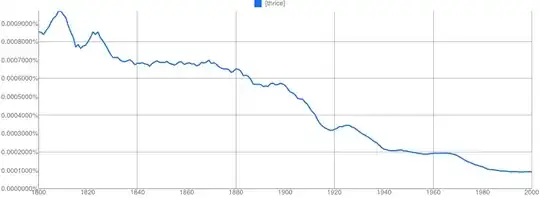
Google Ngram shows the usage more or less steadily falling from 1810, when it was almost 9 times more common than now. From the shape of the graph, one gets the impression that it was more common still earlier to that.

enter image description here

It is a lovely word, easy on the ear.

"Before the cock crow twice, thou shalt deny me thrice," is not only in the King James Version, but in other translations as well.

anongoodnurse
  • 55,278
  • 6
    I suspect there is a historical and linguistic reason that OP is hearing 'thrice' from his or her co-workers. Could it be that they learned a somewhat ossified colonial English in the Indian school system? Full disclosure: If it weren't for English-speaking Indian graduate students, I'd probably be as dumb as a lump of clay. But 'Indian English' sometimes recalls the days of Empress Victoria. – Michael Owen Sartin Jan 13 '14 at 23:06
  • @Mari-LouA - thank you! How did you do that? – anongoodnurse Jan 13 '14 at 23:32
  • 2
  • +1 for the graph. Without the data, I probably would have taken issue with the assertion that 'thrice' is falling out of usage, as I've heard it more and more over the last 15 years or so. At this point I expect everyone to know the word and I hear it at least a couple times a week. Of course, that graph appears to stop at 2000. – DCShannon Feb 27 '15 at 22:29
  • 2
    Interestingly, it has demonstrated a small but sharp increase in usage since 200.

    https://books.google.com/ngrams/graph?content=thrice&year_start=1800&year_end=2018&corpus=15&smoothing=3&share=&direct_url=t1%3B%2Cthrice%3B%2Cc0

    – Chris Sobolewski Jan 03 '19 at 14:50
  • Surely the opening sentence should be "when it was almost thrice thrice times more common than now."? I welcome its resurgence (presumably since 2,000, not 200). – TripeHound Jan 29 '19 at 11:20
7

English taught and spoken as a second or third language in most former British colonies tends to be more florid and formal (old-fashioned if you like) than the ever-changing versions spoken in countries where English is the Mother Tongue.

My father-in-law is a very well educated Kenyan and I relish reading his letters. Some of the vocabulary is near Dickensian and the wit heavily influenced by Wodehouse.

0

Like many words, they just sort of die out and nobody uses them. Sort of like old English words like "thy" "shalt" or "thou"

  • 3
    This doesn't answer the question of why this particular word isn't used a much anymore.. – JJJ Mar 23 '18 at 21:30
  • You could try a google ngrams search to research this further and provide a more fleshed out answer with references. – Pam Mar 23 '18 at 22:18