20

Background

Nowadays, I see "them" used to mean "those" a lot. I don't know if it was as common in the past.

For example, take "one of them people".

On researching about it, I found some people say it comes from a dialect of British English. Some others say it is a "non-standard" usage.

I see this usage in Canadian English also, and it seems some people use it in a sarcastic way.

Moreover, I have seen a song titled "one of them days". I also read, in the book called "A Broken Promise", "Now my mother had become one of them people."

Finally, Wikipedia says that it is a usage in Appalachian English (a common name for the Southern Midland dialect of American English):

Pronouns and demonstratives

"Them" is sometimes used in place of "those" as a demonstrative in both nominative and oblique constructions. Examples are "Them are the pants I want" and "Give me some of them crackers."


Question(s):

What would you say about the usage of this word? Is it correct? Could we use it in daily speech? Could this usage go beyond a specific dialect and be used in other dialects, regions, etc.?

Does it really originate from Appalachian English? Why did this usage become popular among other English speakers?

Note: I have already seen a similar question: What are the grammatical rules for use of "these", "those", and "them"?

However, it only says, "ungrammatical," there. This question is specific to this situation only, and there is more to it.

ermanen
  • 62,797

9 Answers9

18

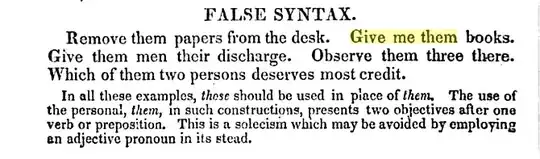
In the succinctly named textbook: English Grammar in Familiar lectures. Embracing a new Systematick Order of Parsing. A New System of Punctuation, Exercises in false Syntax, and A System of Philosophical Grammar. Designed for the use of Schools and Private Learners by Samuel Kirkham, dated 1834 we have this example of usage pertaining to Pennsylvania

Give me them there books.

The author provides further examples and an explanation as to why this construction is considered ungrammatical

Give me them books.

I found an even earlier instance from an American textbook illustrating this usage, dated 1803, The Elements of English Grammar: Methodically Arranged for the Assistance of Young Persons, Who Study the English language Grammatically by George Neville Ussher 1

A Personal Pronoun is sometimes used improperly instead of the Plural Pronoun those. Ex. give me them books; observe them three persons; ought to be, give me those books; observe those three persons

The above extracts prove without doubt that this form of speech (and writing) was used and heard in the past. I cannot say for certain if this usage of them originated in the Central and Southern Appalachian Mountain region of the Eastern United States. I can only testify that when I attended primary school in North London way back in the 70s this form of speech was very common among children.


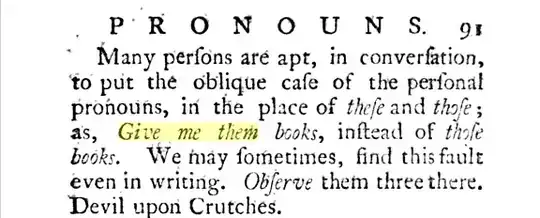
Aha! I found an even older school textbook The Rudiments of English Grammar For the Use of Those Who Have Made Some Proficiency in the Language By Joseph Priestley, dated MDCCLXXII (1772) printed in London, England.2

Many persons are apt, in conversation, to put the oblique case of the personal pronouns, in the place of these and those; as, Give me them books, instead of those books.

Mari-Lou A
  • 91,183
  • 11
    When I said I attended primary school in the 70s I meant the 1970s :) – Mari-Lou A Apr 01 '14 at 04:48
  • Great answer! Do you have any information about the author's or publisher's locations for the first two books? – nohat Apr 01 '14 at 04:57
  • @nohat I have provided direct links, I'll double check now. However both are American, of that I'm sure. First: Rochester, NY. Second: Haverhill, Massachusetts – Mari-Lou A Apr 01 '14 at 05:00
  • 1
    I've just clicked through to the first book. It's really quite charming, but woefully outdated. The section on spelling corrections has some good howlers given what would be standard today. – nohat Apr 01 '14 at 05:13
  • 3
    @nohat I particularly loved the title of the third book, the "for those who have some proficiency" It's like saying: Yes, despite being ignorant in English you're not beyond salvation, there's still hope. – Mari-Lou A Apr 01 '14 at 05:19
  • Love the title of the last book. I fit that there class of people. I frequently hear, give me them there snippers. Mostly from the PA Dutch. (Can you point me to an easy tutorial on how to grab those snippets from them there books, by any chance? Much obliged if you can.) – anongoodnurse Apr 01 '14 at 14:05
  • 1
    Anecdotally, I've heard that Appalachian English is the closest of the American dialects to British English, presumably because it was isolated from the faster-paced linguistic change that took place in the more populated coastal and plains areas. So there being shared features between the two is not surprising, though it does beg the question, "which British English?" – Wlerin Apr 02 '14 at 22:33
  • @Mari-LouA may I ask how you get access to books dated 1834 and 1772, even while living in Italy? Actually, the amount and way you researched to write the answer is really awesome and heavy. :) – RAM Apr 03 '14 at 08:17
  • 2
    @NeerajT I used the Internet for my research, as most users do. http://books.google.com/ This is a good starting point. – Mari-Lou A Apr 03 '14 at 08:24
  • @Mari-Lou A +1 for photo comments. – Emmanuel Angelo.R Apr 03 '14 at 13:25
  • @ermanen prego, it was my great pleasure. – Mari-Lou A Apr 05 '14 at 17:13
  • You really shouldn't use screenshots of text, but if you do, you really can't keep "enter image description here" as the alt text since that's needed for people who use assistive tech. Would you be able to edit to fix this? – Laurel Aug 18 '23 at 12:05
  • 1
    Sweet, thanks for your work on this! – Laurel Aug 18 '23 at 19:47
5

EDIT: It has come to my attention that this is not true apposition, which would be 'one of them, those people.' Even so, my explanation may give you some idea of what you are looking for, and so I will leave it.

'One of them people.'

The two objects, them and people, are in apposition to each other. Each of them is a noun and each serves the same grammatical function; the purpose of each one, however, is to clarify the identity of the other.

In Modern English, it is unusual to find pronouns (them) in apposition; however, in other languages, it is quite normal. When I studied Old Icelandic I often came across such constructions as:

'He Authun went to see them his friends.'

'She his sister went to see him Authun.'

In Modern English you will see apposition in many constructions, usually in titles, but rarely with pronouns:

'King Ethelred was the rightful king.'

'Emperor Julius Caesar was supposedly born via Caesarian section, whence the name.'

'The cook, John, likes his own soup more than we, his customers, do.'

Or, less commonly:

'Look at them stars.'

But never in Modern English:

'They stars are looking down at us.'

A different analysis may simply say that them people is a colloquial variant of those people, and, to some extent, it is; but I thought that you might want a more thorough explanation of what exactly was happening here.

I did not answer all of your questions, but I do hope that this helps.

Anonym
  • 1,714
  • If "them" and "people" are truly in apposition to each other, then shouldn't the expression "One of people" then be grammatical? – F.E. Feb 08 '14 at 21:46
  • You may actually be correct. True apposition would be 'one of them those people.' – Anonym Feb 08 '14 at 21:49
  • 1
    Also, today's standard English also has stuff like "We all enjoyed it", "They all five of them complained". :) – F.E. Feb 08 '14 at 21:52
  • Obviously the first one is quite common, but I've never heard the second. I always took all to be an adjective in those constructions, but it makes sense either way. – Anonym Feb 08 '14 at 21:54
  • Just to confuse, in the English West Country dialect the form "look at they stars" is used. Although that form does seem to be dying out. Younger speakers don't seem to use it. – Chenmunka Feb 08 '14 at 22:59
  • 1
    Have a look at German: einer von den Leuten. When the German den is stressed, it has demonstrative character just as one of those people. And einer von d e n Leuten corresponds exactly to "one of them people". – rogermue Apr 05 '14 at 18:21
4

The other two answers have addressed whether the construct is "grammatical" or not, so I wanted to tackle the other part of the question:

Can we use it in daily speech? Can this usage go beyond a specific dialect and be used in other dialects, regions etc.?

In my experience, within the American South and rural Appalachian dialects it is certainly used in daily speech. There are certain idioms where it's irrespective of region (e.g. "One of them days.") though sometimes it has an ironic flavor to it.

But in some regions (such as the Mid-Atlantic or Northeast America regions), using the construct would definitely raise eyebrows. You might be looked upon as quirky (at best) or uneducated.

I do find it interesting that even in the Northeast region where adults don't speak that way, children still do. I commonly see toddlers say things like: "I want them trucks". Of course they also use it improperly as a subject: "Them trucks are pretty." Or even "He is them friend." Makes me wonder if the origin has something to do with some kind of simplistic mis-application of the objective case.

Lynn
  • 17,801
2

etymonline.com says "them" is related to Old Norse theim written with the special letter thorn, the th-sound as in "them". theim was the dative plural of "they". What I miss is a hint at German:

Compare they die, them denen, their deren/derer. And compare one of them einer von denen, meaning one of those people there.

In English them was used as object case and in dialects "them" is also used for those. Compare the title "Them!" of the science fiction film with the giant ants, USA 1954, directed by Gordon Douglas. Actually the little girl that cries Them! means: Those (giant monster ants)!

rogermue
  • 13,878
-1

It's definitely incorrect to use "them" instead of "those" in the above examples. As an Irish man living in England it never ceases to amaze me how certain English people cannot even speak their own language correctly, but as Oscar Wilde said "the only good thing the English gave the Irish was their language, and then we taught them how to use it!".

My take on it is that the use of "them" originates from the north of England and also from the East End of London/Essex, and that an inverse snobbery has taken hold wherein it's so common-place to use "them" that a whole generation has grown up thinking that this usage is grammatically correct.

  • I was unable to find that quote attributed to Wilde; can you provide a reference? Also, can you offer some references to support your hypothesis? We prefer well-researched answers with supporting evidence. You might want to check out the site tour for starters. – Roger Sinasohn Jul 25 '17 at 19:29
-2

There seems to be a natural tendency for English speakers in colloquial speech to use the objective case in place of the subjective in stock phrases, particularly for emphasis: "It's me", "That's him", and so forth. Over time this will might lead to a loss of the subjective forms altogether, as has already happened with you (objective form of the now archaic ye). Speakers who use them in the way you describe may just be a bit further along in this process.

  • This doesn't explain the use of them for those, since those is a demonstrative pronoun, which can be used in both objective and subjective cases. – Peter Shor Aug 18 '23 at 22:16
-2

This is from personal experience:

"Them" takes the place of "those" in plain speech. Plain speech in America has very strong appeal. Nixon attributed most of Truman's charisma to his plain speech.

Bear in mind that using "them" in the place of "those" will confuse ESL speakers nine times out of ten.

George Chen
  • 1,210
-2

The simple and honest answer is no, it is not correct. In England only those who have been poorly educated use the word "them" in this way.

Laura
  • 5
-4

The usage of "them" as oppose to "those" for the English language comes from the same bastardization (bastardisation for the UK English) of replacing 'my' with 'me'. It is taken from the fact that over time words in the smaller English dialects have been intertwined with modern English to give some mixture of the two. As you can tell, I think it is abhorrent and should be avoided at all costs.

But how does all this apply to this particular subject? Well, the usage is where the problem lies. Because of the medley of words and languages fused within English, the form and structure of sentences is just as diverse. Many smaller villages, including some of the highly educated ones (Oxford and Cambridge, both of which are the home of their respective dictionaries, to name a couple) use an improper English structure. Why would they replace the simple word 'my' with the incorrect 'me'? E.g. "That's me hat!", "That's me car!", "That's me mam!"

Like with all Linguistics studies, the arguments of the form and origin of this type of statement cannot be defined accurately because of how English has ended up being a hodgepodge of multiple languages all rolled up to help express ourselves. There are plenty of words that are borrowed from other languages. Still, I doubt that the origin of this comes from what would have been known as the New World in those days. During the Colonial era, English was not the primary language of the Americas as the French, the Spanish, the Dutch and Germans, etc, had all arrived to stake a claim. I think that this particular use of the language finds itself being brought over from British Isles, perhaps in the form of lower class cockney from the little or even uneducated masses who struck out to the Americas in hopes of finding a new start to their lives.

As to it's propagation? Hereditary. I believe that its origins come in the form of laziness. Yes, laziness. Nothing overtly complex nor extravagant. In much the same way Americans today say moun'ain by refusing to pronounced the 't' in the word, the effort of circling your lips to push out the 'oh' in 'those' is more effort then the 'eh' in 'them'. Over time this habit has been passed down and is now considered 'normal' (if one can consider it that), but has stayed in the rural areas. Over time, the major cities attracted the best and brightest of the world and as a result the standard of the usage has been kept up.

Of course, this is speculation, but I'll keep an eye out for sources that may or may not support this theory.

Tucker
  • 2,885
  • 3
    -1 I have downvoted because of the snobbery of your answer, which I think is causing you to see things incorrectly. I am from Yorkshire, where you will commonly hear 'them people' etc. It is not from laziness. Partly it is culture - if everyone around you speaks like that, then of course you will too. And, Yorkshire at one time being a Viking stronghold, @rogermue's answer sounds good to me. Give the large number of dialects in England, who decided what was right and what was wrong? The French-speaking Normans? The Latin clergy? Johnson? – Mynamite Apr 03 '14 at 18:43
  • 1
    You are also wrong to say that major cities attract the best and brightest in the world, keeping up the standard of usage. Large cities developed because of the Industrial Revolution, when the rural poor were forced to look for work in factories and mills. Do you seriously think that city dwellers speak a more 'correct' language than country dwellers? That the few 'best and brightest' are responsible for maintaining standards amongst the mass of uneducated poor? – Mynamite Apr 04 '14 at 08:49
  • @Mynamite While I can respect your decision to downvote my answer, I must confess I am a little shocked to see that you call my answer snobbery. I was merely pointing out the truth, that laziness is the root of the problem and that it's because the effort in trying to pronounce words and sentences the 'correct' way might not be the 'best' way. And I am no incorrect about saying that cities attract the best and the brightest. We need only to look at cities like Boston with their own mini-version of Cambridge, or to New York for a similar effect. Education was a privilege reserved for the elite. – Tucker Apr 04 '14 at 18:20
  • And yes, I do suggest that most city dwellers have a larger vocabulary, a stronger sense of diction and a much better grasp on the language than the country counterparts. It isn't that hard to prove. Cities like Mumbai and Chennai will have a lot more people who speak in traditional Sanskrit than those in little townships like Kunduluhalli or Chikaballapur. It will be the same for English. When you have libraries that house the world's literature there, people near those places tend to speak better as they have access to a goldmine of literature. – Tucker Apr 04 '14 at 18:23
  • Wait. I did mention that I was mainly talking about the pre-Colonial to Colonial era in my response, did I not? I think that you might be assuming that I am applying this generic statement to today's world. I can assure you that I am not. I was merely stating that back in those days the immigrants from Europe took their colloquialisms with them, didn't really stay in the cities and those that did lived in 'that side' of the city. In the country the language and accents changed and some phrases, such as the one above, became the norm. – Tucker Apr 04 '14 at 18:39
  • 1
    @Mynamite Also, I must point out that it isn't myself who has used this term 'laziness'. Most strong accents have lazy connotations to them. For example, the Australian and New Zealand accents are often called lazy. The American southern accent is called a drawl (defined as: speak in a slow, lazy way with prolonged vowel sounds). In fact in Folk Linguistics By Nancy A. Niedzielski, Dennis Richard Preston states that "..."Ease of articulation" is often equated with "laziness,"...". I must admit though, it took me a while to find the source. – Tucker Apr 04 '14 at 19:06
  • 1
    It's clear from the other answers that this usage is widespread, from at least Yorkshire to London & from there as far afield as Appalachia and Canada. It is documented from at least 1772, and Rogermue and user61979 draw interesting parallels to Norse and Icelandic patterns. Given its heritage, it can't be attributed to laziness. Individual people are lazy, not centuries of many people. Its use is nothing to do with accent and 'lazy' drawls, it is to do with dialect and idiom. Given its widespread use, who are the arbiters who decide what is standard & acceptable, & what is not? – Mynamite Apr 04 '14 at 21:58
  • @Mynamite Granted that individuals can be lazy, but it is proven that certain habits are passed down and the more offspring one has the wider the influence is spread. Let us suppose that a father from a village in Iceland talks a certain way. It can be surmised that his children will follow his habit of speaking as this is the 'proper' form for them. They carry that habit and pass it on to their children until it becomes the norm for them. I don't remember where I've read this, but it was clear that they blamed laziness for the malformation of structure. I'm desperately searching for it! – Tucker Apr 05 '14 at 04:34
  • Your argument implies that the 'correct forms' existed everywhere but some lazy people ignored them, when in fact English is a mongrel language with many dialects. Are you seriously saying that one lazy speaker could have passed on this trait to countless people all over the world? It's not only unlikely, it's unproveable. You have gone from saying 'I believe' and 'this is speculation' in your answer to 'pointing out the truth, that laziness is the answer'. – Mynamite Apr 05 '14 at 22:21
  • What would you say about the usage of this word? Is it correct? Can we use it in daily speech? Can this usage go beyond a specific dialect and be used in other dialects, regions etc.?

    Is it really originated from Appalachian English? Why did this usage become popular among other English speakers?

    Note: I already saw this question: What are the grammatical rules for use of "these", "those", and "them"?

    But it only says "ungrammatical" there. This question is specific to this situation only and there is more to it

    – Third News Apr 06 '14 at 02:13
  • @Mynamite There are 'correct' forms of pronunciations of words for every language. The further away you go from these places, the pronunciations change. This will affect the accent and in same cases the structure itself. This is because of influences. Where from? Friends and neighbors, but more likely, family. The 'single person' was an analogy for a village, an organization or even a religious sect. This is provable, as any Linguist will tell you (as this is one of their primary studies). And yes, I was speculating and as I investigated, it has become apparent that this is actually a fact. – Tucker Apr 06 '14 at 09:15
  • @Mynamite The more I read, the more I come across it as evident. For example, this site states that Many problems of articulation are caused by bad habits and laziness. and using words incorrectly can be argued as a form of articulation, which is defined as (of a person or a person's words) having or showing the ability to speak fluently and coherently. or express (an idea or feeling) fluently and coherently. It seems to be a common term. – Tucker Apr 06 '14 at 09:22
  • @ThirdNews The usage is incorrect and has been for quite some time (evidence is shown in other answers). As for other dialects, definitely there are other tongues out there that will use this form. I know of none, but perhaps Tamil in India? I do know that Kannada (state language of Karnataka) has no tenses. They cannot express past, present or future tense, and when they try to speak in English you get sentences like, "I will do it yesterday." Perhaps they would use this form of reference, but I don't know the language. I will ask around and see. – Tucker Apr 06 '14 at 09:27
  • I doubt we will convince each other. The link you provided is an elocution site and talks about mumbling, it has nothing to do with evidence. My objection to your answer is the implication that there is one correct way of speaking and that anyone who doesn't conform to it is lazy or ill-educated. Some Yorkshire people still say 'thee' and 'thou'. Are they lazy for not keeping up with modern 'you'? Or perhaps the 'you' speakers are lazy because they couldn't be bothered to say 'thee' and 'thou'? – Mynamite Apr 06 '14 at 10:17
  • @Mynamite Egads no! Is that what you garnered from it? Sorry, that is not my intention. Not correct, but 'correct' -- the same way many English abhor the way Americans pronounce some words because it is 'incorrectly' (you say tomaeto, I say tomahto, etc). And I wholeheartedly concur that it's a shame that the use of thee and thou are only used in period plays, poetry, or sarcasm. This is an actual linguistic term. Check this out – Tucker Apr 06 '14 at 14:01
  • @Tucker, I accidentally posted the original questions to refer to them in my answer -I thought I deleted my accidental post. Though use of "them people" is deemed incorrect (it isn't), I believe there is a cultural cledonism associated with its use that homologates the opinion – Third News Apr 06 '14 at 19:08
  • @ThirdNews It is deemed 'incorrect' based on where your English form is from. That means that a person who works for the BBC wouldn't be allowed to use this term as according to their proper and 'correct' use it is wrong, but it would perhaps be acceptable in local news if this is common. The use of the apostrophes is of utmost importance! On a side note, the second half of your last sentence has left me feeling effusive and I appreciate your eloquent usage (though I had to look up cledonism). – Tucker Apr 07 '14 at 09:05
  • First of all, it's not theory if it's not supported, it's just conjecture. I downvoted you because your argument is based on prescriptivism. What you termed laziness, can also easily be argued as evolutionary optimization of spoken English, where written English still has to catch up. – Ahmed Masud Apr 07 '14 at 15:16
  • @AhmedMasud Well, it's not just me. This question has a lot of answers pertaining to laziness. It's not a term that I've thought up and it is used to describe this phenomenon. The more I read about it, the more prevalent it is. I just wish I could find a source because I do remember a professor in Linguistics actually using it. – Tucker Apr 08 '14 at 04:39
  • @tucker please realize that in the reference you gave there isn't a single answer uses lazy or laziness, only in commentaries... And there too it's not prescriptivism. – Ahmed Masud Apr 08 '14 at 11:16
  • 1
    @AhmedMasud You're quite right, 'answer' here isn't the same as comments (commentaries). Well, scoured the internet a little bit more (thanks to your help) I've found this article. In it there is a line "...One of those types of prescriptive attitudes she labelled ‘The Damp Spoon Syndrome’ whereby the belief exists that general sloppiness and laziness is causing language change." Sadly the date is April 1, so I'm unsure if it's a genuine article or an April Fool's prank. – Tucker Apr 08 '14 at 14:50