5

I've noticed in the news that multiple individuals involved in a crime are referred to as co-conspirators.

Etymonline gives the origin of conspire:

conspire (v.): late 14c., from Old French conspirer (14c.), from Latin conspirare "to agree, unite, plot," literally "to breathe together," from com- "together" (see com-) + spirare "to breathe" (see spirit (n.)). Or perhaps the notion is "to blow together" musical instruments, i.e., "To sound in unison." Related: Conspired; conspiring.

Given that the con portion of the word means with or together, is the co redundant?

batpigandme
  • 1,246
  • 8
    Also, if they're conspiring to steal hot chocolate, are they co-co-conspirators? – Digital Chris Feb 20 '14 at 19:07
  • It's a redundant, invented word circa Watergate. I rate it about as highly as I rate "commentator" (which should just be "commenter"). Somewhere along the line people decided they sounded more erudite if they used longer words, leading to a panoply of added prefixes and suffixes. – Carl Witthoft Feb 20 '14 at 20:07
  • 1
    @Carl: No disrespect, but that's a redundant comment (and I use the word advisedly, whereas it seems you didn't! :) An hour before you posted it, I had posted an NGram showing that when associated with a possessive pronoun, the usage was already on a par with conspirator back in WW2. As for "coined circa Watergate", OED has its first citation dated 1863. – FumbleFingers Feb 20 '14 at 23:45
  • 1
    @FumbleFingers thanks for the data. I'm not afraid of being corrected :-) . – Carl Witthoft Feb 21 '14 at 01:09
  • @CarlWitthoft Commentator has been in common use (much more common than commenter) since the 15th century. The commenter/commentator pair reflects a similar pair in Latin commentor (from the verb comminiscī) and commentātor (from the verb commentārī, frequentative of comminiscī). – Janus Bahs Jacquet Feb 24 '15 at 18:09
  • I put co-conspirator & irregardless in the same catagory. –  Dec 06 '15 at 22:19
  • Let me get this straight, the contention here is that one person can't conspire by himself, but it necessarily includes at least one other involved in a conspiracy, therefore a conspirator is already part of a group of at least two conspirators, and co-conspirator is tautologous? – Zebrafish Jul 31 '18 at 20:17
  • @CarlWitthoft For me commenter and commentator have slight shades of distinction. I see a commenter as people writing in this comments section, and see commentators as sports commentators or political commentators. I like different words for different meanings. – Zebrafish Jul 31 '18 at 20:25
  • @Zebrafish per Janus B J comment above, I defer to his insight. Meanwhile, When it comes to French Fries, I prefer using specialty potatos rather than a commentater. :-) – Carl Witthoft Aug 01 '18 at 11:24

3 Answers3

10

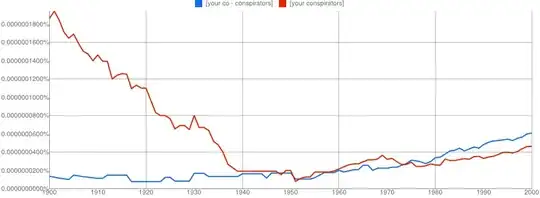
Usage of conspirator / co-conspirator has changed significantly over the past century or so...

But this applies only when it means others involved in the same conspiracy as an identified subject explicitly referenced. In all other contexts we still overwhelmingly use the "non-redundant" form...


Taking that distinction into account, I don't think co-conspirators is normally a "redundant" form. If I came across your conspirators today, I'd assume the person being addressed wasn't directly involved in the conspiracy at all. He might have been the one who stood to benefit from it, or who "bankrolled" them without knowing the details of the operation. Or perhaps he just suggested there might be a conspiracy...

"You're so cynical! Half the time I don't think your conspirators even exist!"

FumbleFingers
  • 140,184
  • 45
  • 294
  • 517
  • 2
    +1 I take your key point to be that a co-conspirator is another conspirator involved in the same conspiracy. Multiple conspirators to an act are simply referred to as conspirators to that act. Multiple unrelated conspirators are simply called conspirators (leaving their co-conspirators unidentified, perhaps). – Canis Lupus Feb 20 '14 at 19:22
  • 3
    @Jim: It's not just that co-conspirators are involved in the same conspiracy. Crucial to the usage is that one of them is already identified within the current context. That's why it's favoured in usages like *his co-conspirators*. – FumbleFingers Feb 20 '14 at 19:33
  • 1
    Interesting. In the news it's usually not directed at a conspirator (e.g. Alleged co-conspirator in pet store fire...), but it does emphasize they are being added to an already identified other involved in the undertaking. – batpigandme Feb 20 '14 at 19:57
  • 2
    I would be quite likely (depending on context, of course) to understand your conspirators as referring to ‘those who conspire against you’, whereas your co-conspirators unambiguously states that ‘you’ is involved in the conspiracy not as its victim, but as a conspirator. – Janus Bahs Jacquet Feb 24 '15 at 18:03
4

I'm going to say that it isn't redundant. Two people can be conspirators, but in two different conspiracies. Co-conspirator tells us that they are conspiring together rather than conspiring with other people. So it provides us with an additional piece of information.

1

Come to think of it, it might be superfluous in some cases.

However the word "co" might carry an important meeting in some other cases. The prefix "co", though it denotes equality in some usage (co-owner, co-teacher) might also suggest that one has a secondary or less important role (Think pilot, co-pilot). So we might use "co-conspirator" to call someone who had a minor role in a conspiracy, although it's true that we also use this term to describe people who had equal participation in the conspiracy. In this instance, it does appear to be redundant--but something that's considered reputable usage.

So I wouldn't say that "co" in "co-conspirator" is entirely useless.

Louel
  • 2,657
  • 3
    I don't think co-conspirator is really the same as co-pilot, co-driver. Very often in those usages the "main man" will still be called the pilot, driver. With co-conspirators, they're normally all considered *equal* within the conspiracy. You wouldn't normally expect a reference to a conspirator (the main one) *and* his co-conspirators (under his command), in the same sentence. – FumbleFingers Feb 20 '14 at 19:17