34

Time magazine (March 5th) carries the article titled, “Ukraine, not the Ukraine: The significance of three little letters,” in which the following comment of William Taylor, who served as the U.S. ambassador to Ukraine from 2006 to 2009 was quoted:

“Ukraine is a country. The Ukraine is the way the Russians referred to that part of the country during Soviet times … Now that it is a country, a nation, and a recognized state, it is just Ukraine. And it is incorrect to refer to the Ukraine, even though a lot of people do it.”

http://time.com/12597/the-ukraine-or-ukraine/

What is the difference between Ukraine and the Ukraine? Does the Ukraine mean Ukrainians or Ukrainian district (of Russia)?

Most of all newspapers call Ukraine Ukraine. Are there a lot of people who call the country “the Ukraine,” Really?

Yoichi Oishi
  • 70,211
  • 10
    See this answer. I use "The Ukraine", "The Gambia", "The Sudan", "The Lebanon", but then I'm a reactionary who objects to other countries dictating how they are referred to in English. We don't tell the French that they mustn't use "Londres", for example. – Andrew Leach Mar 06 '14 at 11:49
  • 8
    @AndrewLeach Then in the case of Ukraine (don't know about the others) you are politically incorrect. The Ukrainian government specifically requested after independence that it be known as 'Ukraine' in English, which is what all responsible opinion (such as the BBC) call it. Ukraine is a territory which has been contested for centuries between such protagonists as Russia, Poland, Austro-Hungary, Ottoman Turkey and others. Previous governments of Russia (not just the Soviet - but take a look at Catherine the Great) had appended 'the' as a way of inferring it was part of Russia. – WS2 Mar 06 '14 at 12:28
  • 4
    I would assume FYRM would prefer Macedonia if Greece had let them. @AndrewLeach What do you call Zimbabwe then? Rhodesia? – mplungjan Mar 06 '14 at 13:49
  • 4
    @AndrewLeach It is not our identity and linguistic self-determination which are in question, but Ukraine's; and disdain for Ukraine's preference is a deliberate discourtesy. – StoneyB on hiatus Mar 06 '14 at 14:38
  • 2
    @StoneyB Actually, it is our linguistic self-determination in question. For someone else to determine what I might be thinking and how I use language is an arrogation to which they are not entitled. – Andrew Leach Mar 06 '14 at 14:52
  • 2
    @AndrewLeach: The whole politically correct thing is annoying. I am prepared to go to some length to appease those who feel strongly about things, and I happen to be young enough to have mostly heard Ukraine throughout my youth, but in general I support your principle. And the idea that an article is denigrating as such is silly, considering The Sechelles, Les Pays-Bas, Die Schweiz, The United Kingdom (I prefer Britain or England btw.: there are several officially so named united kingdoms, such as that of the Netherlands; and I think abbreviations like UK are less elegant). – Cerberus - Reinstate Monica Mar 06 '14 at 15:10
  • 21
    @AndrewLeach Pshaw. Growing up in Alabama in the '50s and '60s I heard this all the time - "Who do these damn Yankees think they are telling us what we can and can't call our niggers." Nobody's telling you how to think or talk; they're telling you such-and-such term is offensive. If you choose to flip them off by persisting in your linguistic habits, you have no cause to resent being regarded as a linguistic boor. – StoneyB on hiatus Mar 06 '14 at 15:30
  • 1
    @Cerberus, the United Kingdom of the Netherlands ceased to be called that in 1839, when Belgium, Luxembourg, and the Duchy of Limburg left the union. (Limburg would later rejoin the Netherlands.) There was also once a United Kingdom of Portugal, Brazil and the Algarves; the United Kingdoms (with an "s"!) of Sweden and Norway; and until quite recently, a United Kingdom of Libya; but the United Kingdom of Great Britain and Northern Ireland is the only currently existing country that has "United Kingdom" in its official name. – tobyink Mar 06 '14 at 23:37
  • @tobyink: Nonsense, Belgium still belongs to the Dutch crown!! OK OK, fair enough, we lost the Verenigd. But still, United Kingdom is a very non-descriptive name. I don't like it at all. Besides, another united kingdom could pop up at any time... – Cerberus - Reinstate Monica Mar 07 '14 at 00:20
  • @StoneyB: In Dutch, we use the word neger (which is perhaps equivalent to negro in English) among educated people. Real racism is non-existent in these circles, and we use this word because we have always done so. But I would be afraid to use it, say, on television, because of some people who are intolerant in the name of political correctness. That makes me said and deplore the superficial, intolerant state of society etc. etc., and now I sound like an old person. The word nikker (equivalent to nigger), is just not used any more by anyone, except perhaps as an archaic word for fun. – Cerberus - Reinstate Monica Mar 07 '14 at 00:26
  • 2
    What's real racism? The racism of other people? – Relaxed Mar 07 '14 at 07:41
  • 3
    @Cerberus If you go into a crowded bar in Scotland, Wales or Northern Ireland (parts of the UK) and say "I prefer to call this nation state I'm in England", it won't be political correctness that will make you want to leave quickly... IMHO the answer to most debates about free speech and offensiveness is "Yes, you are free to say that - and then they and others will be equally free to respond. It might be worth asking yourself if you're sure there isn't a better way to say what you think". Freedom of speech ain't a one way street. – user56reinstatemonica8 Mar 07 '14 at 18:34
  • 1
    @Cerberus - the full name of the UK is 'The United Kingdom of Great Britain and Northern Ireland' which is pretty darned descriptive. – Oldcat Mar 07 '14 at 20:00
  • @Annoyed: Racism is treating some people worse than others based on race. It is not whatever some Whorffian, Puritan, or PC intolerance comes up with, no offence. – Cerberus - Reinstate Monica Mar 07 '14 at 21:11
  • @Oldcat: Yes, the official name is perfectly fine as such. But UK is like a silly emulation of the non-descriptive US. – Cerberus - Reinstate Monica Mar 07 '14 at 21:11
  • @user568458: That would be silly; then you'd use Britain. Abbreviations are generally discouraged by style books, and I agree. – Cerberus - Reinstate Monica Mar 07 '14 at 21:14
  • 1
    just for your information, the Russians don't have articles. So Matthew Piziak's answer with "на" and "в" describes the situation from the point of view of the Russian language. – serge.karalenka Mar 11 '14 at 06:43
  • I'm a native English speaker born in the 60s and, yes, Ukraine was invariably referred to as The Ukraine in the 70s and 80s. They now prefer Kyiv to Kiev too. –  Apr 26 '14 at 16:04
  • With reference to The Bronx, if I remember correctly, this borough is named after the Bronck family, ie, the Bronck's. – B. Scholl May 20 '16 at 13:34

6 Answers6

36

There is something fundamentally wrong with the statement that “The Ukraine is the way the Russians referred to that part of the country during Soviet times”. Russian has no definite article, and as far as I know, the Russian name for (the) Ukraine has not changed since the country’s independence.

‘The Ukraine’ is how English-speaking people have traditionally referred to the country—since long before the Soviet Union was ever a thing, too (at least as far back as the 17th century).

There isn’t one, specific reason why some countries acquire the in English. In some cases, it’s because the name is semantically recognisable as referring to a specific thing (the United States of America, for example, refers to a particular set of united states); in others, it is either random or due to some historical meaning of the name that is no longer clear (The Gambia, for example).

There is a tendency that countries with plural names (as well as archipelagos) have the definite article: the Netherlands, the Philippines, the Canaries, the Bahamas, etc.

There are only two country names and one ‘area name’ (for lack of a better word) that officially have the definite as an integral part: the Bahamas, the Gambia, and the Congo (the latter used in the names of two countries that make up the ‘area’: Republic of the Congo and Democratic Republic of the Congo). In all other cases, it is a matter of euphony and convention—to many people, it simply sounds nicer to include the definite article. With some countries, the tendency to include the article has diminished, making forms with the article sound quaint and archaic. Who these days says ‘the Argentine’, for instance, rather than just ‘Argentina’?

The article does not, however, in and of itself indicate that the country whose name it is attached to is seen as a part/colony/state/subject of another country. That interpretation is—to my knowledge—only applied to (the) Ukraine, and it was invented by the Ukrainians themselves.

There is nothing wrong with avoiding the article and thereby pleasing those Ukrainians who feel that it somehow belittles them—unfounded and unwarranted as such a feeling may be—but outside of official statements where a specific guideline dictates what form to use, there is also nothing wrong with using the traditional English name, with the article.

In brief: the only difference between ‘Ukraine’ and ‘the Ukraine’ is political correctness and official guidelines.

  • 2
    I think "the Gambia" is so called because it's named after the river the Gambia, and rivers are typically referred to with "the". I think "The Congo" and "The Sudan" acquired their "the"s while they were disputed-over geographical regions, before becoming nation states, but I could be wrong. – user56reinstatemonica8 Mar 06 '14 at 15:59
  • Both of the Republics of the Congo derive their name from the Kongo River, the second largest river in the world by volume and a vital commercial resource. – phenry Mar 06 '14 at 17:24
  • Not the country, which did not exist as an independent entity for long, but the geographic area no matter who owns it. – Oldcat Mar 07 '14 at 00:32
  • The Borough of the Bronx (but not the mostly-coterminous Bronx County) includes the definite article in its official and colloquial titles. Not sure if that’s too small for your list but “area” is not well-defined to my knowledge. – KRyan Mar 07 '14 at 04:48
  • @KRyan, ‘area’ wasn't a good choice of word—I really meant that it's the name of the countries, but it's kind of the name of the area that encompasses two countries, so it's not a country name as such. More localised areas with the definite article are quite common (The Valley, The Heights, The Midlands, etc.). – Janus Bahs Jacquet Mar 07 '14 at 08:54
  • Russian has no definite article, You might be surprised at the sheer volume of news items and propaganda that was carried, in English, by the USSR organs. – Greybeard Mar 21 '22 at 18:29
21

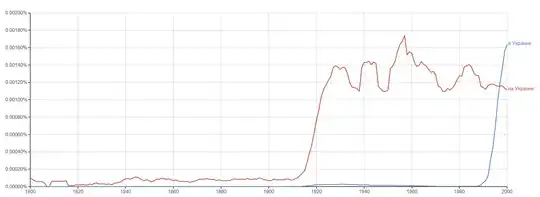
I don't believe that this is a purely English-language distinction, as there is a direct analog of this pattern in Russian. To say the phrase "in Ukraine" in Russian, you can say "в Украине" or "на Украине". "В Украине" literally means "in Ukraine", whereas "на Украине" literally means "on Ukraine". "Нa" is usually used for regions or geographic features, but not generally for countries, and indeed when Ukraine was part of the USSR, it was more common to say "на Украине" than "в Украине". When Ukraine became independent, the phrase "в Украине" was encouraged to emphasize the country's independence. My Russian teacher made it clear that it was polite to say "в Украине" for that reason.

Alaksiej's etymological answer (which is supported by Etymonline) seems to be consistent with this pattern. "On the outskirts" in Russian is "на окраине", which is similar enough that I'd take it as the source of the "на" pattern.

Etymonline "Ukraine" entry

Some additional evidence in response to comments: this Russian-corpus ngram history shows how quickly and recently "в Украине" entered the lexicon. ngram

  • 5
    I don't doubt that this is the reason for the Ukrainian objection to the English article (and +1). But English is not Russian. – Andrew Leach Mar 06 '14 at 20:38
  • Not only this prepositional phrase has no relation to the question under discussion, but also I doubt your Russian teacher's language proficiency, as proper translation for «на Украине» is "at the Ukraine" (e.g.: at Caucasus (на Кавказе — region), at Jamaica (на Ямайке — island), but in Tibet (в Тибете — region), in Phuket (в Пхукете — island)). So your teacher is rather lead by some political considerations than linguistic. – idle sign Mar 11 '14 at 03:37
  • 2
    That is entirely possible. However, I think we have to be descriptivist when talking about language usage. It would be unusual for English speakers to say "at Jamaica" when talking about the country, and frequency analysis supports that. I still believe that the shift from "at the Ukraine" to "in Ukraine" represents the same change in how people view the political status of the region as the shift between «на Украине» and «в Украине», and so I think the difference in preposition has at least tangential relevance to the question asked. – Matthew Piziak Mar 11 '14 at 04:48
  • I got your point, but unfortunately I can't agree. I believe that when speaking of Russian language one should rather use native corpus sources (e.g http://ruscorpora.ru/), as its data differs from Google's. That is if we discuss Russian — in Ukranian the situation may (and is) differ. More over, I think, that speculation upon whether in Russian «в» has a higher political status than «на» or vice versa, is flawed and unworthy. – idle sign Mar 11 '14 at 10:14
10

Ukraine means literally on the outskirts (and that was true from the Russian Empire point of view). I guess the would denote it's a descriptive name rather than a country name (that outskirts, not the other ones). So removing the makes sense, since currently the state is independent, its name is unique and doesn't require any additional classifiers.

Aleks N.
  • 1,094
  • 7
    It was not true from "Russian empire point of view". If anything, it was the Polish Kingdom point of view, as it was them who coined the name for the specific territory. :) – oakad Mar 07 '14 at 00:40
  • 2
    This is utterly wrong answer based on Russian and Soviet shovinistic propaganda. "Ukraine" is literally means "The Country" in ukrainian. What always irked me when I heard this falsehoods from seemingly well educated Russian-speakers is the fact that they seem to forget about a number of russian words with root "kray" that have meaning of "native land", "motherland", etc. – Olaf Mar 07 '14 at 19:32
  • This StackExchange site does not allow editing comments. I believe the better translation of the word "Ukraine" would be "The Homeland". Compare to Polish Armia Krajowa - "Home Army" – Olaf Mar 07 '14 at 19:47
  • @Olaf Native land or motherland would be either батькивщина or вітчизна. There is no sense in naming a country like that. Since I'm a Belarusian speaker, the different meansings of kraj are well known to me. What is not clear in your version is what the preposition u stands for. – Aleks N. Mar 07 '14 at 20:34
  • @oaked Actually both. – Aleks N. Mar 07 '14 at 20:35
  • If you Google-translate "country", you get "країна" ("a country" in Ukrainian). If I am not mistaken, schoolchildren in Russia study subject "история родного края" (history of homeland). Also, when Serbian nationalists called one of their breakaway republics "Republic of Serbian Krajina", I'm pretty sure they felt quite central and not "on the outskirts". Peace! – Olaf Mar 08 '14 at 03:37
  • @Olaf Here is an excerpt from Ukrainian etymology dictionary of 2012: http://tinypic.com/r/2wn35s6/8 If you can read Ukrainian, you will see that official Ukrainian science is backing my point of view. – Aleks N. Mar 08 '14 at 09:56
  • @Olaf: Right, "країна" means "a country", but the addition of "у(с)" transforms the meaning of the word into something like "at the border". (FYI, I'm a Slavic speaker). – serge.karalenka Mar 11 '14 at 06:39
  • "Ukraine" is an autonym and means "The Country". It follows perfectly the pattern: "A group's autonym is often egocentric, equating the name of the people with 'mankind in general,' or the name of the language with 'human speech'." On the other hand, "Human nature being what it is, exonyms are liable to be pejorative rather than complimentary". The perjorative name for Ukraine that was introduced by its Polish overlords and later picked up by Russian tzars and still occasionally used by Russian nationalist is "Malorossia" - "Little Russia" or "Russia Minor". – Olaf Mar 13 '14 at 14:52
  • @Olaf As an endonyn, Ukraine does not follow the general endonymic pattern. Endonyms are frequently called ‘the country’ or ‘the homeland’, but it is exceedingly rare for them to be called ‘in the country’ or ‘in the homeland’. The double meaning of the lexeme kraj- (‘border/edge’ and ‘country/land’) is well-attested throughout the Slavic-speaking area, and both senses are perfectly logically derivable from its origin in the PIE root *kreh₁i̯- ‘cut (out)’; but the ‘border/edge’ meaning is much more logical as the name of an area with the preposition. – Janus Bahs Jacquet Nov 23 '16 at 19:49
  • 1
    @Olaf If you believe the researchers and etymologists who have examined and discussed this name for decades are all mistaken, please post your own answer with evidence that you are right and they are not. The fact that країна means ‘country’ (as well as ‘earth’ and ‘soil’) in current Ukrainian does not constitute proof of this. – Janus Bahs Jacquet Nov 23 '16 at 21:03
10

"The Ukraine" is a region of the world that has existed for some time. "Ukraine" is the name of the country created after the fall of the USSR that more or less governs this region. Parts of what was usually considered part of the Ukraine might be in neighboring nations.

Similarly, "The Great Plains" is a region in North America. It extends across part of the US and might extend into Canada, depending on how generously you draw the boundaries.

Oldcat
  • 8,445
  • 21
  • 32
  • 1
    This. "Ukraine" is a state (nation). "The Ukraine" is a geographic area. – Ben Voigt Mar 07 '14 at 00:30
  • +1. Plus, the Ukranians I work explained that Ukranians prefer "Ukraine" for nationalistic reasons, and they're all great people, so that's good enough for me! It was a change for me, we grew up referring to it as "the Ukraine" in the US in the '80's. – mxyzplk Mar 07 '14 at 19:53
  • It is the name of the country, which did not exist as an independent state until 1990. – Oldcat Mar 07 '14 at 19:58
  • The Crimean peninsula will always be part of the Ukraine (barring continental drift); it is not part of Ukraine at present. – Tim Lymington Dec 07 '14 at 10:54
0

I believe The Ukraine is slightly demeaning. oo krai in russian means on the edge. Many people say na oo krai to say on the edge. this is a reference to the fact Ukraine used to be on the edge of the USSR. Now that it's its own nation, Ukraine without 'the' is more appropriate.

0

The use of the definite article "The" before the name of a country which is in the plural is based on accepted (correct) grammar. Thus, "The United States", "The Netherlands" etc. This also applies to sub-national entities, e.g., "The Catskills", "The Poconos". Also "The Borough of the Bronx", which reflects the fact that the county's name initially referred to where the Bronk family (the Bronks) lived. This origin has largely been forgotten, which is why the county/borough is usually referred to without the preposition "The". So, the use of "The" in referring to geographic names and countries is both grammatically and politically "correct."

The definite article is also used to refer to proper names of geographical areas and some countries that are in the singular. For example, a) "The Mississippi", "The Mid-West", "The South" (sub-national); and b) "The Sudan", "The Congo"; c) "The Gambia"; d) "The United Kingdom", "The Central African Republic". In the case of a) and b) the use is based on tradition (of the namers). In the case of sub-national geographical names it is grammatically correct based on tradition and also "politically correct". When it comes to the names of countries, however, the continued use of the preposition "The" reflects traditional colonial attitudes. "The Colorado" isn't used to refer to the State of Colorado, though occasionally it's used to refer to the river. The case of c), I believe, reflects a degree of Anglophilia among the Gambians. The cases of d), of course, is grammatically based.

The case of Ukraine is trickier in view of some disagreement on translation. I'm against the use of the definite article "The". This would apply a Western colonial methodology to the name of the country. Even if it were considered a part of Russia you wouldn't use the definite article "The" any more than you would use "The" to refer to the State of Colorado. When Ukraine was a republic of the Soviet Union, it wasn't referred to as "The Ukraine" except perhaps by people say from the UK who steeped in the colonial terminology of the lapsed British empire. Before its break-up, the USSR had three seats at the United Nations: Russia, Ukraine and what is now called Belarus. (This was agreed upon when the UN and its original membership were established. The US could have had three seats as well, e.g., US, New York, Connecticut) but it of course refused.

  • 2
    The last part of this answer is quite simply incorrect: referring to the country as the Ukraine was very common in USSR times, whether the speaker was British and “steeped in colonial terminology” or not, and with absolutely no notion that it was a colony in any way. Calling it the Ukraine is in fact still quite common today, even among people who associate nothing colonial with the country, though the official line taken first by the Ukrainian Declaration of Independence and later adopted by style guides around the world, has brought on a change in usage. – Janus Bahs Jacquet Jun 21 '14 at 12:48