13

Usually when discussing monetary amounts, people will say "That cost one hundred million dollars" or "one hundred million pounds".

But I have also seen it written as "that cost one hundred millions sterling". Former UK PM Gordon Brown also used to say millions not million when giving his budget updates.

Are there rules for this usage, or is it just a question of putting the plural in the right place?

apaderno
  • 59,185
Gus Paul
  • 233
  • Are you sure this is the exact context you've seen it? – tenfour Mar 15 '11 at 11:21
  • 1
    See this article from The Economist in 1923. http://www.economist.com/blogs/banyan/2011/03/archive So maybe it's just old, but as I mention I have heard contemporary usage too. – Gus Paul Mar 16 '11 at 13:46
  • Not sure if SO appreciates such comments, but I did not find any of the answers below particularly helpful. However this link, imo, answers the question: http://speakspeak.com/grammar-articles/two-million-dollars-or-millions – Ufos Dec 22 '17 at 16:58
  • 1
    "One hundred millions sterling" is an outright English mistake. It is a typo or transcription error. No doubt about it at all. Period. – Lambie Sep 07 '18 at 15:55
  • @Lambie: I wish I were as certain about anything as you are about everything. But if you read the accepted answer, you will discover that "one hundred millions" is archaic but acceptable. Sterling (which is not the same as pounds or pounds sterling) deos not alter this. – Tim Lymington Sep 07 '18 at 16:33
  • @TimLymington It may be archaic, I believe you. However, *I just do not believe an English PM would say it today.* Also, The Economist from 1923 is almost one hundred years ago. Let's be reasonable here. History and modernity are not the same thing, right? Moreover, if you go to the Ngrams and click on the millions one for the latest date (2000), all the hits date back to the 19th century! So, now what, friend? – Lambie Sep 07 '18 at 16:49
  • @Lambie and all others, jumping in to say that I actually found an online and searchable website that analyzes all of Brown's budget speeches: http://www.channel4.com/news/media/flash/2007/03/budgetspeeches.html. According to this, he's said "millions" twelve times, and most are correct in today's speech, but he has said, according to the analyser, "I can also announce a new fund, initially £50 millions, for microgeneration..." but later in that same paragraph, "The purpose of this £50 million fund is to...". Take that as you will. – Kasenjo Sep 07 '18 at 17:33
  • @Kasenjo You have to see the sentences in that speech analyzer: 1997: Millions more give money to our national charities. 1998: but for millions more, we will make work pay 1999: We expand individual learning accounts to [....] millions more; 2003: millions of pensioners 2002: tax paid by millions of bingo players There are only two instances of millions/billions used the "archaic" way and who is to say it isn't a typo? After all, this speech analzser could be wrong. – Lambie Sep 07 '18 at 17:46
  • The speech analyzes is captures speech and there may be errors. In any case, most of the uses of millions have zero to do with the issue here. – Lambie Sep 07 '18 at 18:02
  • @Lambie, right, that's my point. Most examples are not used in the "archaic" way. I've no idea if it was a speaking error (as in he would not say it normally but happened to misspeak) or if it is genuinely part of his idiolect. I simply became curious if there was indeed a transcription of his speeches (I'm deaf, so I can't exactly just search for them on YT), and if so, how many instances of "millions" was actually used in this way. As it is, not a lot, and rather inconsistently at that, so I agree that it is likely to be an error in either speaking or transcribing. – Kasenjo Sep 07 '18 at 18:15
  • @Kasenjo All those speeches would be in written form but maybe not accessible via the internet and I am too lazy to find out. :) – Lambie Sep 07 '18 at 18:28
  • 1
    Avoid using comments for a purpose other than improving the post they are attached to. For example, comments can be used to ask the author for clarification, point out problems, or suggest changes. Chat is a better place for debate or free-wheeling discussion. – MetaEd Sep 07 '18 at 23:14

5 Answers5

14

The use of "n millions" as a plural noun is somewhat archaic, as evidenced by this Google Ngram comparison of "Two millions" vs. "Two million".
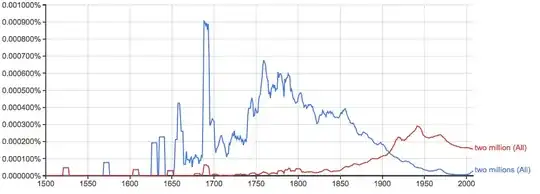
Google Ngram of "Two millions" vs. "Two million"

As the plot shows, "two millions" has long been the standard expression. However, starting around 1850, its usage declined while "two million" rose in popularity. Around 1920, "two million" became the new norm, and today "two millions" is rarely used, except by traditionalists like Gordon Brown.


Here is an excerpt from The Gentleman's Magazine dating from 1841, chronicling proceedings in the House of Commons:

He thought it would be requisite to make up the permanent revenue to fifty millions sterling per annum. … There was now an aggregate deficiency of five millions, and a calculated deficiency of two millions more for the year to come.


In fact, million was once treated more as a noun than as a number. Here are some excerpts from Gales and Seaton's Register of Debates in Congress, 1836:

  • Congress often speaks of a million of dollars, a million of acres, etc. (p. 3992):

    … and although our whole frontiers were embossed with fortifications, and garnished with a million of canon, our country would become the prey of the first invader who should guaranty a relief from such wrongs.

  • That goes for fractions as well (p. 3852):

    Suppose you are to expend half a million of dollars in the construction and equipment of a ship of the line. What portion of the materials of that ship is furnished by the States of the East?

  • However, it is treated as a number when followed by less-significant digits (p. 3857):

    In like manner, Georgia, by her compact of cession, entered into with the United States on the 2d of April, 1802, after expressing certain other stipulations, declares, "that all the lands ceded by this agreement to the United States shall, after satisfying the above-mentioned payment of one million two hundred and fifty thousand dollars to the State of Georgia, and the grants recognised by the previous conditions, be considered as a common fund for the use and benefit of the United States, Georgia included, and shall be faithfully disposed of for that purpose, and for no other use or pose whatever."

  • It is also singular when used as a hyphenated adjective (p. 4601):

    And, sir, it is the same party, headed by the same leaders, whom I have stood by here and seen in days gone by, who defeated the three-million appropriation on the Ides of March…


Note that this archaic English treatment of million as a noun resembles modern French usage, which probably explains its origin:

Millier, million et milliard sont des noms et non des adjectifs. Ils ne font pas vraiment partie du nombre et laissent place à l'accord :

  • quatre cents millions

Le pluriel commence à partir de 2. on écrit ainsi :

  • 1,9 million
  • 2 millions

Translation:

Millier (a word meaning "about a thousand"), million (106) and milliard (109) are nouns and not adjectives. They are not really part of the number and should be inflected:

  • four hundred millions

The plural starts at 2. We write:

  • 1.9 million
  • 2 millions
200_success
  • 6,958
9

Millions is used in sentences like the following.

Millions of TV viewers are following our show.
I've got millions of beer bottles in my cellar.
We make movies for the millions.

The use of millions in these sentences is similar to the use of hundreds.

In American English, I have never seen millions in phrases like 5 millions; million is always used, in the same way thousand is used in phrases like 10 thousand.

It is true that million can be used to mean a million dollars, but millions is used in sentences like "the author is set to make millions," not in sentences like "the author thought to get 6 millions."

apaderno
  • 59,185
  • Another usage: Tens of thousands. People generally do not say tens of millions but as far as I know there is nothing wrong with doing so. Fractional millions would be singular: A quarter-million; a half-million. (Should the hyphen be there?) – MrHen Mar 15 '11 at 17:46
  • Here is a usage I have seen (admittedly from 1923): http://www.economist.com/blogs/banyan/2011/03/archive "the present valuation of Japan's wealth would be between 5,000 and 6,000 millions." and "In order to get a sense of proportion, we may recall that the Japanese population is about 56 millions" – Gus Paul Mar 16 '11 at 13:49
  • @MrHen "Tens of millions" gets Google hits running into the tens of millions. – Jason Orendorff Mar 30 '11 at 15:47
  • His millions is fairly common too (meaning his huge stacks of money). – Jason Orendorff Mar 30 '11 at 15:54
  • @JasonOrendorff Tens of millions [of people, of dollars, of grains of sand]. – Lambie Sep 07 '18 at 18:03
3

I wonder whether millions sterling derives from a misunderstanding of sterling in pounds sterling as a postpositive adjective.

msh210
  • 3,955
  • Wait -- isn't it? I don't see it as an adjective, but it definitely seems to be a postpositive modifier on pounds. As evidence: it is pound and not sterling that is inflected for the plural in one pound sterling / two pounds sterling. – Jason Orendorff Mar 30 '11 at 15:39
  • I suspect this is exactly what is going on in the millions sterling example. I just don't think it's a misunderstanding. (And it doesn't explain the other cases, I don't think.) – Jason Orendorff Mar 30 '11 at 15:41
  • @Jason Orendorff: OED online gives an adj. sense "appended to the statement of a sum of money, to indicate that English money is meant", which it says comes from the older pound of sterlings (=silver pennies). Which means my answer is right, except that said alteration happened centuries ago. :-) – msh210 Mar 30 '11 at 20:31
2

In my experience and understanding, one should use million when it is an adjective telling how many of something:

  • She earned 5 million dollars last year.
  • The city's population included 2.1 million residents.

Use millions as a plural noun:

  • They spent millions of dollars on the project.
  • Millions of people showed up at the march.

I couldn't find anything supporting phrases such as "one hundred millions sterling" but perhaps it is a British usage.

Kristina
  • 1,602
  • 1
  • 9
  • 5
  • 5
    You use million when you are speaking of a precise number, whether it is an adjective or noun. "Give me the five million that you owe me" is correct, millions would not be. The example in this question is a counterexample, of course, but I would assume "one hundred millions" to be a typo if I saw it. – Kosmonaut Mar 14 '11 at 23:11
  • @Kosmonaut: Wouldn't this be worth a full answer? – Cerberus - Reinstate Monica Mar 15 '11 at 00:03
  • @Cerberus: I was thinking Kristina could incorporate the bit about nouns it into her answer. – Kosmonaut Mar 15 '11 at 00:46
  • sorry, but it's no more a British usage than an American one. –  Mar 30 '11 at 15:25
  • I know Churchill used it everywhere in The Second World War. I couldn't give a citation, because the books are not in my possession right now. – Kaiser Octavius Jul 11 '13 at 22:39
1

There's a quote here from an 1896 letter, describing the results of that year's American presidential election as "7 millions to 6 millions and a half." The letter was addressed to the British ambassador, so perhaps Kristina is right that it's a British usage - but the writer was an American. So this may have been an established usage.

Alex
  • 5,032