0

I'm using a website - www.ixl.com - to teach my child how to count American coins, amongst other activities. The site also has many questions on English grammar.

One thing that doesn't seem right - and perhaps I'm missing something here - is their conjugation of the response to "How much money is there?"

Here is an example of what I'm referring to: enter image description here
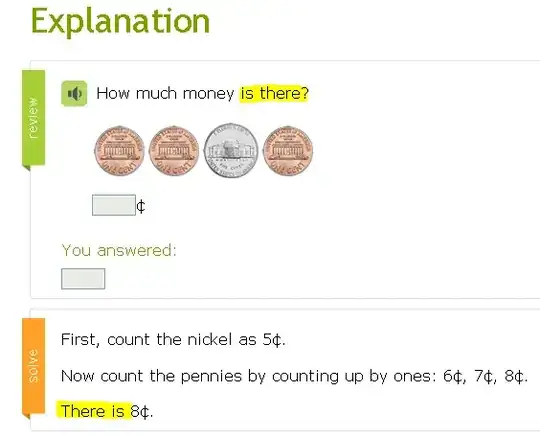
I've never encountered the question where there's only a single penny (1¢) displayed. Thus there are always several cents. I would have thought that the answer should be conjugated with the plural conjugation.

Is the correct answer to "How much money is there?" (in the case of the three 1¢ coins and the 5¢ coin shown in the image) "There are eight cents."? Or am I missing something?

EDITED: There might be a previous question on this site whose answer would be applicable to this OP's question, but neither of those two threads cited to mark this OP's thread as a "duplicate" has an answer for the OP's question: the 1st "duplicate" thread discusses "A total of X" and its number when it is a subject, the 2nd thread involves a possible subject-dependent inversion with a measurement phrase with a sentence beginning with "Here". This OP's specific question deals with numerous topics, and its sentence also involves a leading "There", which ends up making the issue even more involved. Please get the duplicate mark off this thread so I can give the OP an answer. -- F.E.

F.E.
  • 6,208
CJBS
  • 191
  • How much money is there? is certainly correct. However, *there is eight cents sounds woefully incorrect to me. – Anonym Apr 19 '14 at 07:17
  • possible duplicate of "A total of 10 babies is..." vs. "a total of 10 babies are..." vs. "Ten babies in total are..." related: http://english.stackexchange.com/questions/69460/my-last-couple-of-years-singular-or-plural/69546#69546 – Mari-Lou A Apr 19 '14 at 08:53
  • There probably is, or might be, a previous question on this site whose answer would be applicable to this OP's question, but I don't think either of those two threads cited has an answer for the OP's specific question: the 1st "duplicate" thread discusses "A total of X" and its number when it is a subject, the 2nd thread involves a possible subject-dependent inversion with a measurement phrase with a sentence beginning with "Here". This OP's specific question deserves a specific answer, since it deals with numerous topics, and its sentence involves "There". – F.E. Apr 19 '14 at 19:51
  • 1
    I'll try to write you an answer later on. :) -- I'll also try to write an answer for one of those other threads, too. – F.E. Apr 19 '14 at 20:04
  • As we wait for this thread's duplicate mark to be removed, which will then allow me to format my text in an answer box, allow me to put down in these comments some of the things I would like to discuss before I forget them all, and so that you can get that info now. :) -- One point: often when we respond to a question, we tend to echo part of the duplicate info. And so, we'll sometimes echo the subject and verb, or the relevant phrase. You can see that in the quiz's question and answer pair: A:"How much money *is there?" B:* "*There is* 8 cents." And another point is . . . – F.E. Apr 20 '14 at 02:08
  • Another point: In the quiz's context, both the quiz's question and answer could be considered to be existential constructions, which have a dummy pronoun "there" as the grammatical subject, with ellipted info. That is, A:"How much money is there on the table?" B: "There is 8 cents on the table." From this, we can see that the last version "B" response can be an existential, due to a more simpler version: "8 cents is on the table" which has the same info as the existential version. Compare to "There(1) is 8 cents there(2) on the table", where the 1st "there" is the . . . – F.E. Apr 20 '14 at 02:18
  • Compare to "There(1) is 8 cents there(2) on the table", where the 1st "there" is the subject and a dummy pronoun, and where the 2nd "there" is that, er, other type of "there". For "There is 8 cents on the table", We can confirm that the word "There" is the subject by using subject-auxiliary verb inversion: "Is there 8 cents on the table". So, since the quiz's question and answer can be considered to be existential constructions, then the verb's number will be dependent on the criteria that is relevant to existentials: mainly, rely on your ear. -- Another point is . . . – F.E. Apr 20 '14 at 02:29
  • 1
    Another point is that expression "8 cents", for it can be considered to be a measurement phrase. In general, when a measurement phrase is the subject, then, singular number override is often possible; and when singular override is possible, then sometimes the override optional, or strongly preferred, or in some rare cases even mandatory. But that expression "8 cents" is NOT the subject. Though, the stuff to the right-hand-side of the main verb does usually influence the writer's decision as to verb number. Context of the writer's prose is king. Clauses like those two in the . . . – F.E. Apr 20 '14 at 02:37
  • Clauses with a structure like those two in the quiz will in general have singular verb as the default; and it takes something else to change the verb to plural, such as a plural subject or a context that wants a plural verb interpretation. And so, the versions in the quiz sound fine to my ear (AmE speaker). :) – F.E. Apr 20 '14 at 02:40
  • 2
    Thank you for your explanation F.E. As a user of the StackOverflow site (for software developers), on which the focus is about building a collection of knowledge, I find it disappointing that this question has been marked as a duplicate so quickly. As F.E. has noted, the linked questions are only somewhat similar in nature. For those who come to the site (via a question), and then encounter an obtuse link to an only somewhat similar question, and then have to continue to dig through the links for an answer, this must be immensely frustrating. Not a good experience for my first question here. – CJBS Apr 20 '14 at 05:00
  • To my way of thinking the top answer in the duplicate explains fully, clearly and succinctly: "I'm not sure if the British/American analysis holds here, as one would find both forms (there is/there are) widely used. There are certainly sounds better, but some would argue that there is is more correct, because, strictly speaking, total by itself should be a singular noun." I.e in other words "there is (=there is a total) 8 cents" is perfectly acceptable for many dialects and native speakers. – Mari-Lou A Apr 21 '14 at 23:24
  • @F.E. That's how I see it, other times I have voted to reopen questions, this is not going to be one of them. Sorry. – Mari-Lou A Apr 21 '14 at 23:24
  • @Mari-LouA - I suppose it depends on the audience of the site - if it's for discussion amongst experts of the English language, then your assertion that the link "explains fully, clearly and succinctly" is correct. I thought that this was a site for people who are not experts to ask questions of experts, and get answers that are relevant to their questions (with guidance and comment relevant to the example given). In this case, as F.E. has pointed out, there is not an exact correlation, and the answer is certainly not succinct (the quote you use is ¾ through the explanation)! – CJBS Apr 21 '14 at 23:38
  • 1
    @Mari-LouA Afraid not. That other thread's question is not a duplicate of this OP's question, nor does it provide an answer to the the OP's specific question. The accepted answer has, near the bottom of its post, some overgeneralized info on the existential construction, and the link to Oxford Dictionaries that it provided does not deal with existentials. In that post is this: *There is/are a total number of ten babies. [?!] I will not comment on this.* So my conclusion still stands. Those threads do not answer this OP's question. This thread should not have been closed. – F.E. Apr 21 '14 at 23:40
  • But reading that answer, has it helped you? Or are you just like before? I feel that the answer is pretty comprehensive, and I sincerely believe you won't find a better one. It explains well the phenomena of verb agreement, and it is connected to your question. – Mari-Lou A Apr 21 '14 at 23:44
  • @Mari-LouA I know a better answer can be crafted to answer the OP's question. An answer that could have dealt with the specifics that are involved in the OP's question and its context. (That other answer, with its little blurb on existentials, is not very informative or accurate on existentials.) – F.E. Apr 21 '14 at 23:47
  • @F.E. your passion is most admirable, I have been embroiled in the past over verb agreement questions and I remember one post of yours that dealt with "existential there is*. I shall dig around and find it. – Mari-Lou A Apr 21 '14 at 23:47
  • @Mari-LouA Yes, that one was one of my earlier ones, and if you compare the info in that one, you'll see some of the issues are are involved in existentials in general. Here's one post: http://english.stackexchange.com/a/140863/57102 – F.E. Apr 21 '14 at 23:50
  • http://english.stackexchange.com/a/140863/44619 Found it. It was good! But... as good as it is, it's not immediately accessible, perhaps @CJBS might care to read it. It's definitely an instructive answer. – Mari-Lou A Apr 21 '14 at 23:52
  • 2
    Off topic: Even when an OP's question is somewhat similar to another question (grammatically that is) it's often beneficial for a specific answer to be crafted: good for both the OP and for the answers, for it allows other members to get better by wording grammatically accurate answers and indirectly by learning more by researching those answers. That's how a community grows and develops. – F.E. Apr 21 '14 at 23:58
  • @Mari-LouA What do you mean by "it's not immediately accessible"? . . . And is there something that I can do to make it more accessible? – F.E. Apr 22 '14 at 00:00
  • I meant "accessible" figuratively speaking, it's not a glib one line riposte, it's detailed. Look, there are two reopen votes and neither are from Edwin Ashworth's or Peter Shore's. Get them on chat, they might choose to reopen this question. – Mari-Lou A Apr 22 '14 at 00:05
  • OP, in a much earlier post, I had meant to write-- A:"How much money is there *on the screen?" B: "There is 8 cents on the screen*." That would've been something that I could've edited in an answer-post, but can't in a comment. :) – F.E. Apr 22 '14 at 00:08
  • http://english.stackexchange.com/questions/140854/there-is-there-are-depends-on-plurality-of-the-first-list-element-or-not/140863#140863 - Great answer, well summarized with the quote at the end: "In the more complex constructions, you are best guided by your own sense of what sounds right in the particular context to avoid awkwardness and maintain the smooth flow of the sentence." ... which to me reads "If it sounds right, then leave it". – CJBS Apr 22 '14 at 00:10
  • @Mari-LouA Oh, I understand. :) -- But, can you imagine if someone had used that old post of mine as the "duplicate" thread answer to this OP, the poor person (OP) would be thinking "but, but, but I didn't want to know all the ins-and-outs of existentials". – F.E. Apr 22 '14 at 00:11
  • Yes, that excerpt from the MWCDEU is, er, right on. It's a good usage dictionary, though its grammatical foundation is rather old and suspect. That's why I cherry-pick from the grammar sources out there, take the best and ignore the dubious parts, when I create my answers. The existential is a topic about which there is a lot of bad and poor info out there on otherwise somewhat reputable dictionary/grammar sites. A lot of bad info, even by linguists who ought to know better. – F.E. Apr 22 '14 at 00:17

2 Answers2

1

I'm not American but I think you can find both: "There are eight cents" and "There is (a total/an amount of) eight cents".

rogermue
  • 13,878
  • 1
    In the UK, you'd only use plural agreement if numbering the coins. 'There are eight pennies' but 'there is eight pence'. There could be a five pence piece and three pennies, echoing OP's illustration. – Edwin Ashworth Apr 19 '14 at 13:52
1

Q: How much time is there before the New Year?

A: There is exactly two minutes and thirty-five seconds (before the New Year).

Q: How many football players are there in the bus?

A: There are exactly thirty-five (football players in the bus).

And so, to the question "How much money is there?" My answer will be:

"There is eight cents."

Elian
  • 43,007
  • Time is of course continuous. The expression 'There is exactly two minutes and thirty-five (.000...) seconds' will only be true for an instant, and never at the instant it 'has just finished being spoken'. There will even be a finite time before the spoken words are heard by person B, and different ones for C etc. We use such expressions loosely. Measurements of continuous variables (length, time, mass, temperature ...) are afforded singular agreement. Imagine saying '12 degrees are too cold'. But sometimes discrete variables (esp. cash I'm carrying) are treated in the same grammatical way. – Edwin Ashworth Apr 19 '14 at 13:46
  • I don't understand how "There is ... two minutes" is conjugated correctly -- just like in the question. There is more than one minute, just the plural should be used. Again, unless I'm missing something. – CJBS Apr 20 '14 at 04:45