11

I forgot where but I saw the word "night-time" written like "nighttime". Now is that correct or accepted? Can it be written as a single word? I am specifically concerned about British usage.

I did check the dictionary before posting but a dictionary can't tell me about real-life usage frequencies.

MrHen
  • 35,747
  • 32
  • 124
  • 264
verve
  • 271
  • Yes. I'm asking is it accepted in British English? – verve Apr 23 '14 at 18:16
  • If you believe Google NGrams, Brits still usually include the hyphen, but speaking as a Brit myself, I wouldn't. Americans mostly discarded the hyphen several decades ago - and that's obviously the way things are going, so you may as well get used to it. – FumbleFingers Apr 23 '14 at 18:16
  • My Oxford says "night-time". – verve Apr 23 '14 at 18:16
  • @Fumble: so in written form the Brits use "nighttime" too? – verve Apr 23 '14 at 18:18
  • 2
    @verve: We use both, as do Americans. But as with most such "compound" forms, the general trend is to move from two separate words, through the hyphenated form to a single-word form. Note that OED, for example, lists daylight, moonlight as single words, but many of their cited usages (mostly the older ones) are either hyphenated or written as two words. In most cases (including yours) there is no "correct" version. But there is usually that *trend*, so if you ever see a single-word form you can probably use it knowing it'll be okay eventually, if not already. – FumbleFingers Apr 23 '14 at 18:25
  • @FumbledFingers: thank you so much. This helped me learn a lot as I didn't know all this. – verve Apr 23 '14 at 18:29
  • @Verve: I have already closevoted as "Primarily Opinion-based", since there's no real concept of "correct" here (just what different style guides might suggest). I can't change that vote, but strictly speaking I should have said it's a duplicate of "To hyphenate or not?". It's not a stupid question, just "unanswerable". – FumbleFingers Apr 23 '14 at 18:36
  • 1
    Er, actually a decent dictionary can give you info as to real-life usage, and often do in their usage notes. It is to answer questions similar to yours that publishers/editors have an official preference as to the dictionary that is to be consulted at work in issues like this one. If this question is about your own prose, then you'd probably want to consult your favorite BrE dictionary and see whether it uses a hyphen or not. (Aside: You probably should have put in your original post that you had already consulted a dictionary, and which ones--so we'd know where you were coming from.) – F.E. Apr 23 '14 at 19:18
  • 2
    'The British standard' is a fiction. Here, as FF says, "as with most such compound forms, the general trend is to move from two separate words, through the hyphenated form to a [solid] form". I'd add that the transition almost always seems to take place faster in the US. And that there is no rule against using American spellings or grammatical niceties in the UK. Or vice versa. – Edwin Ashworth Apr 23 '14 at 19:39
  • Thanks all of you! If anyone wants to write their answer below I can give it the checkmark. – verve Apr 24 '14 at 00:12
  • @EdwinAshworth: curious as to ...can the word "double-check" which is listed with a hyphen in both American and British just be hyphenated whenever I please since eventually it will become one word though it seems to not be officially recognized? – verve Apr 24 '14 at 18:54
  • 2
    I don't understand. However, this may help: (1) If current US and UK dictionaries give the hyphenated form, not many people are going to object if you choose it. (2) Some compounds resist the evolutionary trend, usually because of the eyesore that would result. Few would like orangejuice, and fewer stomachache. (3) Though dictionaries differ in what they license, it makes sense not to use variants you can't find listed in any of them. (4) It is considered poor style to be inconsistent, chopping and changing. But when quoting transatlantic sources, you may have little choice. – Edwin Ashworth Apr 24 '14 at 19:18
  • "Orangejuice" and "stomachache" make my eyes hurt just looking at them. Gaaaah! – MT_Head Apr 26 '14 at 18:33
  • @verve: I just performed a set of edits to help keep this question open and help make it a little easier to answer. If you have a particular issue with the edit, feel free to roll it back. Thanks! – MrHen May 05 '14 at 15:03

5 Answers5

10

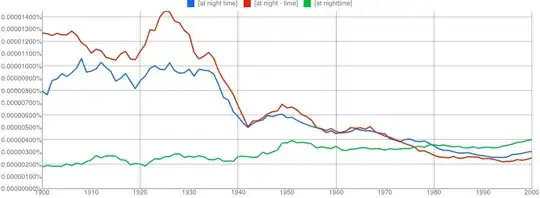
I originally closevoted with a comment saying the general trend is to move from two separate words, through the hyphenated form to a single-word form. But actually it's a bit more complex than that. Compare this NGram for what I would call a "compound noun" usage at nighttime...
...with the more obviously "compound adjective" usage a nighttime [some modified noun]...
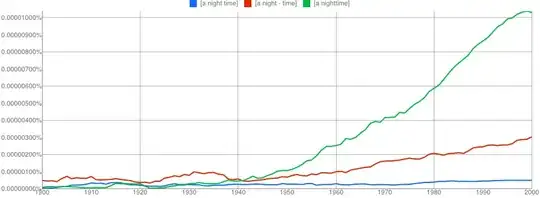
What you see at first glance is that the "noun" usage has declined overall (we've increasingly tended to discard the word time in constructions like "Dracula visited her at night[time]"). On the other hand, we've become increasingly fond of the compound adjectival form.

But if you look more closely, you'll notice that although the single-word form has become the most common in both contexts, there's been a significant shift in relative preferences for the other two forms. As a "noun", the double-word form is now slightly preferred over the hyphenated one, but as an "adjective" the opposite preference is now quite marked.


In light of that I think I should qualify my original comment. The general tendency is indeed to discard the hyphen - but whereas "compound adjective" usages invariably replace it with a single-word form, in other contexts we're quite likely to revert to a two-word form.

This same distinction can be seen if we compare adjectival fleabitten (where the hyphenated form continues to dominate) with the noun fleabite (where the two-word form is now preferred).

I think what this means is that writers in general increasingly reject "indiscriminate" use of hyphenated forms (just as we no longer indulge in the indiscriminate capitalisation of C19 and earlier). But hyphenated compound adjectives are more resistant to this shift than other usages. Because we don't like two-word compound adjectival forms at all, we keep the hyphen unless the single-word form is both familiar (to the ear) and easy to parse (for the eye).

FumbleFingers
  • 140,184
  • 45
  • 294
  • 517
0

A lot of analysis has been already done. Just a look at the etymology which confirm both uses.

nighttime (n.) also night-time, c.1400, from night + time (n.).

nighttime

0

The NGram is very persuasive for the use of "at nighttime" but I agree with Brian Fink that hyphenation is dying in favor of two-word usage (see what I did there?) and I think it's a huge mistake. Hyphens can direct and associate the meaning of a phrase which is totally lost when two words are used. The problem is, people don't want to understand or remember which adjective phrases should be hyphenated (or can't figure them out on a case-by-case basis (see what I did there?). In short, let's just be lazy and drop hyphenation entirely.

-2

In BrE, no. It has to be night-time. In AmE, yes, you can write it that way.

Noah
  • 13,490
-4

Compound words such as nighttime used to be quite common in English; unfortunately, many people in modern times are forgetting about them, so their use is in decline. I wouldn't be afraid to use any word I find in the dictionary. That's how those words stay alive! Go ahead and push back against the anti-compound trend! The word nighttime appears on Dictionary.com.

  • This is completely wrong! As this NGram shows, the single-word form only became more common than the two-word and hyphenated forms about 70 years ago (mainly in the US - the UK hasn't quite reached that "tipping point" yet). – FumbleFingers Apr 23 '14 at 21:23
  • @FumbleFingers I'm not familiar with British English, but here in America, we only use the hyphen in adjectival compound words. So naturally I thought that the compound form was actually older as it appears to be descended from the tendency in German to make a compound word out of everything. Lately in the US, the trend has been to break up compound words and hyphenated words into their base words, as in "night time" instead of "nighttime" or "night-time", or as in "half eaten banana" instead of "half-eaten banana." – Brian J. Fink Apr 26 '14 at 02:55
  • I think you're mistaken about that. The evidence from NGrams for US corpus half-eaten shows the hyphenated form continuing to dominate, but the single-word form is making more inroads than the two-word form. But as you say, that's a different usage (compound adjective, not noun), which is treated somewhat differently. – FumbleFingers Apr 26 '14 at 11:41
  • @Fumble I know what I've seen in print and on the internet. Compound words are not being properly taught in this country anymore. No matter what the book authors are writing, popular writing, media and advertising, as well as common usage, is beginning to accommodate the separate-word usage more and more, so in popular usage, at least in the US, compounds and hyphenateds are dying! – Brian J. Fink Apr 28 '14 at 17:33
  • I'm not sure what you mean there. I don't see this as a matter of "proper" usage anyway, but no-one (apart from me in my own answer) seems interested in the fact that nighttime (however you write it) has two very different usages. Thus at nighttime is a "noun" usage on a par with at dawn, at daybreak, at sunset. Whereas a night-time visit, for example, is an adjectival usage. And there's a tendency (not a "rule") to use hyphens more often in compound adjectives, as is clearly reflected by the usage charts. – FumbleFingers Apr 28 '14 at 17:47
  • @FumbleFingers An intriguing concept. But again, here in the US the common trend appears to be toward using separate words as in "It happened at night time" or "There's a night time burglar on the loose." As far as I'm aware, we haven't used "night-time," even in the adjectival sense, for over 50 years. "Nighttime," however, is still in use for both senses. – Brian J. Fink Apr 30 '14 at 18:54