I know late wife is a common term (dead wife). How about late girlfriend? If that's not the case, what's the most used term?
Asked
Active
Viewed 8,540 times
11


7 Answers
19
Depends on the circumstances; "dead girlfriend" definitely sounds more dramatic and gives a sense of someone who may have been killed or died in an accident. It's a very direct expression and some might feel uncomfortable using it. If you have been following the Pistorius murder trial the term is frequently used
Oscar Pistorius breaks down describing shooting dead girlfriend Reeva Steenkamp source
The athlete, the first double-amputee to ever compete in an Olympics, told his dead girlfriend’s family he was sorry — a move that immediately struck some lawyers as odd. source
On the other hand "late girlfriend" is a softer term, and suggests that the speaker remembers his girlfriend affectionately and with fondness.
I saw the video for P.S. I LOVE U. I remembered my late girlfriend and cried… source
Both expressions are commonly used.
Edit
Google Ngram charts
The OP's question led me to investigate further, so I turned to Google Ngram to see what I could find. Generally speaking, I'm not a fan of this tool as I've seen too many people abuse this feature in the past, but in this case the results are curious and they might be of interest. I'm posting the American English corpus charts because the British English corpus, astonishingly, had no results for "his late girlfriend". The graphs are set between 1950 to 2000. We are concerned with the modern usage of "late girlfriend" not in its history.
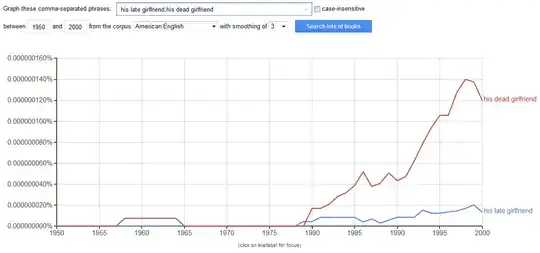
The graph above appears to show an impressive divergence, I then added the following expressions; his late wife and his dead wife, in order to compare the results.
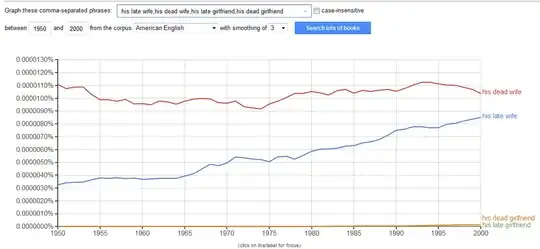
Now the divergence between late vs dead girlfriend appears to be practically insignificant. It's worth mentioning that the term "late + spouse/relative" always comes second to "dead + spouse/relative". Here's another graph but without the term wife
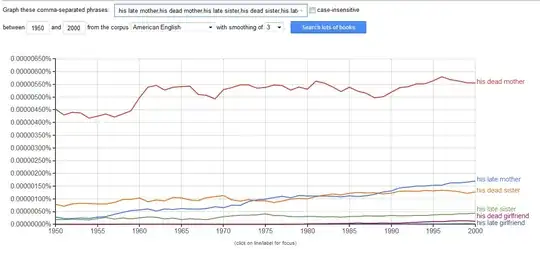
I leave the OP to draw his own conclusions.

Mari-Lou A
- 91,183
-
5Clear and good answer - but your Pistorius example doesn't use "dead" as an adjective. I admit I have not followed the details, but I am quite sure he does not stand accused of shooting his dead girlfriend. Rather, he allegedly shot her dead. – oerkelens Apr 24 '14 at 06:52
-
4@oerkelens There is no allegation, he shot her, that is a fact. The question is whether he believed there was an intruder hiding in the bathroom. Was the murder intentional or was it manslaughter? As for dead not being used as an adjective, the example is taken from a newspaper headline, and I can now see the two different interpretations. Does he describe how he shot his girlfriend dead OR how he shot his dead girlfriend.? Thanks for pointing it out! – Mari-Lou A Apr 24 '14 at 06:59
-
1@MariLouA I just wanted to make sure I didn't get into legal issues by saying he shot her before the trial was over ;) I agree both interpretations are possible, but I doubt that shooting at a person who is already dead would warrant a murder trial - so I would assume it's about how he shot her dead. If he would tell how he found his dead girlfriend, the confusing would be gone :) – oerkelens Apr 24 '14 at 07:03
-
2I think with the Pistorius example, the "dead" attaches to "shooting" not "girlfriend". As in She was shot dead by Pistorius or He is accused of shooting dead his girlfriend. – Neil W Apr 24 '14 at 09:23
-
3@Neil I think there's a case for saying "he described how he shot his dead girlfriend" We identify the poor girl as to be dead, otherwise the journalist should've said: "...describing shooting his girlfriend (name) dead" Newspaper headlines are not always 100% grammatical. Maybe it would make a good question for EL&U? – Mari-Lou A Apr 24 '14 at 09:31
-
Great analysis. Agreed on the Pistorious example. The Ngram results would be more interesting if you could filter out news reports, as they have a tendency to sensationalize the contents of their reports and "dead" is considerably more sensational than "late". I agree more with your original analysis without the Ngram statistic - "lies, damn lies, and statistics" and all that. – Chris S Apr 24 '14 at 17:38
-
Always felt "dead" was a bit of a harsh term. Just because it's commonly used, doesn't make it acceptable. The Pistorius case is a particularly bad example - the media uses the term to hype up the alleged murder. – Muz Apr 24 '14 at 17:38
-
@Muz the word dead is perfectly acceptable, it is not vulgar, crude or offensive. We feel a sense of awkwardness in saying the word because we have been conditioned by the media and society in general, to interpret "dead" as being stark, insensitive and ultimately final, the implication being there is no afterlife. With "passed on", "departed", and even the "late so and so" we are allowing the possibility that the person's absence is, somehow, temporary. – Mari-Lou A Apr 25 '14 at 06:56
-
Mari-Lou - journalists are taught to use direct words like dead when they are in school in the US. It is expected at top newspapers. The word late to me sounds weird. Like it would impose you to describe your girlfriend's death. – RyeɃreḁd May 01 '14 at 17:34
-
@RyeɃreḁd Yes, as I said, dead is more dramatic sounding, but the graphs prove that the term is not restricted to journalism, and the answers posted demonstrate that some people find the word, dead, to be insensitive. I don't have a problem with it, but many Brits used to, although I believe that is changing. Perhaps death is less of a taboo subject nowadays. – Mari-Lou A May 01 '14 at 17:38
-
I agree was just pointing out that as a journalist writing an article you are instructed harshly to never use a word like "late" to describe a death. Therefor the word death/dead may have more usage just because of handbook rules and guidelines than to the journalist/writer's ear and feelings. – RyeɃreḁd May 01 '14 at 21:36
9
It would be OK if she died while still being your girlfriend.
If she is still alive and you have split up it's much more common to say
ex-girlfriend
Slightly humorous warning below (that should appear if you mouse over it)
A degree of caution is required should you have split up and then your ex-girlfriend died. This would make her your late ex-girlfriend which could be misunderstood for something quite different.

Frank
- 4,815
-
3
-
-
6@GauravAgarwal I think I understand, you ask what 'late ex-girlfriend could be misunderstood' means ? It's a play on words late ex-girlfriend is correct but could be heard as latex girlfriend. Be cautious searching for images of latex girlfriend if you are at work (or already have a wife or girlfriend), it could either be a girlfriend who likes to wear latex (a tight rubbery material) or it could be an inflatable doll girlfriend. – Frank Apr 24 '14 at 10:42
-
-
@user3306356 Pretty common if your girlfriend has died, not so common otherwise. – Frank Apr 24 '14 at 15:04
9
Yes; this usage of the word late has no specific restriction to wives, girlfriends, or any other particular relationship or position of people. It is simply a somewhat respectful, tactful way to talk about any dead person. It is mostly used for people who have died comparatively recently, but not exclusively; the subtleties of that point are discussed in some excellent answers here.


4
I'd use the word departed or deceased. They're harder to pronounce, but deceased seems more sympathetic than dead.
Late isn't an impolite word, but it's much more commonly used for someone who's going to show up in a few hours.

Muz
- 394
-
2Re your second para: late is a very unusual adjectives, in that (when applied to people) its meaning depends on its grammatical position. When given as a complement --- my girlfriend was late --- then as you say, it means someone who's going to show up in a while. But when it modifies a noun --- my late girlfriend --- then it pretty unambiguously means they're dead. – PLL Apr 24 '14 at 20:57
-
Perhaps so in a native English speaking country. But where the speaker or listener are used to different language structures, it can be a bit ambiguous. – Muz Apr 26 '14 at 03:01
2
Using the adjectives deceased or departed would prevent the unintentional ambiguity with the alternate meanings for dead such as boring, cadaverous, cold, etc. The adjective late has even more ambiguity even if it feels kinder. But the phrase "dead girlfriend" feels almost disrespectful to her in my intuitions as a listener.

David Morgan
- 29
1
Ok. As I have a girlfriend that died recently (not joking. It was diabetes). I struggled with this term. Now saying my departed girlfriend really dose sound old fashioned. Saying dead girlfriend made people fell bad as it sounds as if they have just died also I personally think it sounds harsh and uncaring (but that's me). deceased girlfriend is ok as it indicates that your girlfriend has died but dose not give the impression it has happoned recently. If used in the right context late is fine for example my late girlfriend liked roses. (Honestly you would have to be stupid to think that his girlfriend who is always later for him to refer to her as his late girlfriend liked roses). I finally settled on a combination of late or deceased depending on who I'm talking to and the subject of the conversation. If I'm talking about her in a fond past tense I use late girlfriend. If answering a question like for example if someone says (so do you have a girlfriend) saying she's late well you get the picture. That's when I say she's deceased

0
It's not a commonly used term that I'm aware of, and I'm sure that you next girlfriend won't appreciate your use of that term, should you choose to continue dating despite your epic heartbreak. Former girlfriend or one of your old girlfriends sounds a lot more like you parted on mutual terms, if you want to avoid the negative connotations of ex-girlfriend. If anyone inquires as to what happened, you can then explain if you want to.

MDMoore313
- 511
- 5
- 14
-
This doesn't answer the question, which is whether it's reasonable to refer to a deceased former girlfriend as "late", not about what other phrasing you could use to talk about such a situation, or about the situation of a person who is no longer your girlfriend for reasons other than her dying. – David Richerby Apr 24 '14 at 15:24
-
@DavidRicherby That's a subjective question yes/no question which is a poor question for the site. Common to what demographic/location? Also, the OP says
if not, what is a more common term?so I gave a more common term. – MDMoore313 Apr 24 '14 at 15:38 -
3
baby-momma. – MDMoore313 Apr 24 '14 at 15:37Lateis fine,deceasedis uncommon. You can also saymy girlfriend who just passed away. As for me, I just say - My wife...she is dead. Hi five ! – Erran Morad Apr 25 '14 at 01:05Seriously the only use of late as a prefix that doesn't sound weird is "late lamented" and then you're really being literary/snooty sounding.
– Dov Apr 25 '14 at 02:42lateas an all-purpose adjective to describe someone who's passed. The late-great MLK, Jr., for example. – Wolfpack'08 Apr 30 '14 at 10:26