13

According to the Wikipedia page for the Oxford Comma, "Use of the comma is consistent with conventional practice" and "Use of the comma is inconsistent with conventional practice." Did the Oxford Comma come before its omission, or was the Oxford Comma traditionally omitted?

It makes logical sense that every item in a list would be separated in the same way: by a comma. If the Oxford Comma is conventionally correct, when and why did people begin to omit it?

Mari-Lou A
  • 91,183
  • 1
    It's still a matter of opinion -- style guides are not consistent on this. I use it or omit it according to applicable style manual or the target readership. – Kris May 24 '14 at 05:52
  • @Kris: I'm not sure what you mean by "a matter of opinion" since I was asking about the history–not the correct usage–of the of Oxford Comma. –  May 24 '14 at 06:06
  • 1
    The history you asked is subject to "If the Oxford Comma is conventionally correct," which is a moot point. – Kris May 24 '14 at 06:08
  • The history of the "Oxford comma" is ~ 100 years long, and came into being after the Oxford University Press advocated it's use. It consists of style guides disagreeing. In the US, pro: The Atlantic 1921, con: NYT 1937, etc. Meh. link – anongoodnurse May 24 '14 at 06:47
  • 3
    Publishers try to stylize writing in general. Oxford no longer recommends the Oxford comma. Harvard does. It really isn't anything but a comma, and "convention" is nonexistent. It's all just style; there is no point of universal agreement on it's presence or absence. – anongoodnurse May 24 '14 at 06:54
  • It would be more helpful to give sensible details regarding the two apparently contradictory statements (primary sources, size / location of sample) than to merely state 'According to ... Wikipedia'. And if you wish to argue that 'It makes logical sense that every item in a list would be separated in the same way: by a comma', are you going to insist on (n-1) and's or zero and's? – Edwin Ashworth May 24 '14 at 11:17
  • 2
    @medica Your appendices need removing. – Edwin Ashworth May 24 '14 at 11:19
  • @EdwinAshworth - do I have a stomach ache? Which appendix needs removing? – anongoodnurse May 24 '14 at 11:38
  • 1
    @medica Two of your it's's should be its's. I was attempting euphemism. (I put a their's recently). – Edwin Ashworth May 24 '14 at 12:47
  • @EdwinAshworth - clever! :) That is my most consistent spelling error. I hate it but do it very often. You're cleverer that me by miles and miles! – anongoodnurse May 24 '14 at 12:56
  • 8
    @medica, is that an Oxford apostrophe? – Kris May 24 '14 at 12:56
  • @Kris - good one!!! :D I'm afraid it's the lowly medica appendix, which needs removing. – anongoodnurse May 24 '14 at 12:59
  • 1
    Huh, I was setting myself up for that one. // But I don't see how their's can be less bad than it's. And I'm hopeless with a trepanner (my wife says it's always better if she does it for me). – Edwin Ashworth May 24 '14 at 13:43

5 Answers5

16

There are situations where use of the Oxford comma will make or break a sentence.

Choose a style and be consistent. When you run into a situation in which your choice suggests a misinterpretation of the sentence, rewrite it in another manner to avoid the confusion.

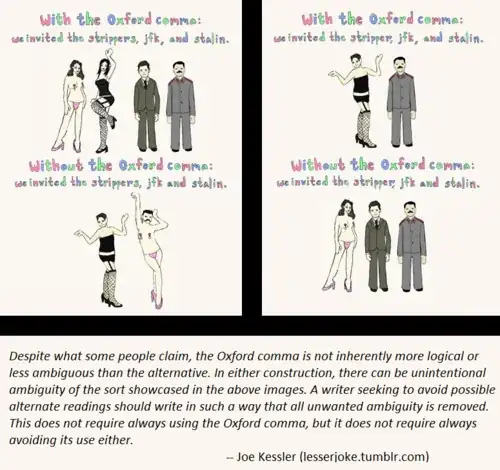
Consider these two pairs where the Oxford comma makes (1) or breaks (2) the intention:

Oxford comma:

  1. We invited the strippers, JFK, and Stalin. = Strippers and JFK and Stalin.
  2. We invited the stripper, JFK, and Stalin. = JFK (the stripper) and Stalin.

No Oxford comma:

  1. We invited the strippers, JFK and Stalin. = Strippers named JFK and Stalin.
  2. We invited the stripper, JFK and Stalin. = Stripper and JFK and Stalin.

A picture (from Joe Kessler's blog) to better illustrate this:

The Oxford comma alters the subjects of these sentences

Adam Katz
  • 894
  • 1
    No no no... example 2 in both cases is correctly written "We invited the stripper JFK", if JFK is being referred to as a stripper. The correct minimalistic way to disambiguate in this sort of situation is to elide an expository comma to indicate a single list item, not to add a comma to separate the penultimate from the ultimate item of the list. – Luke Hutchison Oct 10 '21 at 22:02
  • 'Choose a style and be consistent [but be ready to rephrase grossly where your style causes loss of clarity]' seems to be advocating 'Choose (a) or (b) where (a) = 'always use the Oxford comma' and (b) = 'never use the Oxford comma', both with the proviso '[but be ready to rephrase grossly where your style causes loss of clarity]'. //// However, Kessler advocates using the Oxford comma flexibly. – Edwin Ashworth May 24 '22 at 15:05
  • @LukeHutchison – I think the usage of commas as parenthetical remarks is more common in American English than British English. The publisher's note in Eats, Shoots & Leaves calls this out, explicitly noting "there are a few subtle difference between British and American punctuation". (They're not subtle, at least in a book about British syntax read by a stickler for American syntax.) – Adam Katz Sep 06 '23 at 16:04
4

If find the Oxford comma to give fair representation to how people speak. When listing items in speech, equal pause is given between each item. For me, the Oxford comma emphasizes that there is, indeed, a pause before the 'and' preceding the last item of the list.

I think the Oxford comma also indicates the direction of the sentence -- it makes it clear that you are reading from a list. Often I find myself rereading sentences that don't make use of the Oxford comma because, on the first pass, I have misunderstood what they are saying.

But, as your question points out, many do not use the Oxford comma (e.g., The New York Times).

  • +1 for noting the pause; however, The Oxford comma method only disambiguates nested lists -- we also use commas (pauses) to open and close parentheticals, and a comma before an 'and' can garden-path you into perceiving a new clause. – AmI Nov 16 '17 at 21:37
2

I don't have information about the history of this, so I'm just responding to the second part of your question. Why should there be no comma before 'and'? The answer is simple - there has never been a convention for adding a comma (as far as I know) for mentioning two items: I like apples and oranges or She doesn't mind running or swimming. The problem comes when you want to add a third item: I like pears, apples and oranges or She doesn't mind jogging, running or swimming. It must seem fussy to people to insist on a comma before 'and' here, if there was no comma for two items.

Peter
  • 2,597
  • 1
    You need it for consistency. Elsewise you’ll find yourself wondering what kind of sandwich you are getting when offered ham and cheese, prawn salad, tuna fish and peanut butter and jelly. – tchrist Jun 26 '14 at 02:48
  • 2
    But you miss all the humor caused by the absence of the oxford comma. Such as this recent headline: "Top Stories: World leaders at Mandela Tribute, Obama-Castro Handshake and Same-Sex Marriage Date Set." – anongoodnurse Jun 26 '14 at 02:55
  • I will maintain that most of the time, it doesn't matter. This is largely an AmE-BrE preference issue, and many of us who went to school in the BrE tradition were told not to put the comma before 'and' in lists. – Peter Jun 26 '14 at 04:14
  • @Peter Many of us were also taught (whether correctly or not) that the commas were used in place of repeated "ands". The idea was that "My vassalls grow cabbages, oats and barley" would originally have been "My vassals grow cabbages and oats and barley" – BoldBen Jan 28 '20 at 13:53
2

English is inherently ambiguous and no amount of punctuation can solve this. Ever notice that the examples on the internet showing how one style is better than the other are invariably contrived? In context we'd know things like whether Stalin and JFC are alive in the surrounding narrative or if a couple of strippers used the least alluring pseudonyms in history. Or, and hear me out, maybe the context is that JFC is the airport in NYC. I admit this is an unlikely possibility, but surely there's room in the universe of possible stories for locations to be personified, given agency and eligible to being invited to parties?

My personal style is to leave off the serial comma unless it clarifies. In the usual case, a comma substitutes for "and" in a list:

I like coffee and tea and chocolate.

becomes:

I like coffee, tea and chocolate.

In this case the Oxford comma would be superfluous because there's not much room for ambiguity. But consider a more complex sentence:

I relax and enjoy coffee, tea and chocolate.

In this case I use "and" to separate two halves of a sentence and as the final separator in my list of caffeine sources. I don't think these uses are particularly ambiguous, but the serial comma can help readers parse this sentence:

I relax and enjoy coffee, tea, and chocolate.

So why not use the serial comma every time you make a list of things? One reason is that nobody uses the comma for a list of two items: "tea, and chocolate". The ambiguity doesn't come from the comma or lack of comma, but from the different ways "and" is pressed into duty. It's a conjunction and the terminating separator in a list. The Oxford comma attempts to remove this ambiguity, but only if the list contains three or more items. For the vast majority of cases in typical usage, this is unnecessary and redundant.

  • Written English is inherently ambiguous, and no amount of punctuation can solve that. There may be some unambiguous spoken English sentences, though they're hard to identify. The relevant reference is Abney 1995. – John Lawler May 27 '23 at 22:54
0

According to Willam J. Strunk in The Elements of Style, Rule 2 states that a comma should be used after each term except the last in lists of three or more items. There is an exception which is in names of businesses, the correct example given is: Brown, Shipley and Company (as opposed to Brown, Shipley, and Company).

See the link for the full online text:

https://faculty.washington.edu/heagerty/Courses/b572/public/StrunkWhite.pdf

wgb22
  • 101
  • 2
    Hello, wgb22. As a new contributor, you won't be aware that certain reference works are rated more highly than others. I don't know how often S&W has been updated, but it used to be considered not too near the top of the pile. The 'rule' you give is a style recommendation; there are competing ones (see the other answers). Surely commas should be used to aid rather than impair understanding. And ... – Edwin Ashworth Oct 05 '19 at 14:50
  • 1
    surely the rule 'When you run into a situation in which your choice suggests a misinterpretation of the sentence, rewrite it in another manner to avoid the confusion.' (@Adam Katz's answer) (and note his superb examples) finds other 'rules' wanting. – Edwin Ashworth Oct 05 '19 at 14:51
  • 1
    Like most of the answers to this question, it doesn't really answer the primary question: WHEN/WHY did people start to omit it? I think many people understand the logic of its use, and use it. Many others understand its logic, and don't use it. Everyone is correct. This is usually true in matters of style. It's no different than other rules such as Never wear white pants after labor day.. Why not? Well, because someone authoritative once said so. S&W was the manual I was taught in high school, so I tend to cleave to it. But, then again, as @EdwinAshcroft points out, it's dated. – David M Oct 05 '19 at 15:20