2

The other day I used the term confab, and the person I was talking to (50-ish, smart) had never heard the term. I know it was a buzzword in the 1980's, and I was amazed that she had never heard of it and doubted it was even a real word.

In a sentence: "Today, my boss and I had a confab over the wording of the new policy procedures."

herisson
  • 81,803
Engineer
  • 571
  • 2
    I don't recall *confab* at all - in my salad days it was always *conflab*. Not that it was ever common. 70s equivalent of "geeky slang", I'd say. Good riddance. – FumbleFingers May 30 '14 at 21:08
  • 2
    Google Ngrams shows use peaking between about 1879 and 1924. – StoneyB on hiatus May 30 '14 at 21:10
  • @FumbleFingers Yes, in Britain anyway, it was always conflab (though I haven't a clue what it was short for). And it dates back earlier than the 1980s. I seem to recall it from at least as early as the 1960s. – WS2 May 30 '14 at 21:29
  • @WS2: Haha - I never knew what it stood for either! (presumably because of that extraneous /l/). I thought it was "clever" to use the word when I was 14 (late 60s), but a few years later when I was in college I quietly dumped it (by then it just seemed "quaint" - the kind of word only a "would-be educated rustic" would use). – FumbleFingers May 30 '14 at 21:43
  • @FumbleFingers Yes it definitely went out of fashion. I guess the 'con' part related to 'conversation'. And 'flab'was perhaps just typically British understatement, in this case for a serious exchange of views. – WS2 May 30 '14 at 22:43
  • 2
    It would seem that conflab is a variant of confab, perhaps importing the l from the source word. – Jon Hanna May 30 '14 at 22:59
  • 2
    @WS2: OED says *confab/conflab* are definitely both short for *confabulation. Originally, Talking together; a familiar talk or conversation; chat* going back to 1450, but *humorously A conference* by 1845. I can only offer OP my sincerest contrafibularities on his attempt to resuscitate it. – FumbleFingers May 30 '14 at 23:01
  • 2
    I can recall it being used in computer techie journals and the like to refer to a semi-formal conference. (This recollection is likely from the 80s or so -- haven't seen the word more recently that I can remember.) – Hot Licks Jul 18 '18 at 01:27
  • Apparently asking the question made some people angry - lol. – Engineer Nov 05 '18 at 00:45

4 Answers4

3

It is fairly clear that both confab and conflab originate from "confabulation". They have identical meanings as an informal conversation/unstructured dialogue/impromptu meeting. "Confab" is clearly the original abbreviation and appears in significantly more works of reference than "conflab", which seems to be a later corruption of "confab" and has become the more used variation in recent years, possibly because of the additional connotation of "flab"-biness or looseness/informality of the conversation in question.

3

For many years, starting in at least the early Sixties, confab was used regularly (and correctly) by Hall of Fame baseball announcer Ernie Harwell to describe a small conference at the pitching mound. But Harwell retired about fifteen years ago (and is now dead), and I rarely hear any other announcer use the term even though it offers excellent economy of verbiage. When it is used, the word is often attributed to Harwell, as if it were a made-up word, which it is not.

Rudy
  • 31
  • 2
  • 1
    An informative first answer, but on SE we really like some citation or link so we can corroborate or follow up answers. I suggest you search for "Ernie Harwell and confab" and edit your answer include a link to one of the web pages that come up. – David Jul 04 '17 at 21:04
2

The other day I used the term confab, and the person I was talking to (50-ish, smart) had never heard the term. I know it was a buzzword in the 1980's,

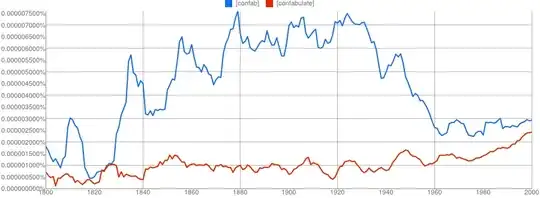
It would seem it had started to die out already by the 1980s, to judge from this, though it's more popular than the unabbreviated form:
enter image description here

and I was amazed that she had never heard of it and doubted it was even a real word.

The flip-side of the frequency illusion is that people start off thinking the information is new.

The flip-side of that flip-side is that this seems weird to those who are already cognisant of the "new" information. For example, some people call the frequency illusion "the Baader-Meinhof Phenomenon". That seems sensible to them, but not to me, because I already knew who the Baader-Meinhof Gang were.

Jon Hanna
  • 53,363
  • I think you charted against the wrong "full form". I only ever knew it as a noun (as in "We need a conflab to discuss tactics before we get started"). If you chart against confabulation it seems the abbreviated form has been falling off for almost a century, while the full form continues to gain prevalence. – FumbleFingers May 30 '14 at 21:34
  • @FumbleFingers good point. We can look for a bit more info again, for that matter. – Jon Hanna May 30 '14 at 21:56
  • 6
    Note however that confabulation acquired a new, psychiatric/psychological meaning during the 20th century. I suspect it is this meaning that is responsible for the growth in usage, due to the rising social awareness of dementia and mental illness. – Neil W May 30 '14 at 22:07
  • Nice extra info there @Neil – Jon Hanna May 30 '14 at 22:18
  • 2
    @Neil Yes I have never heard 'confab' used and was unaware of it until tonight. (Conflab I know all about). But 'confabulation' is a word my son uses. He is a post-graduate student in neuroscience, and 'confabulations' are what his granddad (my father) suffered from, in the few years leading up to his recent death aged 99 and three quarters. It was a form of dementia which involved less a loss of memory than strange imaginings about reality, e.g that he had recently been attacked in the street by 25 people (whilst all the time lying peacefully in a hospital bed) – WS2 May 30 '14 at 22:50
  • @WS2: Sorry to hear of your father's passing. Like my grandmother a few years back, just missing out on a telegram from the Queen (which in both cases probably wouldn't have meant anything to the recipient, who was already half-gone before they actually left us). – FumbleFingers May 30 '14 at 23:06
  • @WS2 Sorry for your loss. – Neil W May 31 '14 at 03:26
  • I think that bump between 1980 and 1985 may have come from business buzzword usage! It's not exactly an "attempt to resuscitate it", but who wouldn't want to see "The Bourne Confab"? ... perhaps "Terminator 17: Skynet Confab". "Come with me, if you want to confab." – Engineer Jun 02 '14 at 18:06
0

It's certainly used by my brother and me (he b.before, I after the war)(which tells you roughly how old we are! However, it was precisely because I was checking whether it was confab or conflab that I should use in a message to him that I found myself here this evening! I'm going to use the l-less version of the abbreviated form as that's what I remember from the late fifties - early sixties. Cheers, Harry