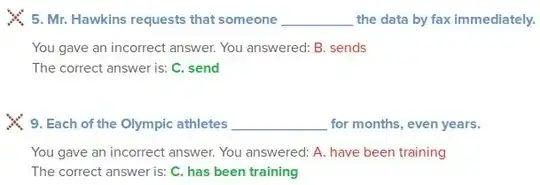
The subjunctive mode (or mood) requires the word send, because there is an "ought-ness" in Mr. Hawkins' request. When something is required of you (assuming you are the "someone" in your first question) or you are given a directive (or order, or command) by someone, the use of the subjunctive mode is appropriate. There seems to be a movement today toward eliminating that mode in both speaking and writing. Nevertheless, here are a few examples which may give you a "feel" for what the subjunctive is all about.
Orders, Ought-ness, Commands, Things Required
Ms. Hanley, the eleventh-grade English teacher, demanded that Ted, her student, apologize for his insensitive remark.
Jim's boss required of Jim, hired as a salaried employee, that he put in several hours of overtime each week.
Mr. Hazard told me, "I suggested to Sally that she curb her enthusiasm."
The subjunctive mode can also be used to express a wish, a desire, an imagined but impossible outcome, or anything in the realm of the impossible. Some examples:
If I were a rich man, I'd buy my parents a mansion in Florida, but that's just a pipe dream.
If I were you, I'd lease a new car instead of buying it.
Even though my new neighbor was a beautiful and single young woman, I knew that if I were to ask her on a date, she'd shut me down immediately.
With "Each," "Every," and "Every Single One," for Example
When one particular person in a group of people, for example, is being singled out and described as having done something, that one person is the focus, not the whole group.
The word each in your second sentence indicates one person; therefore, whatever his action has been is the focus, not the group's action.
The largest one of the statues has not been generating much interest in potential buyers.
Every single one of the team members has been raising money for the trip to the open competition in Seattle, which is 2000 miles away.
Only one of the many items up for bids has been available for immediate delivery since September 26; all the others cannot be delivered before the first of January.
In other words, a singular subject requires a single verb, even when the plural word is closer to the verb than the singular word.