I cannot understand why there is "in" in the sentence "I grew up in the east coast..." - why it is not "on"? Google search provides results for both with quite high number of hits.
Asked
Active
Viewed 9.4k times
4

-
1Could be a regional thing. Is it possible to link to an example? – Andrew Leach Jul 22 '14 at 14:15
-
I simply googled "I grew up IN / ON the east coast" It is 3 million for the former and 4 for the latter. But that could be it - if there is no grammar I am missing, I am happy to know it is a regional thing. – SilkySand Jul 22 '14 at 14:16
-
3I get quite different numbers from you. “I grew up in the East Coast” gives me about 3.1 million hits, whereas “I grew up on the East Covers” gives me about 57.6 million hits, which tallies with the fact that on is by far the most common preposition here. If you consider the East Coast and the West Coast to be pseudo-names of more or less inexactly defined areas, though, in makes sense. You would say, for instance, that you grew up in the Ivory Coast, not on it. – Janus Bahs Jacquet Jul 22 '14 at 14:44
-
I would think "on" is the more correct way to say it.. unless you're a mermaid or a groundhog and actually grew up within the coast itself. – Othya Jul 22 '14 at 16:44
-
I think people use both interchangeably without thinking. I know I do at least. 'On' sounds more correct but I feel like it's a semantic splitting of hairs. Saying "I live in the east" is a lot more acceptable than "on the east". – Embattled Swag Jul 22 '14 at 19:29
-
I agree that it should be "on", but consider: we're not talking about oysters and turtles that might have grown up on the beach. When a person says, "I grew up in the east coast," he's referring to "the east coast" as a region, so it's short-hand for "I grew up in an east coast state." – Scott - Слава Україні Jul 22 '14 at 23:55
-
Hi Janus. You wildly understate the case. You say "If you consider the East Coast and the West Coast to be pseudo-names of areas..." You might as well call "europe" or "the south" or "the middle east" or "asia" a "pseudo-name". Of course, obviously, it goes without saying that "east coast" is (of course, obviously) the absolutely commonplace, universally used (by English speakers in every country), indeed only, Name for that region. Really the question is a bit silly. You may as well ask "When Dr Dre says west coast sound was it made on the beach hah hah hah". – Fattie Jul 23 '14 at 08:36
-
@Joe As far as I'm aware, neither coastal area has an official name or exactly delimited area. That's why I used pseudo-. It's less of a ‘real name’ than, say, Maryland or Massachusetts, by virtue of being common, but informal and unofficial names of an area that is not quite clearly defined. Equating it exactly with Europe, which is an official name of a precisely demarcated geographical area, as a way of countering (?) the argument that the term is used as the name of a region, is disingenuous at best. – Janus Bahs Jacquet Jul 23 '14 at 08:51
-
Nah man, "west coast" is precisely like saying asia, europe, or the middle-east. (Note - in your comment just here you wrote: Europe, which is an official name of a precisely demarcated geographical area. That is absolutely incorrect. Was that a typo? Are you thinking of the "European Union"? "Europe" is exactly as vague as "Asia" "Burgundy" or "West Coast".) (You need only look in wikipedia, for goodnesssake :) to see this ... http://en.wikipedia.org/wiki/Europe ) – Fattie Jul 23 '14 at 09:12
-
FWIW, I don't think I've ever heard anyone say *in* the East|West Coast. That sounds as odd to me as living in the mountaintop. But maybe that's because I've lived mostly on or near the coast. ;-) (And, @EmbattledSwag, IMO this is completely unrelated to in the East.) – Drew Aug 09 '14 at 05:07
5 Answers
3
According to the Oxford American dictionary:
Coast - The part of the land near the sea; the edge of the land.
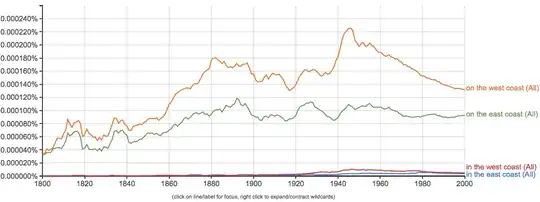
This suggests that one grows up on the coast, rather than in the coast, since the latter would indicate being raised inside a piece of land. Usage statistics also support this conclusion, as "on the east/west coast" is significantly more popular than "in the east/west coast," according to Google Ngrams.
3
It really depends on common usage around the headword. All of these are common usage:
I live in the east.
I live on the east coast.
I live in the east coast city of XXX.
I live on the outskirts of the east coast city of XXX.
I live in the suburbs of the east coast city of XXX.
We tend to use on for lines or borders between areas (hence on the border).
Note: I have a house on Lake Como (it's not actually on the lake; it's on the line around it).

-
Welcome to ELU. This looks right to me, and the ngram results for "in the east coast" are probably explained by examples of "... city of..." – JHCL Oct 22 '15 at 14:11
0
This is an interesting question. I wouldn't say that I live on America when I live in America. However, I would say that I live in New York, vs. on New York. I stood in the Empire State Building has as clear and as different a a meaning as saying that I stood on the Empire State Building. In the former I could have been on the 26th floor and in the latter it is clear that I stood on the roof.
Does size or location matter more? I would say that I live on Planet Earth, in North American, in New York, on Hazel Street, in a house, and am sitting in a chair. But you could say you sat on a chair as well. It would seem that the word, in, has a lived-in, actionable sense, whereas, "on" seems more passive as well as dwelling on the surface. I worked on a farm, and fell in the pigsty. In the case of chair, the chair I sit in at my desk where I write, I would say I sat my butt in the chair and wrote for two hours, vs. I sat my butt on the chair and wrote for two hours.
This is more of an exercise in logic than anything.

SiameseRobot
- 39
-
A common thread runs through all of your examples: in each scenario where you use in, the thing you are in is envisioned as a container. In each scenario where you use on, the thing you're on is envisioned as a surface. This applies equally well to both chair examples: picture yourself sitting in your comfy office chair. Now take away the left armrest. Now the right. Now remove the back, entirely. Now, are you still sitting in your chair? But you're still sitting on it, right? – Dan Bron Aug 09 '14 at 11:52
-
Yes. I see that. But what about the case on Planet Earth, in North America? If North America can be considered a container, why not earth? Would we say we live on the Milky Way Galaxy? No. But there are larger bodies that contain the Milky Way. So why not, in the earth? And why, in North America? The earth is also thought of as soil. We can be buried in soil. So to say, in earth, implies death. Yet can we be buried in North America? Technically, yes. But this is a larger container and as long as we can go deeper into a smaller container then the larger container is no longer suitable. – SiameseRobot Sep 25 '14 at 15:19
-
We can live in and on North America because it's a continent with both a well-defined surface and well-defined boundaries (the coasts, where land meets water). The planet Earth is a sphere: it's finite but unbounded. That is, it has a well-defined surface, but no boundaries. The Milky Way galaxy, by contrast, has boundaries (in 3 dimensions), but no well-defined surface. The difference between a planet and a galaxy that a planet's surface is defined by the inward pull of its own gravity; that is, the concepts up and down apply to planets, but not galaxies. – Dan Bron Sep 25 '14 at 15:24
-
-
@DanBron then what's the point in "live in the desert"? it has a definite surface but no boundaries. – Cavid Hummatov Dec 22 '16 at 18:30
-
@CavidHummatov How do you mean "the desert has no boundaries"? It's that area of land marked on the map as "desert". Same as "live in the city" or "live in Idaho". – Dan Bron Dec 22 '16 at 18:51
-
@DanBron so that's why we say "on the prairie" because it's not marked as a limited area on the map? – Cavid Hummatov Dec 22 '16 at 20:32
-
@CavidHummatov Both "in the prairie" and "on the prairie" have been used, but I have not seen a map with an area labeled prarie – Dan Bron Dec 22 '16 at 20:57
-
I would say that I live in Hazel Street, though I'm fine with on Hazel Street too. – nnnnnn Nov 18 '20 at 21:25
0
You live in the desert. You live in the mountains. But, you live on the prairie. You live on the (east, west) coast. We were looking for instances where the "vaguely defined regions" didn't apply to using "in."

-1
It's completely straightforward.
"West coast" does not literally refer to the strip of beach - it means places like nevada, sacremento, fresno, etc. It's one of the (vaguely defined) "regions" in the US .. like "the south" or "midwest" or 'bible belt" and so on.
The fact that: if you take a phrase, which has grown to have a common meaning, literally, then it is confusing, funny or whatever: so what?
If you asked "Do people who live on the bible belt live on a strip of leather??" the question would probably just be closed!

Fattie
- 10,520
-
1However straightforward it is, it is still unconventional. Things happen on American coasts, shores, and seaboards. – choster Jul 23 '14 at 16:24