4

There is "length", "width", "height", "depth", etc but these words are all relative in respect to the current viewer. The width for one person could be the depth for another person (who is at a 90 degree difference).

There is also "latitude" and "longitude", which describes position in terms of cardinal direction. This is close, but I'm wondering if there are words for describing the length of something in respect to a cardinal axis (north/south and east/west). Essentially "east-west-length" and "north-south-length".

I've had no luck with finding this using search engines. =(

Wisteso
  • 295
  • Cardinal dimension? There's also the explicit, unambiguous, absolute, "dorsal", "ventral", "lateral", "anterior" and "posterior", though those typically refer to faces of a cube (abstractly; the sides of a body more concretely), rather than dimensions. – Dan Bron Aug 07 '14 at 21:25
  • 1
    Yeah basically the cardinal dimension, but specific terms for each axis, rather than a term for describing both. "Dorsal" and friends are relative AFAIK, like "rise", "run", etc. If you rotated yourself around the object, the same terms would describe different faces of the cube. – Wisteso Aug 07 '14 at 21:28
  • No, they wouldn't. A dolphin's dorsal fin is always in the same position relative to its other features, and remains dorsal whether you're looking at the animal from the left, right, below, or 3 miles into space. (That's the both the intent and the utility of these words; at least in an anatomical context.) – Dan Bron Aug 07 '14 at 21:30
  • See also: http://en.wikipedia.org/wiki/Anatomical_terms_of_location – Dan Bron Aug 07 '14 at 21:35
  • 1
    There is the term meridian distance for the north-south direction. – Anna Taurogenireva Aug 07 '14 at 21:35
  • 1
    Good point. Though something abstract like a cube doesn't really have features that would establish an "underside". If there are no terms for longitudinal / latitudinal dimensions, then I may need to settle for lateral, etc. – Wisteso Aug 07 '14 at 21:36
  • I think that the reason why there is no common term for the magnitude might be that longitude and latitude are angles, and therefore don't have magnitudes associated to them (angles are ratios of lengths and the lengths cancel in the division). Nevertheless when quoting position, to indicate the direction the numbers are followed by a suffix N, S, E, W. So, you could say that city A is 15°E from city B. – Anna Taurogenireva Aug 07 '14 at 21:53
  • Yes agreed that most people dont need a term for this typically. I'm thinking that there may not be a specific word for this idea, since we usually use relative vector based measurements like X degrees/minutes/seconds east/west/south/north. – Wisteso Aug 07 '14 at 22:15
  • Well, taking into account that north-south, east-west are directions in the sphere (earth usually) you may use the names altitude (north-south) and azimuth (east-west). Both measured in angles. Although this is still not quite what you want, I imagine. Can you give an example of the type of objects/subjects you want to measure/describe with the words that you seek? – Anna Taurogenireva Aug 07 '14 at 22:17
  • 1
    English doesn't have cardinal directions built into the language. English deixis works on right/left, front/back orientations However, there are languages (most Australian languages, for instance) that do orient themselves by cardinal directions. The linguist Eunice Pike tells a story about walking with some Australians she was learning a language from, when one of them said "Look out! A snake. Quick, jump East." – John Lawler Aug 07 '14 at 22:19
  • That's very interesting information, John. If English had developed that way, I imagine we might have terms for describing exact cardinal based movements.

    ABC, a good example would be a satellite measuring the size of a moving object on the ground. It can measure the distance between the west/east/north/south-most points on an object, but that's it. So it has no concept of where the front of the object is.

    – Wisteso Aug 07 '14 at 22:32
  • Latitude and Longitude are not cardinal directions, but coordinates on a spherical surface. – Oldcat Aug 07 '14 at 23:16
  • You might find this an interesting read: http://en.wikipedia.org/wiki/Map_projection – Lumberjack Aug 08 '14 at 02:12

2 Answers2

9

The cardinal axes of the Earth, "North-South" and "East-West", are termed "meridional" and "zonal", respectively.

This usage is particularly common in the atmospheric and earth sciences, where the words are used as adjectives to, for example, describe flow of climate and weather patterns; see for example the Wikipedia article on these terms.

But while these terms are usually used to describe movement, they are also used to describe size and extent; for example:

The zonal extent, meridional extent, and depth of the model are Lx = 4400, Ly = 5500, and H = 4000 meters respectively.

Numerical Methods in Atmospheric and Oceanic Modelling, edited by René Laprise, Charles Augustin Lin, Harold Ritchie

Dan Bron
  • 28,335
  • 17
  • 99
  • 138
1

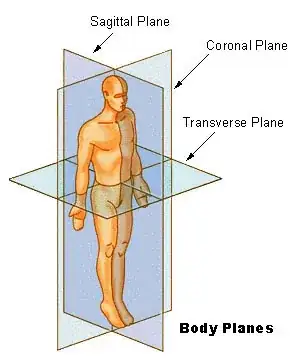
Ok, pursuing the anatomical analogy, I found the words you're looking for: "sagittal dimension" (north-south), "coronal dimension" (east-west), and "transversal dimension" (up-down). http://upload.wikimedia.org/wikipedia/commons/3/34/BodyPlanes.jpg

Source: Wikipedia article on anatomical terms of location

Dan Bron
  • 28,335
  • 17
  • 99
  • 138
  • 3
    Wouldn't these dimensions remain the same for any rotation though? Whereas longitudinal/latitudinal dimensions could vary depending upon the rotation of the object (unless it was a sphere). – Wisteso Aug 07 '14 at 21:46
  • No, for the same reasons as above. Think about it this way: these terms were specifically, intentionally created in order to have an clear, unambiguous vocabulary for describing the anatomy of a body to others who don't have access to the same specimen. A coroner's autopsy report would be really confusing if the statement "a ventral incision" changed meaning depending on the orientation of the corpse on the table. No: by contrast, when you read "a ventral incision" you know the orientation of the body; it's lying on its back (because otherwise a ventral incision is impossible). – Dan Bron Aug 07 '14 at 21:50
  • Ultimately, this might work. Though the original request was a dimension that actually would change depending upon the rotation.

    E.G. the longitudinal length and latitudinal length of a rectangle could become flipped if the object was rotated 90 degrees. The coordinates are relative to the cardinal axis rather than the specific object.

    – Wisteso Aug 07 '14 at 21:54
  • You want a set of terms which are independent of the observer's orientation, but relative to the orientation of the object? Let me think about that (foremost, let me think about whether it's possible, given that orientation fundamentally describes a relationship between observer and observed). – Dan Bron Aug 07 '14 at 21:57
  • Oh, now I get it - you mean literally relative to the North-South axis of the Earth. – Dan Bron Aug 07 '14 at 22:02
  • Only relative to the cardinal axis. The amount of space at any given time between the west-most and east-most point, and the amount of space between the north-most and south-most point.

    Yes exactly. Literally relative to the axis. There is the idea of "minutes" and "seconds" but those are the units rather than the "dimension type". I realize these words may not exist though.

    – Wisteso Aug 07 '14 at 22:03
  • I just want to be be really clear here: when you say "literally relative to the axis" and "the cardinal axis", the axis you're referring to is exactly, precisely, literally the axis of the planet Earth, in the concrete, geographic sense, as identified by a physical, real-world compass, where "North", unambiguously means "in the direction of the North Pole of the planet Earth" and nothing else? – Dan Bron Aug 08 '14 at 01:47
  • I ask because I was taking the question more abstractly and mathematically, where such an universal and absolute reference as "the North Pole of the Planet Earth" does not exist (which is why I had to define the dimensions relative to the object being measured: without an absolute frame of reference, I was forced to make you create one by choosing the "front" of the object). – Dan Bron Aug 08 '14 at 01:47