7

The entry for "dust" from LDOCE says:

dust1 (n.)

  1. [uncountable] → HOUSEHOLD dry powder consisting of extremely small bits of dirt that is in buildings on furniture, floors, etc. if they are not kept clean:

    All the furniture was covered in dust.

  2. [uncountable] → HOUSEHOLD ...

  3. [uncountable] → INDUSTRY, HARD SCIENCE ...

  4. a dust (BrE) → CLEANING the act of dusting something:

    I need to give the sitting room a dust.

  5. ...


dust2 (v.)

  1. → CLEANING to clean the dust from a surface by moving something such as a soft cloth across it:

    Rachel dusted the books and the bookshelves.

  2. ...
  3. ...

Now, the entry for "undust" from Wiktionary says:

undust (v.)

  1. (obsolete) To free from dust.

I do notice the entry being marked as "obsolete" for undust, and also I remember my English classes as a child where we had a rectangular cubic sponge called a "duster" that we used to dust/undust the chalk on the blackboard, however every time I'm cleaning my desk, computer, furniture, etc. I'll automatically think of "undusting" and then will force myself to undo and say "dusting" instead, just to convince myself that the latter is the grammatical one; however I can't see the logic behind this verb and its usage based on general English grammar.

Google Ngrams also shows up some results (even if not many) for undust:
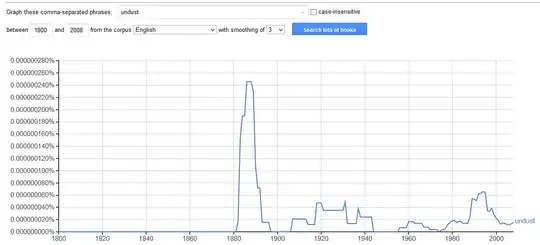
A usage frequency graph for "undust". The first, and highest, peak occurs around 1883, then it drops back to zero for a few years, then there's a bit of activity between 1903-1943, then another gap, then a slowly-increasing curve from ~1960-1998, after which it  tails off (but doesn't go down to zero).

Is undust incorrect? Did it exist as a correct verb years ago, and can I still use it?

I feel paranoid to say: "I'm dusting my keyboard!" because it makes me feel that it has the opposite meaning, as if I'm spreading dust and particles on my keyboard, especially since these chores aren't all that commonly spoken with today's lifestyle, and stating the former sentence might sound a bit odd.

P.S. Note that "dust something off" is slightly different in usage e.g. "They were dusting off leaves and twigs.", and based on my understanding from the definitions in dictionaries, saying "I'm dusting my keyboard off." isn't correct.

herisson
  • 81,803
Neeku
  • 3,786
  • 6
  • 34
  • 45
  • 1
    Contextually "I'm dusting my keyboard!" is appropriate and acceptable as it refers to the act of dusting. I've never heard the word "undust" used. A variation I've come by is "dust off". – MegaMark Aug 11 '14 at 09:39
  • 1
    What's unclear about dust² = "to clean" and undust (obsolete)? – Andrew Leach Aug 11 '14 at 09:43
  • @MegaMark Yeah, but "dust something off" is slightly different, since it indicates that you're removing that something off by dusting it. e.g. They were dusting off leaves and twigs. – Neeku Aug 11 '14 at 09:43
  • But when you are dusting off your keyboard... are you not removing dust...? It's just not repeated, "They were dusting off dust from their keyboards" – MegaMark Aug 11 '14 at 09:48
  • @AndrewLeach I updated my post. – Neeku Aug 11 '14 at 09:54
  • 'Give [the room] a dust' is best seen as an idiom; otherwise someone will be asking "Why is 'a' used with a noun that doesn't take a plural here?" – Edwin Ashworth Aug 11 '14 at 09:55
  • @MegaMark I think it's not correct to say it that way. See my updated post. – Neeku Aug 11 '14 at 09:55
  • It's not obsolete in OED(2), neither are both meanings of undusted. My earlier comment has bit the dust it appears. – Frank Aug 11 '14 at 09:56
  • I don't have access to OED @Frank, so please put it here if you think it's appropriate as an answer for this question. (: – Neeku Aug 11 '14 at 09:59
  • The intransitive usage of 'dust [the thing in need of cleaning] off' is licensed by the Cambridge Dictionary of American Idioms: "[The metaphorical sense derives from] the literal meaning of 'dusting yourself off' (cleaning dirt off yourself) after you fall". Obviously, there's always an implication of the stuff needing to be removed. – Edwin Ashworth Aug 11 '14 at 10:00
  • It's not an answer as such, just pointing out that LDOCE is at odds with a slightly older version of OED - what's more surprising is that LDOCE does NOT have a definition for undusted at all. – Frank Aug 11 '14 at 10:01
  • True @Frank, I suppose LDOCE is doing its best to keep everything contemporary! But yeah, there are entries that it doesn't have. However searching online, I couldn't find many reliable sources for "undust" either. – Neeku Aug 11 '14 at 10:05
  • The first few dictionaries I've checked in giving 'undust' flag it as 'obsolete', except Webster's (1913). It's a matter of whether you'd rather feel paranoid until the feeling wears off, or sound ridiculous to 99.99% of anglophones. But no, I didn't downvote. – Edwin Ashworth Aug 11 '14 at 10:07
  • 2
    On the lack of undusted in LDOCE, surely it is still a contemporary usage for ... If you're desk is covered in dust, and you dust it all off except for your keyboard, you have left you're keyboard undusted. (DV not from me - in fact +1) – Frank Aug 11 '14 at 10:07
  • @Frank That's also a subtle point that I hadn't thought of. I still think all that information can be collected as an answer. – Neeku Aug 11 '14 at 10:10
  • @EdwinAshworth Same to your comments; they have useful info that I think can be gathered as an answer for this question. (: – Neeku Aug 11 '14 at 10:11
  • oerkelens has given the answer I'd give. – Edwin Ashworth Aug 11 '14 at 10:15
  • 1
    Even in the (presumably now always) current version of OED online undust is not marked as obsolete. I can't make an answer (of sorts) because I can't copy from the OED due to copyright restrictions. If you want to collect my comments up and add them to your question feel free. I'd trust OED over LDOCE. undust might not be in common use but obsolete seems harsh. – Frank Aug 11 '14 at 10:38
  • OED still takes time to update. The entry for undust (as in "remove dust") is marked as not completely updated; the last update was in 1921. The last real citation dates from 1654; a citation from Notes & Queries in 1884 is really a pun. It was certainly rare by 1921, and it's entirely reasonable to suggest that it's obsolete now, even if OED hasn't quite caught up yet. – Andrew Leach Aug 11 '14 at 16:22

2 Answers2

20

Undust is used so little that you should indeed see it as obsolete. That ngram shows some results is not really relevant if you compare it with the occurences of dust.

Your paranoia is uncalled for, there is really no proficient, let alone native, speaker of English that will think that dusting your keyboard is similar to watering your plants.

I can understand where your hesitation to use it comes from, as you seem to be saying to opposite of what you are doing. Actually, to complicate matters, dust is used in the sense of adding dust as well: lightly dust the cake form with flour.

In context, however, there will usually be absolutely no confusion. When you dust your keyboard, everyone will understand that you are cleaning it.

As to the logic behind one word meaning two different (opposite) things, we are talking about English, the language that uses words like inflammable, and in which people say I could care less when they mean the opposite. Don't get stuck too much on logic when it comes to natural language!

oerkelens
  • 36,622
  • I didn't compare it with "dust" in NGrams, because it'll definitely include all the noun forms of the word, in addition to the verb ones that are much more common... – Neeku Aug 11 '14 at 09:45
  • 1
    True - to avoid the nouns, try comparing dusting and undusting . They can only be verb-forms, and undusting doesn't appear at all. (My browser spell-checker doesn't accept undust and undusting btw...) – oerkelens Aug 11 '14 at 09:48
  • Right. Neither does mine :D, but it doesn't accept many other correct words like "realise", "humour", "travelling", etc. but yeah, thank you for the information. – Neeku Aug 11 '14 at 09:57
  • 1
    @Neeku - those words are a matter of American vs British spelling :) If you tell your browser that you want to use AmE, then "humour" is not correctly spelled... – oerkelens Aug 11 '14 at 10:21
  • 1
    Neeku -- regarding the fact that "dust" can mean two opposite things. This is utterly unsurprising and normal in English. You can give any number of examples like that where, "logically" a word does "not make sense." It's just no big deal; it's irrelevant and normal in the language. – Fattie Aug 11 '14 at 10:50
  • @JoeBlow Those words are called auto-antonyms or contronyms. See also: cleave, custom, oversight, sanction. – Kyle Hale Aug 11 '14 at 16:08
  • 1
    +1 Perhaps the most pertinent point: "Don't get stuck too much on logic when it comes to natural language!" – Disillusioned Aug 11 '14 at 16:18
  • 3
    In the same vein, consider the difference between watering a cow and milking a cow. – Bobson Aug 11 '14 at 17:36
  • 1
    @oerkelens not to put too much weight on what the browser dictionary says though. I have to add real words all the time. A recent addition was analyte. Definitely a word, yet absent. – Brad Aug 11 '14 at 19:24
  • 1
    @Brad - it never is an argument for a word's non-existence! I discovered elsewhere today that ditransitive is not a word according to my browser. The thing is quite illiterate. :) – oerkelens Aug 11 '14 at 19:43
  • 1
    @Bobson I don't see the difference...in both cases you're pouring a liquid on the cow so it grows, right? :P – rob Aug 11 '14 at 20:00
  • 1
    @rob - Totally. Maybe we should try juicing the cow and see if that also helps it grow... – Bobson Aug 11 '14 at 20:09
  • @Kyle - magnificent work on the contronyms, cheers! – Fattie Aug 12 '14 at 08:29
  • 1
    @Bobson Gah! Now you're making my brain itch even more! I recently bought a device that cores pineapples! Similar logic somehow. – Neeku Aug 12 '14 at 14:02
-5

"undust" is obsolete at best, or more likely just "not a word".

"Is undust incorrect?" Yes, it's that simple: undust is incorrect.

"can I still use it?" Absolutely not, you quite simply can not use it. It's that simple.

Note: You seem to have found "undust" in "wikitionary". You can dismiss "wikitionary" as a language source, it's just an unlike scribble board.

Note: There's a great danger on this site: here, a speaker learning English is asking: "Hey I saw this weird word 'undust' mentioned, is that a word??" The full and complete answer has two letters: the answer is "No".

Of course, one could have an arcane discussion about how often that typo is used, was it a word historically, does it occur in print, etc. But it's really just plain not relevant. In the fullness of the question, the sense of the question, the answer is just "no, that's not a word dude."

tchrist
  • 134,759
Fattie
  • 10,520
  • 5
    I'd certainly label it 'obsolete' in spite of the OED stance. Other dictionaries label it so, and the OED isn't infallible. Perhaps they're picking up perverse usages such as that contrived for Amelia Bedelia. – Edwin Ashworth Aug 11 '14 at 11:35
  • Right - heh good one on Amelia :) – Fattie Aug 11 '14 at 11:51
  • 1
    According to dictionary.com, Webster's Revised Unabridged Dictionary also contains the word "undust", marked as obsolete. – Simon B Aug 11 '14 at 12:10
  • OMG! The Amelia is awesome @EdwinAshworth. (: Also, see Frank's last two comments up there. – Neeku Aug 11 '14 at 13:21
  • 1
    @EdwinAshworth I never imagined I'd find Amelia Bedelia being used as an example of perversion! What a day! – talrnu Aug 11 '14 at 13:51
  • 4
    There is no danger. This site is specifically not for people learning the language and is for "arcane discussion". Especially when it pertains to an obsolete word and not a typo as you incorrectly labeled it. Also note that the OP is asking whether it was ever a word so your answer is not really helping. – terdon Aug 11 '14 at 16:31