Should I put an apostrophe in "for all its worth"? The meaning comes to about the same thing either way, as far as I can make out, and it seems like "it's" is more popular. But is there an accepted version? Or any reason for preferring one over the other, other than staying conventional?
Asked
Active
Viewed 2.7k times
44

-
1By the way, I did read the question What's the evolution of the phrase “milk it for all its worth”?. It was asked and answered on the basis of the verb milk. The OP did ask an ancillary question about the apostrophe, but that question (my question) was not answered by anything but personal opinion/experience, google hits, and two quotes from the OED entry on "milk". – Daniel Aug 14 '14 at 04:06
-
My gut instinct says you should put the apostrophe in there, but I have nothing beyond that. – tchrist Aug 14 '14 at 04:15
-
12You found an answer to this question. – SrJoven Aug 14 '14 at 04:32
-
3Both could be correct depending on how you view all. If you view all as a predeterminer, then it would be its, but if all is a pronoun followed by a relative clause, then it would be it's. – Jasper Locke Aug 14 '14 at 04:34
-
ngrams like the apostrophe. – SrJoven Aug 14 '14 at 04:35
-
possible duplicate of Why is there a distinction between "its" and "it's"? – brasshat Aug 14 '14 at 04:39
-
6@brasshat Where does it answer my question? I understand the difference between it's and its - I'm not asking if they have the same meaning. I'm asking which is correct/accepted in for all it's worth. And why, if applicable. – Daniel Aug 14 '14 at 04:46
-
http://languagelog.ldc.upenn.edu/nll/?p=4179 http://www.phrases.org.uk/bulletin_board/21/messages/625.html – Kris Aug 14 '14 at 05:05
-
2@SrJoven That other question was the first thing I thought of when I saw this one. It's interesting that this works with "For all its worth"/"For all it's worth", but not with "For what its worth"/"For what it's worth". – Joshua Taylor Aug 14 '14 at 15:12
-
For what its worth, "for all it is worth" follows the exact same pattern as "for what it is worth". – RegDwigнt Aug 14 '14 at 22:18
-
What a great question! – Fattie Aug 15 '14 at 11:17
-
Astoundingly, this is relevant to FWIW, probably the second most popular "internet-word". Awesome question, I never thought about it. – Fattie Aug 15 '14 at 11:18
-
1Rule of thumb check should be, would you say "for all she's worth" or "for all her worth"? I realise this doesn't help if you don't have an answer to that question either, but I'd lean toward the former. Of course both are grammatically correct (in the right context) and mean so close to the same thing that I assume you aren't concerned about the difference, just about which is idiomatic. – Steve Jessop Aug 16 '14 at 11:36
-
@SrJoven, Nope,
is ungrammatical: You need – Pacerier May 08 '17 at 17:01. -
@Pacerier: I'm interested what dialect of English you speak, and also are you a native speaker? If so, does your native speaker intuition also find "you can have all my cherries" ungrammatical but "you can have all of my cherries" grammatical? Or is that different? – iconoclast Jul 06 '23 at 20:10
7 Answers
40
Apparently, the writer's intention was always to mean "it is," not "its." (A hasty conclusion and a sweeping statement, yes.)
Comparing "for all it's worth" and "for all its worth" with "for all it is worth," and considering that apostrophe use for the genitive was in fact an after thought.
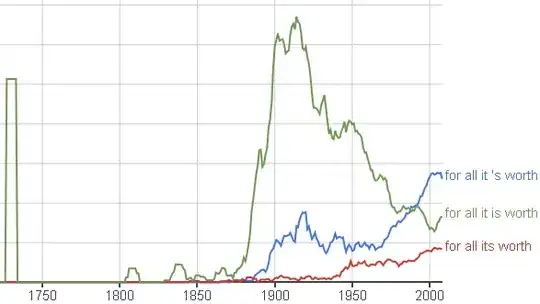
The arrival of the apostrophe as possessive indicator confused both the writer and the reader, so that today more often than not, authors do not know which is the "original idiom" and the reader is not sure what the author had meant to say.
The safest approach for writers would be to avoid the apostrophe altogether in this case and be specific, and for the reader to rely on context where needed and possible.

Kris
- 37,386
-
4Note that in the similar expression "for what it's worth", the genitive "its" doesn't work. That's a different case, but would also suggest that "all it is worth" would be more common. – Joshua Taylor Aug 14 '14 at 15:15
-
-
1That seems to be Google's Ngram Viewer. It's a very commonly used tool for any basic question of documented language usage statistics and history. – Phil Miller Aug 14 '14 at 23:03
-
Yes! I always thought it was "for all it is worth", not "for all the worth belonging to it". Your graph seems to confirm that. – Adeptus Aug 15 '14 at 04:04
-
1
-
@Adeptus: I don't think "the worth belonging to it" is an idiomatic way to paraphrase "its worth"; this isn't the "belonging to" sense of the possessive. To distinguish the noun sense of worth, how about "for all of its worth" or "for all its value"? – ruakh Aug 15 '14 at 18:24
-
Re: "The arrival of the apostrophe as possessive indicator": Are you referring to the (mis)use of it's to mean its? Or are you referring to the Early Modern adoption of -'s for the possessive clitic? Or something else? – ruakh Aug 15 '14 at 18:27
-
@ruakh Originally, the apostrophe merely stood for missing letters, as in isn't (is not) from where it evolved to include the possessive "By the 18th century, apostrophe + s was regularly used for all possessive singular forms" (Wikipedia). – Kris Aug 16 '14 at 06:05
-
@Kris: Right. I just didn't think that could be what you were referring to, since your graph shows that this idiom originated much later. (Your wording makes it sound like the arrival of the possessive apostrophe caused the idiom to become confusing in some way.) – ruakh Aug 16 '14 at 15:27
-
@ruakh I was trying to differentiate between the possessive and the abbreviation, by leaving "its/it's" out of the sentence altogether (as there is confusion when an apostrophe is used). I thought "belonging to" was the clearest & easiest way to illustrate what I was trying to say. Maybe "all the worth it has" would sound better to you? – Adeptus Aug 18 '14 at 02:22
-
6
"For all it's worth" wins in my opinion as it is more adaptable to other sentences also.
"For what it's worth" for example doesn't make sense if changed to "For what its worth". That might make one wonder "For what, its worth?"
It ultimately depends on what "it" is. Does it own the worth? Or is it simply worth the worth?

Anon343224user
- 565
5
Depending on whether there is an apostrophe, the phrase has two quite different meanings, and that is what needs to be explored further.
'For all it's worth' suggests the thing is not worth much. And what you are intending, 'for all it's worth', is a way of minimising the importance of the task.
When you 'use something for all its worth', the thing may well be, and probably is, worth a lot. For example if I am a politician and someone important says something nice about me, I might decide to refer to the matter as much as I possibly can and hence 'milk it for all its worth'.

WS2
- 64,657
-
3Do you have some references to validate the difference in meaning? To me, "milk it for all it's worth" is identical in meaning to "milk it for all its worth". – talrnu Aug 14 '14 at 14:22
-
@talrnu Yes I did think about this further. There is overlap here. You are right that those two are more or less identical in meaning. But 'it's worth' does mean 'it is worth', whereas 'its worth' is 'the worth of it'. So saying 'I would throw it away, for all it is worth' is different to saying 'I would hold on to it given the worth of it'. These sentences place quite a different value on the worth of the item in question. – WS2 Aug 14 '14 at 14:30
-
@WS2 Do you think that "for what it's worth" (where "its" is not an option) more clearly minimizes the importance of something? – Joshua Taylor Aug 14 '14 at 15:16
-
Your two contrasting examples, "I would throw it away" and "I would hold on to it," are different because of what you would do with it, not because of a distinction of "the worth it has" and "the value which it is worth." – Reinstate Monica -- notmaynard Aug 14 '14 at 15:37
-
@iamnotmaynard I was just providing instances of where I would use 'it's worth' and 'its worth'. And that is how it turned out. I can't imagine using the former for something valuable nor the latter for something trivial. But that's just me. – WS2 Aug 14 '14 at 16:24
-
@JoshuaTaylor Don't we tend to use that one where we are unsure of the worth of something - 'I tell you for what it's worth that I saw someone leaving the building with a computer under his arm'. This would mean that it could be valuable information about the suspicious disappearance of office furniture; but it might be of no importance whatever. – WS2 Aug 14 '14 at 16:29
-
It's worth noting that is you use the words "all its worth" alone (no "for"), it is easier to construct examples for WS2's clarification. So, "The new world, we took all its worth back to Spain" is an example where, as WS2 clarifies, you have to use one or the other. – Fattie Aug 15 '14 at 11:21
-
I don't think it's correct that the phrase "for all it's worth" suggests that something is not worth much, so I'm downvoting this answer as it currently is. Could you add a source indicating that people commonly use the phrase this way? – Tanner Swett Jul 17 '16 at 04:04
-
@TannerSwett Used in everyday speech, I would suggest, anywhere English is spoken. "You can take that broken-down car, for all it's worth". – WS2 Jul 20 '16 at 19:11
-
I'm a native English speaker in an English-speaking country, and I don't know if I've ever heard anyone use that phrase that way. – Tanner Swett Jul 21 '16 at 19:29
-
@TannerSwett You may find you hear it now. That is often the case after your attention is drawn to something you have not before noticed. – WS2 Jul 22 '16 at 23:46
3
I think it depends on the context. If you're referring to specific attributes of the object and its value, then you use "its". Usually these values are not defined by units like money, and are subjective. However, if you're referring to the object's overall value - for example, its value on the market - then you use "it's". However, I really do not think there is a solid rule for apostrophe use in this case, and I suppose that it is arbitrary for most.


-
1True, but the question is what was it "actually," originally, historically, and "correctly." – Kris Aug 14 '14 at 05:29
-
Yes, I agree with that too. I actually tried to answer this question on a technical basis rather than a historical one, but I do understand the importance of tradition. However, I appreciate the information you provided, and I found your answer very informative as well. This is another reason I like this site; people could share opinions and knowledge. c: – Emily Aug 14 '14 at 05:32
2
This is mostly a matter of distinguishing between having worth ("all its worth") and being worth something ("all it's worth"). I can only find subjective arguments for the value of either case over the other.

talrnu
- 5,224
-
I neglected to mention that the it's form wouldn't make sense with "of". Possibly "which", though: for all which it's worth. But this feels clumsy. – talrnu Aug 14 '14 at 14:24
-
The answer you linked specifies that "of" is optional with "all", "half", or "both". Still, including it here would help distinguish the meaning from "for all it is worth". – supercat Aug 14 '14 at 20:02
-
@supercat I think you missed the last sentence in the answer I linked to: "But you can't leave out of before the pronouns us, you, them, and it." – talrnu Aug 14 '14 at 20:04
-
1The term "pronoun" is sometimes used to refer to things that aren't nouns but are associated with pronouns (especially adjectives such as "its"). The adjective "its" is not the same thing as the pronoun "it". When used with countable nouns, "all of its Xs" has a different shade of meaning from "all its Xs"; the former applies to Xs individually, and the latter collectively. – supercat Aug 14 '14 at 20:16
-
Ah, I see I've confused possessive pronouns with possessive determiners. I'll remove the second half of my answer, as this means it's clearly incorrect. – talrnu Aug 14 '14 at 20:33
-
Incidentally, the rule requiring "of" with pronouns does apply to actual possessive pronouns (e.g. "all of hers") even though they weren't listed. The issue is probably as much one of prosody as grammar; in the phrase "all of hers", both "all" and "hers" need major stress, while in the phrase "all her books", the word "her" would be unstressed. Putting two major stressed syllables consecutively tends to create a break between them, which would be inappropriate in this context. – supercat Aug 15 '14 at 01:51
0
As others have noted....it depends.
When you use the sentence, if you can insert the word "that" ("for all that it is worth") and have it still make sense in the way that you are using it, then you need an apostrophe to contract "it is" to "it's". If the word "that" makes no sense in the way you're using your sentence, then you need to leave out the apostrophe so that you are using the possessive "its".

Ray
- 21
-
I agree, that's a good way to tell. And the its alternative would allow inserting the word "of", so depending on what you want to say:
"for all that it is worth" (contract to it's)
or
"for all of its worth" (no apostrophe)
– Reversed Engineer Aug 20 '14 at 06:30
0
As above, it depends, but WS2 brings up a good point that is probably easier to understand by replacing 'it' with 'he', namely, making the debate: "for all he's worth" vs. "for all his worth".
The former statement has the implication that "he" is not worth a lot, while the latter statement implies a sense of greater value. This may be due to the fact that the former statement implies that "he" can be converted to a pure monetary value, and has no value beyond that, while the latter statement creates a sense that "he" contains additional humanistic values that cannot be measured in monetary units, such as strength of character, intellect, wisdom, etc.
Thus, depending on the sense of worth/tone you wish to convey, you may wish to use "it's" for something of more concrete value, and "its" for something more abstract. Considering that "it" typically refers to objects that can be valued in monetary terms, and is frequently used in the context of "milking something for all it's/its worth" I would usually default to "it's" when in doubt.
