60

So I saw a post on a funny pictures site...

"In the word "Scent", is the S or the C silent?"
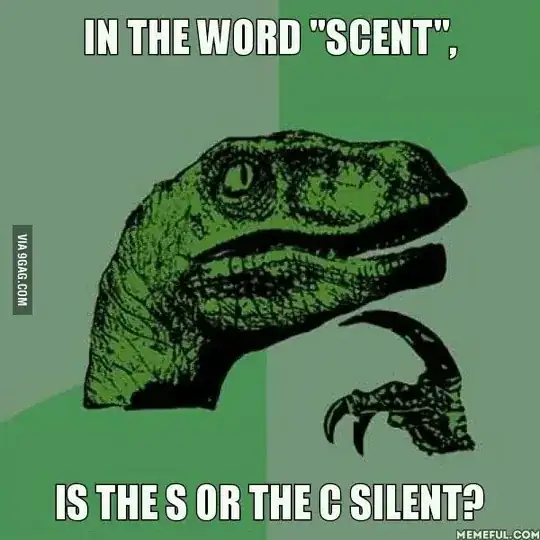
In particular, how does the pronunciation of "scent" differ from "cent" and "sent"?

Small audio references would help me in particular.

Pimgd
  • 663
  • 4
    the pair "sc" forms a sound in English. (just like, say "sh" or "ch" or "ck" or many other examples.) It's a funny poster though! – Fattie Aug 27 '14 at 11:42
  • 1
    Neither. The s is the usual, while the c is the soft-C, that's all. When was scent first used as a noun? – Kris Aug 27 '14 at 12:01
  • 23
    The only honest answer is: all letters in that word are silent. All letters in all words are silent. It's spoken language that gets written down, not written language that gets pronounced. – RegDwigнt Aug 27 '14 at 12:12
  • 4
    @RegDwigнt Feel free to edit my question to "How does the pronounciation of scent differ from sent and cent?" if you feel that "silentness" is not objective enough. – Pimgd Aug 27 '14 at 12:26
  • 5
    The referenced post is making an attempt at humor. The point is, such a question has no answer, since the distinction is meaningless. – Robusto Aug 27 '14 at 14:01
  • Yeah, like @Robusto said. In fact, both the "s" and the "c" are silent, but together they force the "e" to be pronounced with a leading sibilance. :-) :-) – Carl Witthoft Aug 27 '14 at 15:21
  • @Kris That can't be correct, because otherwise it would be a double length geminate like we find for example in guests /gess/ when the /t/ is elided. – Araucaria - Him Aug 27 '14 at 16:55
  • 3
    The problem is that you're trying to make scents out of Englisc as if it were a science and not scpelling scoup. – user3105234 Aug 27 '14 at 18:39
  • 1
    Neither. They're both pronounced. – Bob Jarvis - Слава Україні Aug 28 '14 at 02:56
  • From the Online Etymology Dictionary - "late 14c., sent "to find the scent of," from Old French sentir "to feel, smell, touch, taste; realize, perceive; make love to," from Latin sentire " to feel, perceive, sense, discern, hear, see" (see sense (n.)). Originally a hunting term. The -c- appeared 17c., perhaps by influence of ascent, descent, etc., or by influence of science". So, although my first comment is funnier, it would appear that the -c- is silent. – Bob Jarvis - Слава Україні Aug 28 '14 at 03:01
  • @Pimgd RegDwight is just being silly and there's no need to edit your question. To answer the question at the end of your post, "scent", "cent", and "sent" are all pronounced exactly the same. – JLRishe Aug 28 '14 at 06:12
  • Huh, @BobJarvis ? Etymonline doesn't seem to say "Neither. They're both pronounced." – Kris Aug 28 '14 at 06:14
  • @Araucaria It indeed is extended length, though not quite double, even as it is in science. – Kris Aug 28 '14 at 06:15

5 Answers5

57

User dawnhunter of Reddit writes in the /r/Showerthoughts/ thread called In the word "scent", is it the S or the C that is silent?:

Here's what a google search brings up:

late Middle English (denoting the sense of smell): from Old French sentir ‘perceive, smell,’ from Latin sentire . The addition of -c- (in the 17th century) is unexplained.

So the c is silent and also shouldn't really be there.

Also, further down the thread, another comment says:

The 'c' was probably added because that was the style at the time.

Originally a hunting term. The -c- appeared 17c., perhaps by influence of ascent, descent, etc., or by influence of science. This was a tendency in early Modern English, also in scythe and for a time threatening to make scite and scituate.

Stating this entry at etymonline.com as the source

Frantisek
  • 21,938
20

Speakers of the Queen's English have no trouble with this; if neither letter in "scent"were silent, it would be pronounced like the beginning of "sceptic". Actually, the C is silent, making the word (to all but Professor Higgins-level phoneticians) identical to "sent". Coincidentally, there is a funny little foreign coin, cent, that is pronounced the same way.

(I understand the question may be harder for those across the Atlantic; that is just one of the many disavantages of having left the British Empire all those years ago.)

Tim Lymington
  • 35,168
  • 2
    ... would be pronounced like the beginning of "sceptic:" why not like science? – Kris Aug 27 '14 at 12:03
  • 2
    I know how to pronounce SCIENCE! and I know that removing the c leads to a weird pronunciation where it sounds more like "see-ense". For me the answer "it's like the word science" helps me to understand it better. – Pimgd Aug 27 '14 at 12:07
  • @Kris: because science has a silent letter. That's rather the point. – Tim Lymington Aug 27 '14 at 13:13
  • 8
    @TimLymington So which letter in science is silent? :) – GalacticCowboy Aug 27 '14 at 13:16
  • Yeah but science is sci-ence right? There's a pretty clear difference between "si" and "sci", I'd say one would be like "see" and the other one like "sai". – Pimgd Aug 27 '14 at 13:28
  • 10
    "to all but Professor Higgins-level phoneticians" - oxforddictionaries.com has sɛnt for both scent and sent - is there anyone who would have these different?? – AakashM Aug 27 '14 at 13:47
  • Even accepting the notion of ‘silent letters’ (as Reg points out, all letters are really silent—there is no one-to-one correspondence between written letters and phonemes or phones in a word), this is just wrong. A c before a front vowel would not be expected to be pronounced /k/; this is only the case in a few words where the letter-to-sound correspondence is even lower than on average: sceptic, ceilidh. The default interpretion of ‹ce› is that it likely represents /se/. – Janus Bahs Jacquet Aug 27 '14 at 13:50
  • 6
    @AakashM No, no one. Scent, sent, and cent are all pronounced exactly the same in every single dialect of English that I have ever heard the words pronounced in. – Janus Bahs Jacquet Aug 27 '14 at 13:51
  • 2
    @Pimgd Science and sience (if it existed) would most likely both be pronounced the same: [ˈsɑɪəns]. ‹si› and ‹sci› and ‹ci› all default to representing /si/ or /siː/, depending on the word and the context, though it is true that only ‹si› would normally be used to represent /zi/ or /ziː/. – Janus Bahs Jacquet Aug 27 '14 at 13:53
  • 1
    @JanusBahsJacquet: I pronounce sent/scent/cent differently; the soft c is pronounced with the jaw still, lower jaw pulled in, pushing the air through the space between the teeth. The s is pronounced by sliding the lower jaw outwards while holding the tip of the tongue up towards the top of the mouth, resulting in a much softer sound. The sc in scent and science is a combination of the two (i.e., neither letter is silent). Now, maybe this is just my weird affectation, maybe it's a Canadianism, I don't know. – AmeliaBR Aug 27 '14 at 15:01
  • 1
    @Pimgd: Why do you have a problem pronouncing "sience" the same as "science"? At the risk of opening a recursive self-referential vortex, how do you pronounce "silent"? "see-lent"? Or with the first syllable (si-) rhyming with "die", "lie", "pie", and "tie" (and like "bi-" in "biannual", "binary", "biology", and "bivalve")? – Scott - Слава Україні Aug 27 '14 at 21:31
  • @Scott I don't know anymore TT_TT English is hard and I have no idea how and why my mouth produces words... at least my mouth knows. Or would that be my vocal chords? – Pimgd Aug 27 '14 at 22:07
  • 5
    @Tim: Your answer is a red herring. According to Google, "skeptic" is about 10 times as common as "sceptic"; even Stack Exchange spells it with a "k". Most words containing "sce" are pronounced "se" rather than "ske"; e.g., "scene" (and "obscene"), "abscess", "ascend"/"ascent"/"descend"/"descent", and "scepter". – Scott - Слава Україні Aug 27 '14 at 22:14
  • 6
    @AmeliaBR I suspect that is your own weird affectation. I have never seen any description of or myself heard any dialect of English that distinguished more unvoiced sibilants than /s/ and /ʃ/, and in all the words we’re discussing here, plain old /s/ is used. No difference whatsoever. Their identical pronunciation is why some words can be spelt differently with no problems in different orthographies: offence/offense, defence/defense, etc. – Janus Bahs Jacquet Aug 27 '14 at 22:25
  • 2
    @Scott, I'm pretty sure Tim's reference to "the Queen's English" was an allusion to the differences between North American (skeptic) and British (sceptic) orthography; see for example Oxford Dictionaries Online, which also lists the k version as an archaic form. Your Google search, and Stack Exchange's own usage, reflect the American spelling. – AmeliaBR Aug 28 '14 at 01:48
  • Tim, There are no silent letters in science either :) http://english.stackexchange.com/questions/193548/in-the-word-scent-is-the-s-or-the-c-silent/193552?noredirect=1#comment405093_193548 – Kris Aug 28 '14 at 06:17
  • 1
    This appears to be a weird instance of dialect-warring? I realise the coda is probably typically-British humour, but, ah, we're not all Brits here and the joke is flat. – SevenSidedDie Aug 28 '14 at 16:30
  • 1
    @SevenSidedDie A schism? http://www.oxforddictionaries.com/definition/english/schism – Frank Aug 29 '14 at 08:21
  • sceptic versus skeptic - despite being a native mumbler of the American language (such as it is :-}) even I shudder in horror at skeptic. That's Just SO Wrong! – Bob Jarvis - Слава Україні Sep 17 '14 at 15:29
3

Neither is silent.

The "s" and the "c" together make a softer "s" sound. Compared to the words "sent" and "cent", the word "scent" sounds more like "sscent."

Similar to the words "ascent" and "assent", where assent has a harder and faster sound.

  • 1
    Hmm, another Canadian who believes that sent/scent/cent are pronounced differently; perhaps it isn't just my affectation after all. That said, I'm not sure that ascent vs assent is a good comparison: that could be interpretted as the difference between a-scent and as-sent, the two separate s sounds in the second word blurring into the stronger hissing sound. – AmeliaBR Aug 28 '14 at 14:35
  • 2
    Approach a random person, speak any permutation of the phrase "Cent sent scent." (e.g. alternately "Sent scent cent."), and then ask them how the phrase is written. Do you really think they'll be able to naturally (i.e. without prefacing with a discussion about how "sc" is/might be pronounced) determine which of the three words is spelled "scent"? I'm inclined to think not. – talrnu Aug 28 '14 at 16:25
  • 2
    As Canadian who doesn't hear this difference, I condescend to dissent. Perhaps it's regional, perhaps it's a hypercorrection. :) – SevenSidedDie Aug 28 '14 at 16:26
  • @talrnu I think all the remains is for you to carry out your experiment – Code Whisperer Sep 22 '14 at 13:59
  • 2
    I think an even more telling experiment would be to take one of these people who claim to have a distinction, record them reading an extended passage which uses all the different forms a few times, extract the individual words from the passage, and ask them to identify which extracted word is which. I'd be willing to bet they'll be statistically no better than random. – nohat Oct 07 '14 at 08:44
3

Neither letter is silent. Both make the same sound /s/ And when two identical sounds are put together in the same word English, they are almost always said as if they were one sound. So we say [s] instead of [ss].

The fact that the C was added later is irrelevant, as it was likely added because it would not change the pronunciation of the word.

Silent letters in English were usually at one time pronounced (whether in English or the originating language). The P in pneumonia is silent because we don't say /pn/ at the beginning of words. The W in write is silent because we can't say /wr/.

Analyzing a letter as being silent is more of a last resort thing, what you do when no other rule of English orthography will work.

trlkly
  • 451
  • 1
    Oh, I dunno. A penknife seems to have two different (geminated) /n/ sounds in it to me. – tchrist Aug 29 '14 at 02:44
  • Some silent letters were just added in English and were never pronounced in any language; but in most cases, you're right of course. – Janus Bahs Jacquet Aug 29 '14 at 08:04
  • I confirm what @JanusBahsJacquet said. The r-wr distinction was present in Old English but I think it was gone by Middle English already. The difference was that r wasn't "rounded" while wr was. As for scent, see here. – MickG Aug 29 '14 at 08:38
  • Not all silent letters were originally pronounced. "Debt" was never pronounced /debt/; although borrowed from Old French "dette", the "b" was added (restored?) to resemble the original source word, Latin "debitum". – chepner Aug 29 '14 at 18:47
  • @tchrist Yes, it does, but it's an exception due to it being a compound word. It is not uncommon for doubled consonants to be geminated between words. – trlkly Aug 30 '14 at 20:26
  • I hope my edits have addressed all the complaints. – trlkly Aug 30 '14 at 20:30
2

"Sc" in "scent" or "science" is used as a consonant digraph (two consonant combined to make one sound); therefore, neither are silent (they are being used as a consonant digraph). "Sc" in "scare" is used as a consonant blend (two consonants combined to make two different sounds), so the two different usages can't be compared effectively.

Julie
  • 29