7

How would I talk about something that is either a laptop or a desktop, but not a smartphone or tablet? Is "computer" ok, even though technically speaking, smartphones and tablets are or contain computers?

For example, how would I say something like "If you're on a [computer], click on the arrow to see the relevant chat message"?

Golden Cuy
  • 18,154
  • 1
    Depending on your audience, "PC" would be one option. – msam Aug 29 '14 at 12:19
  • 4
    You're not looking for an antonym of "device" (a laptop is surely a device), nor even an antonym of "mobile" (a laptop surely is mobile); you're looking for an antonym of "small". But now I'm stumped. . Yes, use *computer*. – Dan Bron Aug 29 '14 at 12:19
  • 1
    @MSAM, Unfortunately, Microsoft has co-opted the term "PC" to mean "Computer running Microsoft Windows", so that "If you're on a PC" might confuse Mac users. – Dan Bron Aug 29 '14 at 12:24
  • 3
    @DanBron It might but hence the "depending on your audience part". The Microsoft part probably stems from the origin of "IBM-Compatible PC" on which the cheapest and commonest system was MS-Dos and subsequently Windows (Linux is of course cheaper but that came later). Nowadays, the hardware on Macs is also based on the same architecture so can comfortably be called "PC" in some circles and especially while differentiating between mobile and non-mobile devices. I do agree that "Computer" is also enough on its own in some circumstances. – msam Aug 29 '14 at 12:36
  • Dan, good grief! We're not addressing an audience of literally 80+ year olds, heh :) everyone knows "pc" or "desktop" just means "not a mobile" – Fattie Aug 29 '14 at 12:57
  • 1
    @Joe: I also associate PC with Windows and I am well under 80. – Brian J Mar 14 '17 at 12:20
  • @DanBron it was actually the IBM PC compatible market that appropriated the PC acronym to specifically refer to IBM-compatible personal computers. Prior to that, I believe that they were called IBM PCs. I don't believe Microsoft, who made DOS and Windows, had anything to do with this. – Jeff Axelrod Nov 13 '21 at 16:05

7 Answers7

12

I would suggest computer (in agreement with Dan Bron's comment).

You're not trying to win a medal for ontology, you're trying to point people in the right direction. Laptops and Desktops are commonly called computers, those other devices are not.

This would be strengthened by adding a contrasting reference to something like mobile device, mobile, or phone nearby. (For example saying how such things are not available from mobile devices or are available elsewhere).

I think using these terminologies would minimise genuine confusion at the slight expense of annoying pedants who could think of counterexamples (You are actually assisting these people as well, in satisfying their need to find examples with which to demonstrate their linguistic superiority to others).

Dan
  • 4,554
  • 17
  • 36
  • I've no idea how old you are Joe, but I'm no spring chicken either. Yes, "phone" or "mobile" will do as well. It might exclude tablets, etc, but not cause any genuine confusion. Do you mind if I edit my answer to agree with you, and doing so maybe take some of the rhetorical force out of your comment? – Dan Aug 29 '14 at 13:05
  • (Dan - you surely don't have to ask ME to edit anything man! The key thing in your answer is that you'd be mentioning this in contrast to the other term nearby which makes the phrase self-evident. incredibly for such a simple question, notice I bothered to make a screen shot which clears this up, in my answer.) – Fattie Aug 29 '14 at 13:19
  • Thanks, done! I didn't want to be seen as some terrible idea-stealing revisionist, :-). Didn't see you had an answer as well: upped it. – Dan Aug 29 '14 at 13:24
7

You're question is unclear, but you probably mean Desktop

The ubiquitous formulation is "this dotcom works on both Desktop or Mobile!" or "We have apps for Desktop and Mobile!"


Another formulation (if for some reason you don't want to say what everyone else does, "desktop or mobile") is just "For Mac/Windows, or, Mobile". So you can use "Mac/Windows".


Just regarding "desktop". Not unreasonably, DB has pointed out that, say, 295 years ago, people referred separately to "Lap-Tops" :)

Don't forget - if I tell you "this [whatever] is for a desktop", then of course, obviously, that same software or hardware also runs on a "Lap-Top".

So again, it's totally normal to say "Desktop or Mobile" and this would be why you can find a million goole hits for that, including, it's the language google's ad agency uses
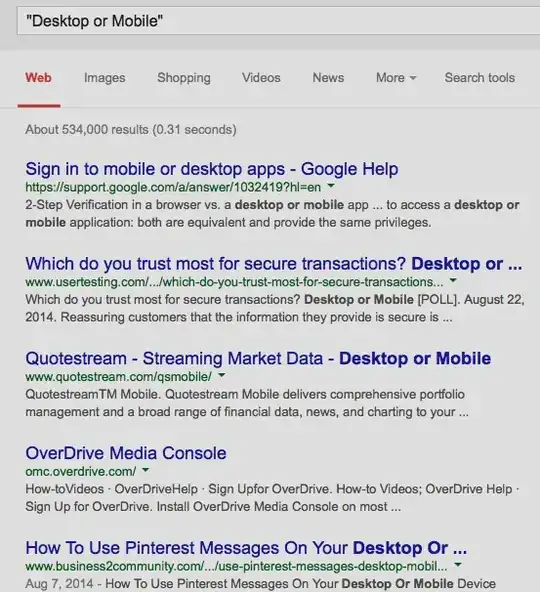
enter image description here


And finally here's a link to the all time classic

SHROVIS-BISHOPTHORPE Envaliant III

sequence, since you may have misplaced yours.

http://achewood.com/index.php?date=04012008

enter image description here

Fattie
  • 10,520
  • 1
    The term has to cover laptops as well as desktops. – Dan Bron Aug 29 '14 at 12:53
  • 1
    Right, it does. (there are no "desktops" any more, only macbooks which are desktops. iMacs and Macbooks are desktop devices; iphones and androids are mobile devices.) You can see a zillion examples of this use commercially. – Fattie Aug 29 '14 at 12:55
  • 1
    I have a Lenovo ThinkPad X1 Celeron. If you can find a quote from Lenovo describing that model as a desktop, I'll give you a +1. Though nice dual in using "desktop" *adjectively; perhaps you should make your answer "desktop device" as an antonym to "mobile device", rather than the noun desktop*. Maybe that's worth a +1 too. – Dan Bron Aug 29 '14 at 13:01
  • 1
    Dan, like I say note that the 18 million times you have seen a sentence "this [product/software/etc] is for desktops", you have understood that you can use the [product/software/etc] on that pc. Indeed, if the text had said "You can use this web site on your desktop -- or laptop!!" you'd think the writer was an Idiot :) – Fattie Aug 29 '14 at 13:18
  • 1
    That comic is hilarious. – Dan Bron Aug 29 '14 at 13:19
  • 1
    Dan - I am SO PLEASED you had not seen it before!! Wait till you read through the whole thing. I gotta go work on my own EnvaliantIII cheers men – Fattie Aug 29 '14 at 13:20
  • 2
    This is elegant, but desktop in this sense is more rightly understood as a paradigm or metaphor (the desktop paradigm). If we're talking about devices, it's not quite right—a notebook is not a type of desktop computer. Further, some tablets fall under the desktop paradigm, since they run desktop operating systems: for some time now a few tablets have run Linux; and now quite a few Surface tablets run Windows. So this nomenclature more a question of the OS than the form factor, for most purposes. Still, it's usually the right term. – Mathieu K. Mar 13 '17 at 04:44
  • 1
    Hi @MathieuK. - it's difficult for hardware engineers like you and me to realize how much the actual world has moved on. Regarding actual, normal humans it is utterly inconceivable they would have any interest in the staggeringly subtle differences between concepts like "laptop" "laptop touch convertible whatever" "desk-top" "tower" "all in one" and so on. Note that indeed young people literally do not understand, and have utterly concern about, the distinction between "a monitor" and "a computer". Heh! You can safely just say "desktop" (ie "NOT A PHONE") for consumers. – Fattie Mar 13 '17 at 13:48
3

Your best bet is "computer" or "PC". Laptops and desktops are understood to be computers or PCs. People don't usually think of smart-phones and tablets as "computers".

+1 @DanBron

Of course, you and I know that all mobile devices contain computers (CPUs), but then so do microwave ovens, TVs and cars.

1

One way could be to call it a real computer. Example usage in this comment by tchrist. If you google search for real computer, you will find more usages of this meaning. In particular when in contrast with tablets or smartphones, chances are people will understand what you mean.

gerrit
  • 2,263
1

In C# in depth, Jon Skeet uses the phrase "full computer", when contrasting against mobile phones:

The idea of a whole runtime executing Intermediate Language (IL) via the JavaScript engine in a browser, not only on full computers but also on mobile phones, would’ve struck me as absurd just a few years ago.

Golden Cuy
  • 18,154
0

Size has lost relevance since computers have shrunk and all-in-ones have become available. The tech community now considers PC as a "smart device" with a mouse/keyboard, and a mobile device as a "smart device" without a mouse/keyboard. or with the mouse/keyboard disconnected.

  • How "smart"? It's not about having a keyboard & mouse, but all about POWER BABY! Processor power, RAM, hard-drive storage. Cell-phones and tablets are in a much lower class than desktops or PCs, with microwave ovens below that. It's like comparing a 4X4, a scooter, and a bicycle. You can still ride across America on a scooter (or bicycle!), but you can't climb any mountains. To run AutoCAD : Desktop / Computer / PC (4X4). To email and IM with your friends : Mobile device (scooter). To turn on magnetron for a specified cooking time: Non-mobile device (bicycle). – Reversed Engineer Aug 31 '14 at 08:21
  • Laptops are also in the 4X4 / computer / PC / desktop class. The "lap" part no longer really means your lap. My cat is more of a "laptop" than my laptop. – Reversed Engineer Aug 31 '14 at 08:28
0

Since a smartphone or tablet can be referred to as "a handheld," how about a non-handheld?

If you're on a non-handheld, click on the arrow to see the relevant chat message.

listeneva
  • 1,447