17

In the office, we've been having a discussion about the grammar in a sentence and have differing opinions about what is right and what is wrong... It is a very minor issue but is still bugging me :)

The sentence in question is:

A wide range of features is available.

Which sounds more natural to me if it is written as:

A wide range of features are available.

The justification for it is that the "is" is referring to the "wide range of features" as a whole rather than just the "features".

I was just about getting used to it when I decided to substitute a different word instead of "features". I just can't get my head around something like:

A wide range of sausages is available.

Further to this, if I substitute "a wide range of" with "various" then it has to be are.

Which one is right?

Edit: Thanks for all of the responses. I didn't expect to open up such a can of worms but now I understand the technicalities. I still prefer are in this case though :)

RegDwigнt
  • 97,231
  • 1
  • 1
    It's not so much a can of worms as a hardy perennial that manifests in a wide range of forms. The standard one being the majority. – FumbleFingers Apr 04 '11 at 18:55
  • Here's a case from real life - in an article I'm editing right now: "Successful marketing is a complex system of tasks that includes planning, positioning, implementation, and tracking." Is there really an argument here for "include" in this case? – The Raven Apr 04 '11 at 20:21
  • @The Raven: Successful marketing should also include good writing, and in that context it really is "the less, the better". So I'd replace ...of tasks that includes... with ...covering.... Not my own coinage, but "Perfection isn't when there's nothing left to add, it's when there's nothing left to take away". – FumbleFingers Apr 04 '11 at 22:44
  • Define your terms, as Voltaire said. Assuming Hutus and Tutsis have different native languages, many will thus have a 'second language'. There must have been dire situations where speaking exactly as the other tribe actually do would be infinitely more 'right' than following their grammar and syntax rules to the letter. – FumbleFingers Apr 04 '11 at 23:37
  • @FumbleF: You can always rewrite your way out of almost any problem. I prefer not to stomp on my authors overmuch. Just thought I'd share with you a case of the problem in question as it exists in the wild. – The Raven Apr 05 '11 at 00:40
  • 3
    Collective noun phrases in English can be morphologically singular but syntactically plural. They can also be syntactically singular. Both ways are grammatical! Anyone who tells you collective noun phrases must take singular verbs is just wrong about the facts of how English grammar works. – nohat Apr 09 '11 at 00:52
  • 1
    The verb depends on context. "A wide range of features is* necessary for the product to be popular." "A wide range of features are available to choose from."* – Peter Shor Nov 21 '12 at 23:05
  • @nohat This (and Peter's follow-on comment, with the tag 'logical concord') should be a mandatory warning on the front cover of every grammar. – Edwin Ashworth Sep 11 '14 at 17:08
  • A 'fix' in this particular instance is to restrict the usage of range of to notionally continuous domains of a single concept such as temperature or price. We have other, better words for discreet sets, diverse sets (such as features) and spans over multiple variables. – Phil Sweet Jun 10 '18 at 12:31

10 Answers10

15

“A wide range of features is available” is more ‘technically correct’ according to traditional prescriptive grammar, and arguably more logical.

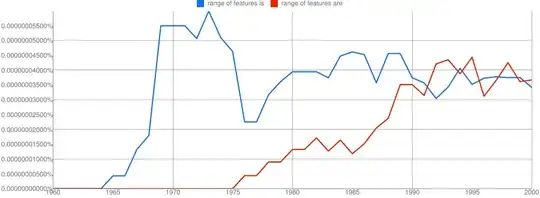
Both forms are completely idiomatically acceptable, though; Google n-grams suggests that as of the 90’s, they were roughly equally common:

enter image description here

That shows just this specific example, which appears only in recent decades, but there are a host of other similar constructions, going back for centuries, and in many levels of writing, not just casual speech. So well-informed modern grammars agree, both forms are completely correct; go with whatever you feel flows best!

Edit: Actually, in contexts like yours, are is probably rather more common than that graph might suggest. Looking more closely, of the results for “range of features is”, quite a lot are in contexts like “The range of features is typically quite large…”, where “are” wouldn’t make sense — the predicate unambiguously applies to the range, not to the individual features. I can’t think of a corpus search that would weed out such cases; on a very rough perusal of Google Books results, I’d guesstimate that in contexts like yours where either is idiomatic (eg “…a remarkable range of features is/are visible…”), the are form is maybe about twice as common as the is. (Thanks to @FumbleFingers for pointing this out in comments.)

Edit: as comments on other answers show, the two versions aren’t always interchangeable; one can certainly come up with examples where only one or the other is idiomatic. But in this specific example, both are quite fine, as the n-grams search above and more in-depth searching along similar lines illustrate.

PLL
  • 20,575
  • 3
  • 50
  • 103
  • 1
    This Ngram may be a bit misleading. The viewer currently limits number of words in a search term to 5, making it difficult to see exactly how the variants get used. A quick glance through some actual texts suggests is occurs most often where the noun is just "The range", often with focus on exactly that noun. Where the focus is actually the manifold features, are seems to predominate. – FumbleFingers Apr 04 '11 at 17:30
  • @FumbleFingers: excellent point, thankyou. Will update the answer to reflect it! – PLL Apr 04 '11 at 18:12
4

I can't go with the mavens on this one. By strict rules of grammar it's obviously right to say is is correct. But I'm sure we all know that nearly everyone uses are in this context without giving it a second thought. And of the one's that don't, I bet many do so with misgivings.

So it really depends on your definition of 'right'. Assuming we're not interested in any moral overtones of righteousness, I would say it's 'right' in linguistic terms to fall into line with the overwhelmingly more prevalent usage. On the grounds that language itself couldn't really work as a means of communication if we didn't normally honour that principle.

FumbleFingers
  • 140,184
  • 45
  • 294
  • 517
  • 2
    -1 for polemic argument. Subject-verb agreement is predicated on logic rather than a weak arbitrary convention (like split infinitives, for instance), and just because something is conventional does not make it appropriate. It is pretextual to assume that "nearly everyone" ignores proper subject-verb agreement in speech. In fact, I'm apt to assume that one is ignorant or undereducated when I read or hear s-v disagreement, which I admit is equally pretextual but probably more accurate. – HaL Apr 04 '11 at 15:52
  • 2
    +1 for non-prescriptiveness. The number of times we point out that dictionaries follow usage not the other way around, you'd think that we would take the point more easily about grammar as well. –  Apr 04 '11 at 16:53
  • 1
    @Hal: I do agree with with your position in the general case, and I certainly don't think an 'illogical' violation of clearly-defined grammar automatically becomes 'right' just because, say, 60% of speakers use it. It just seems to me this is one of those rare exceptions where not only is the 'illogical' usage overwhelmingly more common - I also believe that many speakers actually consider and reject the 'correct' form. And to paraphrase Mrs T - you can't buck the majority indefinitely. Anyway, let's not drag this one out. I concede. – FumbleFingers Apr 04 '11 at 17:06
  • In writing, it's simple enough to follow the grammatical rule. With regard to spoken English, I strongly doubt that a person speaking the phrase in question consciously evaluates "is," then rejects it favor of "are." Rather, from a linguistic standpoint, the speaker selects a verb based on the proximity of the nearest noun, all things being equal. This is surely happening at a deep-structure level. Curiously, I'd imagine that a foreign learner would be less likely to miss the mark. – The Raven Apr 04 '11 at 21:02
  • @The Raven: I quite agree the proximity and 'plurality' of the nearest noun are usually crucial in a speaker's choice of verb form. I may have muddied the waters a bit there because I tend to say "speaker" and "utterance" even when I'm also (or even, only) talking about written language. I just hope nobody points out that should be "...I tend to write..." – FumbleFingers Apr 04 '11 at 23:03
2

The verb should match the noun without the prepositional phrase. In this case, drop "of features" and you have "A wide range is/are available." Since range is singular, you would go with is, not are.

Kevin
  • 7,900
  • 3
    Why should you drop "of features"? Why not "A wide range of"? Contrived reasoning is contrived. – RegDwigнt Apr 04 '11 at 15:00
  • 2
    Don't blame me, I didn't come up with the rules, contrived though they may be. You drop the "of features" because it is a prepositional phrase. – Kevin Apr 04 '11 at 15:25
  • 1
    @Kevin: Except when you don't. "A lot of people has been here lately" — does this sound correct to you? – Kosmonaut Apr 04 '11 at 15:44
  • @Kosmonaut, no but it doesn't sound right without the the prepositional phrase either. "A lot has been here lately" vs "A lot have been here lately" – Kevin Apr 04 '11 at 16:03
  • 1
    Aggressive aren't we? @RegDwight Obviously you wouldn't drop "a wide range" because the resulting sentence, "Features are available." isn't very useful. Kevin was simply demonstrating why dropping the prepositional phrase will make the s-v disagreement more apparent, not suggesting that you do so to rewrite the sentence. @Kosmonaut See above. Why not say "many" or "several" people instead? Providing a poor example in a zealous attempt to prove a point is not helpful either. – HaL Apr 04 '11 at 16:06
  • @Kosmonaut: that's a bit of a fallacious example, as "a lot of" is used as a plural in case of countable nouns (such as your example) but singular in case of uncountable, such as "A lot of water is on the floor". – nico Apr 04 '11 at 16:06
  • 1
    @Kevin: "Do many Italians visit your city?" — "Yes, a lot have been here lately." Now try that with has, I dare you. – RegDwigнt Apr 04 '11 at 16:08
  • 1
    @HaL: "Features are available." is not any less useful than "A wide range is available." – RegDwigнt Apr 04 '11 at 16:11
  • @nico: It is a perfectly apt example. It shows that the rule is not absolute and simple. It is actually complex and context-dependent. Why don't we replace "a lot" with "a large number". Does "a large number of people is here" sound good to you? – Kosmonaut Apr 04 '11 at 16:11
  • @RegDwight You're missing the point, buddy. :) – HaL Apr 04 '11 at 16:13
  • @nico: precisely. And features are neither singular nor uncountable. – RegDwigнt Apr 04 '11 at 16:14
  • @HaL: How so? I am directly responding to your claim that "Features are available" isn't very useful, which you prove by boldly stating that it's "obvious". Well, it isn't obvious to me, sorry. If I am missing your point, then please clearly state what your point is, for dummies like me. Thank you. – RegDwigнt Apr 04 '11 at 16:18
  • 4
    @RegDwight: features is not the subject of the sentence, range is. – nico Apr 04 '11 at 16:19
  • "A lot" is a strange phrase because it looks singular but in many cases is plural. I would probably have to go with nico and say it depends on its use. If you are using it with countable objects then I would say it would be synonymous with "several" and conjugate it accordingly. If you are using it with something uncountable, then I would conjugate it as if it were singular. – Kevin Apr 04 '11 at 16:19
  • 1
    @Kevin: That is my point, and @RegDwight's point, and it contradicts the logic of your answer. "A lot" is not the only phrase where this is possible either — there are a range of phrases like this: "a number of", "a ton of", and so on. So the question is: "is a wide range of one of these phrases?" – Kosmonaut Apr 04 '11 at 16:20
  • @Kosmonaut, I think you might have changed my mind. I would probably say that yes, it it one of those phrases and would go with are, especially in verbal communication. Although I wouldn't judge harshly either way. However, I bet "are" would still be graded as "incorrect" on most English term papers. – Kevin Apr 04 '11 at 16:30
  • 4
    @nico: on paper, to you and me, yes. In practice, to millions of native-speaker brains, quite obviously no. If native speakers all around the world happily produce "a wide range of X are" every single day without even noticing, you can't call it ungrammatical. Much rather, it's called notional agreement, and is an extremely common and well-documented feature of English. – RegDwigнt Apr 04 '11 at 16:32
  • 1
    @RegDwight: You may call it "common usage" and claim that it is acceptable as such, to which I will not object (although I am of slightly different opinion, but that's not the point). However, it remains ungrammatical. We cannot change the rules of grammar just because many people can't recognize the subject of a sentence. Otherwise we should also start using its and it's interchangeably... – nico Apr 04 '11 at 17:07
  • 1
    @nico: the thing is that "common usage" is precisely where "the rules of grammar" come from in the first place. The rules of grammar are not carved in stone anywhere. It's native speakers' brains that get to decide what those rules are. If those brains collectively decide that they don't care about whom vs who, grammatical genders, or certain inflectional suffixes, then all these things fall overboard. If they stop parsing a prepositional phrase as a prepositional phrase, then it stops being a prepositional phrase. If they regard "a lot of cars" as plural, then that's what you get. – RegDwigнt Apr 04 '11 at 18:00
  • 1
    @nico: We actually can and do change the rules of grammar quite often. The grammar of today differs from the grammar of 50 years ago, which differs from the grammar of 100 years ago. Even the formal prescriptive rules of grammar do not remain static over long periods of time (let alone the linguistic grammar we use in day-to-day interactions). That said, I would be surprised to find a prescriptive grammar that doesn't allow for "a lot of" and many other similar constructions to take plural agreement. Why should this one not fall into that category? – Kosmonaut Apr 04 '11 at 21:00
  • @nico We do use its and it’s completely interchangeably, because they sound exactly the same when spoken. How we write them is nothing to do with grammar—it’s pure orthography, which is orthogonal to grammaticality. A couple of hundred years ago, people did in fact quite frequently write it’s for the determiner/pronoun. That’s a problem not at all comparable to this question. – Janus Bahs Jacquet Oct 10 '14 at 16:40
1

As others note, the correct form is:

"a wide range of features is available"

Some speakers will use "are" here due to the proximity of "features" to the verb. That is an error (and an extremely common one). The subject of the sentence is "range," which is singular and thus takes a singular verb.

The Raven
  • 12,593
  • 5
    "Correct" in the odd sense of "what the self-appointed pundits say but nothing to do with the English that almost everybody speaks". – Colin Fine Apr 04 '11 at 14:43
  • 3
    @Colin this is English Language and Usage - Stack Exchange. A person seeking a correct answer should be provided with one. "Well, X is incorrect, but everybody does it so you should do it too" is a poor way of answering the OP's question. – The Raven Apr 04 '11 at 15:11
  • 4
    The point is that this "correctness" has a somewhat arbitrary justification and doesn't match usage, which makes its actual correctness rather less certain than you are making out. –  Apr 04 '11 at 15:45
  • 5
    @Raven: And I think a person seeking a correct answer should be gently advised that "correct" is not a single-valued function. If they are writing a formal report, they'd better know and stick to what the style guides say. If they're just talking English, they're better using it the way almost everybody else does. What I hate is people perpetuating this horrible and destructive idea that "I do it but it's wrong". I don't expect that everybody will agree with me. – Colin Fine Apr 04 '11 at 16:43
  • And in view of PLL's answer, I'd better modify my "almost everybody" to "many people". – Colin Fine Apr 04 '11 at 16:51
  • 1
    Just because lots of people make an error that doesn't make it correct. Unfortunately the quality of grammar and language teaching in schools is dramatically going down (everywhere in the world). I have read reports written by university students that were written with style and grammar that I would not accept even from first year high school students. Not being able to recognize the subject of a sentence is an important error and should be corrected, especially when the error is so evident, as in this example. – nico Apr 04 '11 at 23:19
  • @nico Interestingly, the human race and its languages got by just fine for tens of thousands of years without anyone even having the vaguest idea what a grammatical subject is, much less the ability to recognise one. Written language is one thing—it’s far more strictly codified and a lot more prescriptive than spoken language will ever be—but spoken language evolves and develops all the time, whether you want it to or not. When everyone makes the same error in speech, it is no longer an error. It’s only an error to you, because it differs from your own idiolectal grammar. – Janus Bahs Jacquet Oct 10 '14 at 16:48
  • @Janus interestingly the human race got by for thousands of years doing many stupid things, but that doesn't make them right... I do not have a problem with people not following grammar rules, however I like to follow them as much as I can. And yes I will correct people if I think they are wrong, even if it is just my opinion, what's wrong with that? – nico Oct 10 '14 at 16:53
  • 2
    @nico Only the fact that it means you consider your own personal grammar to be superior to other people’s, which to many (myself included) would be quite a presumptuous and offensive assumption to make. If I had ‘corrected’ the lack of a subjunctive in the paenultimate clause in your comment, would you not have taken issue with that as an improper correction? After all, everyone says, “even if it is” perfectly naturally. Well, in my grammar, that’s just an error, and I will correct you for not adhering to my grammar. Sorry, but that’s not how language works. – Janus Bahs Jacquet Oct 10 '14 at 16:57
  • Also, allow me to rephrase my point about the human race not knowing their subjects: human languages did not suffer from lack of human understanding of grammar at all, and they still don’t. Being able to identify the subject in a sentence is irrelevant to using the grammar of a given language correctly, and even those who are very much able to identify subjects cannot escape the gradual changes in grammar that happen all the time. Language instruction in schools are neither the cause of, nor to blame for, this. – Janus Bahs Jacquet Oct 10 '14 at 16:59
  • So, I am presumptuous, that is fine with me, as long as you don't mix it's and its... And, yes you are right on the subjunctive, it slipped through, it happens (but it's wrong). – nico Oct 10 '14 at 17:01
1

The correct sentence would read:

A wide range of features is available.

This is because the verb must modify the subject of the sentence. Removing the prepositional phrase of features makes this rule more apparent:

A wide range is available.

HaL
  • 8,876
1

'is' would be the correct choice for this sentence as, like your colleagues say, the word 'range' is the head word and it is singular.

You have here a Noun Phrase, the words before the head (a wide) being pre-modifiers and the words after it (of features) being post modifiers.

A noun phrase is a group of words that represent one noun; the head word could stand alone in the sentence as a noun, structurally speaking. Therefore, any other elements of the sentence are applied to this head and not the rest of the phrase.

range is...

a wide range of features is...

Karl
  • 6,526
  • This is over-simplistic. Notional agreement is rarely considered unacceptable per se nowadays. Thus 'The majority were in favour'; 'The team were arguing among themselves' are acceptable. Here, one must analyse whether one wants to emphasise the set/number involved or the individual members. Either singular or plural agreement may be used. 'A wide range of' is intermediate between a compound quantifier and a collective noun. This choice would not be available with 'A lack of features was ...' or 'A score of features were ...'. – Edwin Ashworth Oct 28 '15 at 09:26
1

Without wanting to get too many bum splinters, I think the honest answer is that both are correct. It depends on whether the subject of the sentence is the range or the features.

Put another, consider what is actually available. Is it a single range that people can elect to have or have not? Is it a selection of features, from which people can choose as many as they desire?

If it is the former, I would suggest that range is your subject and you should use is.

If it is the latter - if you could replace

A wide range of...

with

Numerous...

then you should use are.

With this specific example, I would lean towards are, since it's unlikely that it's a single range that people can have or have not. However, the general question of subject/verb agreement with regards to plural phrases is not as simple as some answers would suggest.

If in doubt, there will invariably be an alternative phrasing that makes the answer obvious. Just go with that one instead.

Dancrumb
  • 5,080
0

The first step in solving a subject/verb agreement question is to determine the subject of the sentence. In doing so, remember this rule: The subject of a sentence never appears in a prepositional phrase (in this case, of [the preposition] features [the object of the preposition]).

So, in this case, the subject of the sentence is range. Range is singular, and it calls for a singular verb:

A wide range of features is available.

0

"A vast/wide range of" is the head phrase, with range as the head word. plus,look at the letter "A". As you have correctly mentioned in your description in your statement of the problem, the head phrase is considered as a whole and simply we have to use the singular form of the verb.

Sajjad
  • 309
-2

Morphologically "a lot of" is singular, but syntactically we all know it is plural. That is just one example.

  • Syntactically, what number a lot of is is irrelevant. Notionally or semantically, it can be either singular or plural, depending on the notional head noun. In any case, this question is about a (wide) range of, not a lot of. – Janus Bahs Jacquet Oct 10 '14 at 16:43
  • "A" is a morphological marker, and we all know it is for singular things. – Frank Burns Oct 10 '14 at 16:48
  • Which is why your first point (that a lot of is morphologically singular) is perfectly fine. Morphology does not have to follow semantics, however. – Janus Bahs Jacquet Oct 10 '14 at 16:50
  • Yes, morphologically singular, AND it takes a plural verb. And this is pertinent, as it points out another case where a morphologically singular expression is considered as a syntactic plural. "Lot" means a set, and is very similar to "range". The aim is to point out a case of singular morphology with a plural verb that everyone can agree with, so that all can see that there is always the possibility of singular/plural consistency. As Jesperson liked to say, "English common sense trumps pedantic nonsense." – Frank Burns Oct 10 '14 at 17:09
  • It may be pertinent (it is—that’s why it’s been mentioned in comments to other answers, too), but it is not an answer in and of itself. It’s more of a comment. It would have to be fleshed out and made relevant to a (wide) range of in order to be an actual answer. – Janus Bahs Jacquet Oct 10 '14 at 17:14
  • Well you like a real know it all, so why don't you just post the "actual" answer and be done with it? Instead of policing what you call pertinent but incomplete comments. – Frank Burns Oct 10 '14 at 17:44