21

Is there a standard adjective or term which classifies "questions with a known, single, unambiguous, objective, and correct answer"?

That is, questions like "2+2=?" or "What is the capital of Ohio?", as opposed to questions like "Who's the best band of all time?" or "What is human nature?".

If you wanted to describe the kinds of questions StackExchange welcomes and encourages in as few words as possible (ideally two: adjective + "questions"), what would you say?

PLEASE: No philosophical debates about whether "objectivity" is possible or a meaningful concept, or the infinite possible interpretations of "2+2"; for the sake of answering this question, assume objectivity and correctness are meaningful and achievable goals.

Dan Bron
  • 28,335
  • 17
  • 99
  • 138
  • 10
    Unclosable. :) – tchrist Sep 02 '14 at 02:16
  • 2
    What's wrong with objective (which you use in your question)? – Jim Sep 02 '14 at 02:20
  • 1
    Straightforward, perhaps? That probably would include a question like "Who's the best band?" though. – user0721090601 Sep 02 '14 at 02:21
  • 2
    @Jim, it doesn't imply "known". A question can be "objective", but still open to debate ("can general relatively and quantum mechanics be reconciled"?) – Dan Bron Sep 02 '14 at 02:22
  • 1
    Ah. Good point. – Jim Sep 02 '14 at 02:25
  • 1
    The problem with known is "known by whom?". Even a question with a known answer can be debated at length until the person with the proof shows up. And the asker has no way of knowing whether that person exists or not. – Jim Sep 02 '14 at 03:49
  • +1 I strongly suspect there's a single unique term for this. Can't recall right away, though. – Kris Sep 02 '14 at 04:49
  • We call it "bullshit" because, whether or not something is a "factual question" is a matter of opinion -- err, this is extra- of your italic caveat at the end, sorry :) – Fattie Sep 02 '14 at 08:34
  • @Dan dude -- do you mean QUESTIONS ON THIS SITE, or are you just asking about "questions" in general, in the universe? Cheers – Fattie Sep 02 '14 at 08:35
  • @Joe, I mean questions in general, out there in the universe (of which SE is a part). – Dan Bron Sep 02 '14 at 10:36
  • "Who's the best band of all time?" is a bad example! It does have a known, single, unambiguous, objective, and correct answer. It's just that many people refuse to accept it. – oerkelens Sep 02 '14 at 13:12
  • Verifiable perhaps? – Araucaria - Him Sep 02 '14 at 15:27
  • 1
    @tchrist, While an amusing response, unclosable SE questions would have to also be on-topic, and perhaps some other conditions depending on the site. For example, SO questions need to show at least some effort to reach a conclusion before asking, and Skeptics.SE questions need to show that the question is notable. [/wet blanket] – Brian S Sep 02 '14 at 18:24
  • Ohio has moved its capital four times to three different towns, so one of your examples of a 'known answer' has an ambiguity in its answer. – Oldcat Sep 03 '14 at 01:22

10 Answers10

28

It is called a factual question. Because the answer is a fact rather than a subjective opinion.

factual

Concerned with what is actually the case rather than interpretations of or reactions to it: a mixture of comment and factual information

[oxforddictionaries]

An explanation of factual question from the book "Spoken Language Understanding: Systems for Extracting Semantic Information from Speech" By Gokhan Tur, Renato De Mori:

The simplest and most frequent question type is a factual question. These questions are questions for which the answer can be a single word or a multi-word expression, often is a named entity. An example question is: Who is the French president?

Another explanation of factual question from the book "Principles of Research Design in the Social Sciences" By Frank Bechhofer, Lindsay Paterson:

When discussing the design of individual questions, it is quite useful to have a basic distinction in our mind between factual questions and opinion questions. An example of a factual question is:

How much wine did you consume last week?

By 'factual' is meant not whether the answer is factual - is true - but rather whether there is in principle a true answer. So the example does have a single true answer, however intrinsically difficult it might to find out what that is.

Lastly, the below excerpt explains the difference between factual and nonfactual question (from the book "Applied Survey Methods: A Statistical Perspective" By Jelke Bethlehem):

Kalton and Schuman (1982) distinguish factual and nonfactual questions.

Factual questions are asked to obtain information about facts or behavior. There is always an individual true value.

The fact to be measured by a factual question must be precisely defined. It has been shown that even a small difference in the question text may lead to a substantially different answer.

Nonfactual questions ask about attitudes or opinions. With opinion and attitudes, there is no such thing as a true value.


There is also a question type called answered question which is considered to have a definite answer. [It is mentioned under philosophic questioning on http://www.uri.edu/personal/szunjic/philos/whystudy.htm]

"Those questions that are already capable of definite answers are placed in the sciences, while those only to which, at present, no definite answers can be given, remain to form the residue which is called philosophy." Thus philosophic questions can turn into scientific truths as soon as they are answered. In other words, many scientifically established truths have started as philosophic questions, but once they received definite answers they get moved to the realm of science.

ermanen
  • 62,797
  • This may be the best you can do with a single word: "factual." The only thing it doesn't necessarily cover from the original question is that the answer is known; it is possible to ask a factual question whose answer nobody yet has found out. – David K Sep 02 '14 at 04:07
  • 1
    We don't have to look only to the social sciences; the hard sciences (physics, chemistry, biology) and especially mathematics have plenty of factual questions, and the really interesting thing is that even in mathematics we don't know all the answers yet. I still stand by your answer to this question (of opinion) as the best. – David K Sep 02 '14 at 04:22
  • Short, clear, universally understood word, and well-argued, well-researched and supported answer. +1. I'm going to wait a while to see if anyone comes up with an answer which additionally covers "known" or "matter of record"; if that doesn't happen today, you'll get a ✓ as well. – Dan Bron Sep 02 '14 at 10:39
  • @DanBron: Factual questions generally have known answers. There might be some exceptions because it might be hard to measure the value to give an answer and this is usually a scientific fact :) – ermanen Sep 02 '14 at 14:15
  • I'm not convinced. Goldbach's conjecture poses a factual question (it's literally either "yes", every even integer greater than 2 can be expressed as the sum of two primes, or "no", it cannot, and here's a counterexample), but it remains unresolved. Similarly, courts concern themselves with factual questions (did Dan steal the crown jewels, or not?), but those questions are open while being argued, and in many cases remain unresolved. Last night it came to me that we might call such questions "settled", but I was waiting to see if anyone else suggested that or synonyms other than me. – Dan Bron Sep 02 '14 at 14:25
  • @DanBron: I think it is called "Question of Fact" in law. There might be a better adjective but the generally accepted question type for what you are asking is a factual question. – ermanen Sep 02 '14 at 14:38
  • @DanBron, Ermanen, Is Does God exist a factual question? If so is that kind of question one that you'd include in your with a known, single, unambiguous, objective, and correct answer definition Dan? It seems to me that it might have a definitive answer (I don't know it!), but it isn't known in the sense that we know that 2+2=4 ... – Araucaria - Him Sep 02 '14 at 15:33
  • In short, no (because it's metaphysical and quite possible the question is unresolvable; it may have an answer, but that doesn't matter if the answer is inaccessible.) It certainly isn't known. – Dan Bron Sep 02 '14 at 15:34
  • @Araucaria: It is a part of philosophic questioning so it is a philosophical question. It is mentioned as an insoluble question in this source also: http://www.uri.edu/personal/szunjic/philos/whystudy.htm – ermanen Sep 02 '14 at 15:42
  • @DanBron: In philosophic questioning, there is also a question type called "answered questions" defined as ""Those questions that are already capable of definite answers are placed in the sciences, while those only to which, at present, no definite answers can be given, remain to form the residue which is called philosophy." http://www.uri.edu/personal/szunjic/philos/whystudy.htm – ermanen Sep 02 '14 at 15:43
  • @Eramen, please add that information to your answer (potentially with some synonyms for "answered"?), and I'll accept it. – Dan Bron Sep 02 '14 at 16:00
  • @DanBron: Ok added. I will edit the question if I come up with any synonyms. – ermanen Sep 02 '14 at 16:49
5

There is a concept in mathematics similar to this, where a question can be described as well-posed.

Loosely speaking, a question is well-posed if (1) a solution to it exists and (2) is unique. In its original use by Hadamard there was a third technical caveat, but the term now gets used widely in the above sense.

RossXV
  • 51
3

Questions like

"2+2=?" or "What is the capital of Ohio?

are normally described as
General Knowledge

General knowledge has been defined in differential psychology as "culturally valued knowledge communicated by a range of non-specialist media" and encompassing a wide subject range. This definition excludes highly specialized learning that can only be obtained with extensive training and information confined to a single medium.
Wikipedia

or General Reference

General Reference questions are questions that can be fully answered with a single link to a place that is specifically designed to provide the information in the question. These sources include online dictionaries [also thesauruses] or etymology sites.
Writing Good ‘Meaning’ Questions EL&U Community Blog

or Literal Questions

Literal questions ask for answers that are specific and can be confirmed and therefore agreed upon by many people. Examples include: "What time does the concert start?" "What size do you wear?" "What references did you use to write your paper?" and "What do two and two total?
What are Literal & Inferential Questions? eHow.com

Mental Floss offers thirty quiz-type questions, which cover

• biology: What part of the body produces insulin? • physics: What chemical element is diamond made of? • literature: Who wrote 'The Scarlet Letter'? • geography: Name a US state beginning with K. • television: Who did Matthew Perry play in 'Friends'? • animation: What type of animal is Bambi? • vocabulary: What is the name of the 'tool' needed to play snooker or billiards to hit the ball? etc.

These questions have two things in common:

  1. There is only one correct answer.
  2. They do not require expert knowledge.

Nowadays, the answers to these type of questions are easily found on the Internet, you don't need to know the answers. But for exams, and quiz shows such as Jeopardy, individuals must have this type of knowledge at their fingertips. Jeopardy offers a twist inasmuch as contestants are first given the answers to which they must supply the questions.

General knowledge/reference questions are unsuitable for the SE format, precisely because it is an online Q&A website. The SE model would cease to exist if every question only had one correct answer. It's precisely because there isn't one clear-cut answer that many users post a question. They are ‘lost’ in a labyrinth of over-information and contradictory explanations.

As a reminder, the questions listed above, all conform to the criteria asked by the OP

questions with a known, single, unambiguous, objective, and correct answer

Take for example this type question, which could be found on EL&U:
What is the name of the 'tool' needed to play snooker or billiards to hit the ball?

It's a good description, easily understood, and it has one clear unequivocal answer in English. But is it a good fit for the SE model? No, it isn't. Because if you don't already know the answer, you can find out just by searching the terms snooker and billiards and visiting the corresponding Wikipedia pages. All that is required is a bit of research (if you don't already know the answer), and speed to be among the first to post an answer.

The ideal questions on EL&U are those which encourage the best explanations. But even that doesn't necessarily equate with being high-level.

Take for instance this simple question: What is the name of a small unluxurious restaurant?. Despite it being a general knowledge/reference/literal question there isn't one correct answer. In fact eighteen answers were posted and with the exception of one, all of them have been upvoted, which means there are at least 17 possible answers to that single question. The top three answers earned more than fifty upvotes each, which surely suggests that there are at least three ‘correct’ answers. The top answer has so far received 113 upvotes, which according to the SE model, makes it the best.

In answer to the OP's final request

If you wanted to describe the kinds of questions StackExchange welcomes and encourages in as few words as possible (ideally two: adjective + "questions"), what would you say?

I would suggest: stimulating questions, the “why” questions whose answers you cannot find in one single resource, questions that teeter perilously on the POB (primarily opinion-based) edge. Yet SE would probably prefer convergent questions, I think it typifies the SE model.

Convergent Questions

A convergent question by its nature has a more narrowly defined correct answer – the answer is generally short, requires little reflection and requires that the responded recall from memory a bit of factual information. Convergent questions may also be referred to as “closed-ended” questions, meaning that the instructor is looking for an anticipated response that requires little original thought on the student’s part. Convergent questions will not require students to put original thought to the development of an answer. In other words, the answer will have been provided within the context of the lecture or readings assigned by the instructor.
Asking More effective Questions
William F. McComas and Linda Abraham

Wikipedia has this to say on convergent thinking

Convergent thinking is the type of thinking that focuses on coming up with the single, well-established answer to a problem. It is oriented toward deriving the single best, or most often correct answer to a question. Convergent thinking emphasizes speed, accuracy, and logic and focuses on recognizing the familiar, reapplying techniques, and accumulating stored information. It is most effective in situations where an answer readily exists and simply needs to be either recalled or worked out through decision making strategies. A critical aspect of convergent thinking is that it leads to a single best answer, leaving no room for ambiguity. In this view, answers are either right or wrong.

Here's a diagram that illustrates the concept.
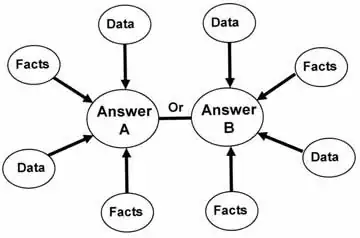
enter image description here

A third source defines convergent questions as:

Answers to these types of questions are usually within a very finite range of acceptable accuracy. These may be at several different levels of cognition — comprehension, application, analysis, or ones where the answerer makes inferences or conjectures based on personal awareness, or on material read, presented or known.
Five Basic Types of Questions Leslie Owen Wilson, Ed. D

The latter appears to be a duplicate of The University of New South Wales website article UNSW What is questioning? The irony is that Wilson placed this symbol © next to his name, suggesting he is the intellectual proprietor. Who copied whom I don't know, so in fairness I shall post both sources.

Mari-Lou A
  • 91,183
2

I suggest 'definitively answerable'.

Erik Kowal
  • 26,806
  • Yeah, a lot of the ideas / suggestions I've had describe the answers (e.g. "uncontestable", "not open to debate"), but I was hoping for a word or term which describes the questions which elicit / require such answers. – Dan Bron Sep 02 '14 at 02:41
  • @DanBron: It might well be that the best way to describe a question is to describe its possible correct answers. An answer is "not open to debate" only if it answers a question that doesn't have any other reasonable answers. – John Y Sep 02 '14 at 02:59
  • Sure, it might well be so; that's what this question is specifically seeking to determine. That is to say, if the answer to this question is "foo", the question itself is "foo". If there is no single, objective, correct answer to this question ... well, then, it isn't. – Dan Bron Sep 02 '14 at 03:03
1

I would call it a resolvable question.

resolve

  • Settle or find a solution to (a problem or contentious matter). Source: Oxford Dictionary

  • To find an answer or solution to (something) : to settle or solve (something). Source: Merriam-Webster

Edit: I changed my answer from resolved question to resolvable question because I think it better describes a question that might not have been answered yet in the current context, e.g. on StackExchange, despite the fact that it does have a known answer.

peatb
  • 111
0

While I have seen unequivocal as a descriptor of answers, I suppose the OP is looking for unequivocal questions. The questions would be strong, clear, unquestionable, and leaving no doubt. (Curious thought, that: an unquestionable question.)

If it would survive Stackoverflow, the question would have to be

(However, judging from this forum and its siblings, it seems that the questions that garner the highest attention and rank do have some ambiguity, are subjective, and attract competing answers, of which several may be correct. Look for the soft-question tag or questions that have been closed despite many votes.)

rajah9
  • 16,242
0

If this term is for describing SE/ELU questions, there may need to be a nontrivial condition for questions closed as General Reference. (Relevance may be an issue too.)

If so I like substantive. Oxford Dictionary defines it thus:

Having a firm basis in reality and therefore important, meaningful, or considerable

A lot of the definitions I see in Merriam-Webster are qualities that good questions have:

important, real, or meaningful

supported by facts or logic

having substance : involving matters of major or practical importance to all concerned

For maximum effectiveness, substantive may need to be used in a different way than adjective + "questions". One I've thought about is "questions that solicit substantive answers." Perhaps then uniqueness could be captured through:

belonging to the substance of a thing : ESSENTIAL

Substantive question(s), according to Google nGrams, is a recognized expression but used less than factual question(s).

Two other substant- words I considered were substantial or substantiable.

0

A phrase I've heard when the answer is known and unchangeable is "given" (sometimes preceded by "a"; i.e., "It's a given that 2+2=4", or "It's given that the capital of France is Paris".

Brian
  • 335
0

Questions which have "a definite, known answer?"

"Definite" is rather explicit, being "clearly defined or determined." "Known" implies not only solved, but the tone is such as leans away from "esoteric."

"Definite and known," is nailed down on a post, a post that anyone can go and look at, considering today's easy access to information. It is not nebulous or debatable, as the meaning and weight of words like "consensus" are.

Rather than saying "superfluous," which depends on one's point of view and ken, I will say that we can call such questions "common knowledge."

Yes, I know- we are looking for what to call the questions... but if you ask me if the sun is hot or cold, let us be friendly, and agree that the information you seek is common knowledge.

-1

Leading Question. Used in court in cross examination in order to force specific answers from witnesses or suspects.

Jeff74
  • 1