14

This summer I went to Ireland, to be more precise Dublin. Overall good weather and good fun. Anyway, while I was staying in Dublin I'd buy the local newspaper and one tabloid headline caught my eye.
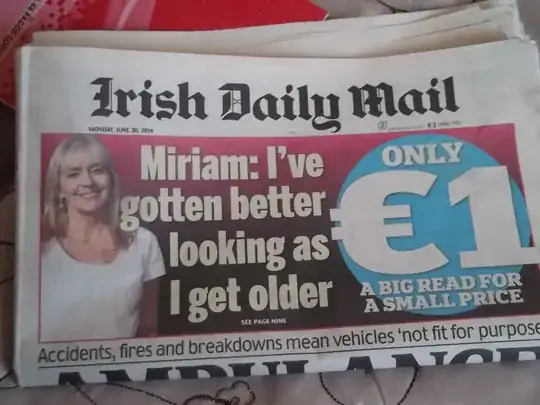
Issue of the Irish Daily Mail from Monday, June 30, 2014, folded in half. Banner image has three columns, first is a picture of a woman, second is the text "Miriam: I've gotten better looking as I get older see page nine", third is the text "only €1 a big read for a small price". The third's background is a baby blue circle. The whole banner image has a gradient background going from red to black. Below the banner image is a by line: Accidents, fires and breakdowns mean vehicles 'not fit for purpose'. The main headline is below the fold.

Now I've thought long and hard before posting this question because I don't want to know or hear that sentence is correct if it's spoken by a native speaker. Tell me it's dialectal, tell me it's peculiar to Irish (Is Miriam an Irish speaker? I don't know any more because I've thrown out the rag), tell me that it's American English "slang" which has caught on in the UK and in Ireland. But more than anything else, please tell me if that statement is grammatical.

If it had been me, I would have said:

I've become better-looking as I've got older

or at a stretch

I'm better-looking as I get older

I prefer the hyphen in better-looking, am I mistaken? Is this punctuation symbol superfluous? Isn't gotten AmEng? In BrEng the conjugation of the verb get is get, got, got but wiktionary tells me that gotten is archaic British English. I can't pinpoint why that headline bothers me so much, but it does. Can someone explain if this sentence is grammatical/ungrammatical and why?

Thank you.


EDIT

Some users have commented the dissonance of different tenses used in the statement. The present perfect I've gotten, with the present simple I get older.

Perhaps the present perfect continuous I've been getting older would be more appropriate because it expresses an action that began in the past but is still in progress. Whereas the present perfect I've gotten better-looking might be "perfect" for describing an action that began in the past whose results are felt in the present. All of which leads me to conclude that the following sentence is more grammatically acceptable

I've got better-looking as I've been getting older.


EDIT TWO

On EL&U today I saw this question pop up: Differences between "I have got" and "I have gotten" The highest voted answer says

In general, "have got" is the present perfect form of "to get" in UK English, while "have gotten" is the US English version.

While a second contributor quoting from The Cambridge Encyclopedia of English Language wrote

Gotten is probably the most distinctive of all the AmE/BrE grammatical differences, but British people who try to use it often get it wrong.

It is not simply an alternative for have got. Gotten is used in such contexts as

They've gotten a new boat. (= obtain)
They've gotten interested. (= become)
He's gotten off the chair. (= moved)

It appears to me the headline in The Irish Daily Mail clearly conflicts with both these claims.


EDIT THREE
As correctly pointed out in @fdb's answer "I do not know why you think that Ireland is part of Britain." I made a serious mistake in my second edit and title, Ireland has been a republic since 1922. The six Northern counties in the north east of Ireland who chose to remain in the United Kingdom of Great Britain and Northern Ireland are British.

But because I am no longer resident in the United Kingdom, I was surprised by the Irish headline. As a child I don't think I ever said gotten but I was conscious of it being American and to me it was "slang". If gotten is currently used in Ireland, an island which is only 496 Km from England, and American English is omnipresent, it seems likely that "gotten" should be part of the BrEng vernacular. If that is the case...

When did "gotten" re-enter the BrEng vernacular?

Mari-Lou A
  • 91,183
  • 1
    Wouldn't it be I've become better-looking as I've gotten older – mplungjan Oct 03 '14 at 08:35
  • @mplungjan you tell me! I don't normally say gotten it's not in my genetic make-up but I recognize its legitimacy. :) – Mari-Lou A Oct 03 '14 at 08:44
  • I am not native, but it flows better to my ears – mplungjan Oct 03 '14 at 08:45
  • 1
    I'm not using the terms I think are too broad-brush, but I'm sure that many in Britain vastly prefer 'got' (colloquial for 'become') to 'gotten', where the situation is reversed in the US. That apart, the headline mixes tenses direly. – Edwin Ashworth Oct 03 '14 at 08:46
  • 'As I get older, I get wiser.' [Don't quote me on that.] No; I think it can be punchy if not used too often. 'As I've aged, I've become more pulchritudinous' [Again, don't quote me on that] perhaps wouldn't be considered suitable for a headline (in the Irish Daily Mail or elsewhere). – Edwin Ashworth Oct 03 '14 at 08:55
  • Yes, it is grammatical in some Englishes, in particular all (AFAIK) varieties of American English. It is not grammatical in most British varieties (or, I think, Irish varieties), but it is possible there are some where it is. – Colin Fine Oct 03 '14 at 13:33
  • 1
    I’m not convinced that gotten is so non-British in this context. To me, this particular sense of get (sense 32 in the OED, meaning ‘become [adjective]’) actually requires gotten as its past participle, both in AmE and BrE, and it’s definitely something I’ve regularly heard from native BrE speakers. “I’ve gotten so much better since last time” is perfectly natural to me, where “I’ve got so much better since last time” is at least borderline ungrammatical. (The tense mismatch in the tabloid headline is ungrammatical to me, though.) – Janus Bahs Jacquet Oct 03 '14 at 19:07
  • 1
    Wiktionary says that gotten is used in Ireland, Northern Britain, and North America. I'd say that this is evidence that they're right. – Peter Shor Oct 12 '14 at 00:09
  • 1
    @Mari-LouA Erm, since when is Irish English the British vernacular? Is that like James Joyce the Welsh author? ;) – Araucaria - Him Oct 12 '14 at 04:49
  • @Araucaria fine, I get it. But nobody said anything the three times I updated this question. If it was such a glaring mistake I'm sure (knowing one particular user) it would have been pointed. It's easier to mock when someone has already pointed out the incongruity. The credit belongs to fdb. Note too that I also mention American English, dialects, "peculiar to Irish" and it's clearly stated I went to Ireland. Your comment "Erm, since when is Irish English the British vernacular? Is that like James Joyce the Welsh author? ;) " only serves to rub in the salt. Thanks. Very helpful. – Mari-Lou A Oct 12 '14 at 05:48
  • P.S. I have not upvoted nor downvoted any one answer, I will wait until the bounty ends before doing so. – Mari-Lou A Oct 12 '14 at 06:09
  • @Mari-LouA Sorry, that wasn't meant to be a stinging criticism, just a tongue-in-cheekish observation. Hope you noted the winky emoticon!!! To be honest I hadn't reread the contents! or any fdb's post. You could just use British Isles vernacular in your title, perhaps?? – Araucaria - Him Oct 12 '14 at 12:52
  • @Araucaria too late. Tchrist suggested Insular English which I thought needed an explanation as I've never heard of it before. Yours is clearer, but I've recently edited my question, and it's losing enough focus. But That was a good tip. Thank you! Note that in my bounty question I mention BrEng, so, logically, I can't change my title. – Mari-Lou A Oct 12 '14 at 12:59
  • The headline is quoting the (off-the cuff) remarks by Miriam. Presumably, Miriam has gotten better. – Elliott Frisch Oct 15 '14 at 19:33
  • 1
    gotten is very natural in AusEng too. I can't imagine how you'd speak without it. – curiousdannii Oct 17 '14 at 08:44
  • Please note in American English the difference between these two: "I've got a house." ("I currently possess a house, and have had it for an unspecified length of time.") "I've gotten a house." ("I recently acquired a house.") – bubbleking Oct 21 '15 at 16:03
  • Personally I would have said "I've gotten better looking as I've gotten older." – bubbleking Oct 21 '15 at 16:06

7 Answers7

11

Gotten is not slang in the US.
Gotten is the normal past participle of get, for certain uses of get; and got is the normal past participle, for other uses of get. There are an awful lot of idioms and constructions with get.

This post on the difference between the grammar of got and gotten in American English dates
from about 1995 or so. It's one of the most popular things on my website; it gets 8 kilohits a month.

John Lawler
  • 107,887
  • 1
    Oh, and I have nothing at all to say about its use outside the USA. – John Lawler Oct 11 '14 at 23:26
  • I have no idea whatever when it appeared in the UK. I do know that David Crystal's remarks on it seem to indicate that it's been around for a long time, since Americans use it in TV and movies, as well as when speaking English to the English. It seems to have been around as one of the funny features of the American accent for quite a long time. Of course, since Brits don't really know the rule -- and rarely intuit it correctly -- it seems rather bizarre to them, but it's just one irregular verb form, like shined/shone, dived/dove, etc. – John Lawler Oct 17 '14 at 16:58
6

There are several possible problems, but most of them are matters of style rather than grammar.

Get rather than become could be considered unimaginative or ugly, but I suspect those who think it so are haunted by the ghost of an English teacher inculcating rules rather than commonsense: personally I get older every day, and would never say become older.

As I get older cannot be justified in that position - grammatically. The sub-editor who composed the strapline may have been in a hurry, or it may be a deliberate mistake. Do not forget that headlines are not, in most cases, required to do anything other than grab your attention -if the journalist knew that his error had caused a discussion like this (and possibly somebody taking the trouble to try and find the original story), he would consider it a job well done.

Better-looking would normally be hyphenated, but again that is subject to journalistic requirements; space is at a premium in headlines, and the omission does no harm.

Gotten for got is the interesting part. Gotten is certainly archaic, and several dictionaries call it "especially U.S."; but it's not wrong. The best reason why it is used here is the rhythm; the three trochees of gotten better-looking sound better and are more memorable than I get or I've got, and certainly better than the dreadful (but grammatically correct) I have got. Whether that was a deliberate decision by the writer I know not. If Miriam is an actor, it may well be a verbatim quote; nobody knows better the value of memorable wording.

Tim Lymington
  • 35,168
  • 1
    So you would write/say As I get older, I've gotten better-looking? Which I think expresses the idea of a woman becoming increasingly more attractive as the years pass by, but I still find "I've gotten better-looking" to be distasteful whereas I've got better-looking...? sounds more agreeable to my ear. – Mari-Lou A Oct 03 '14 at 11:12
  • In the U.S., gotten and got have different meanings, and got would be wrong there. – Peter Shor Oct 03 '14 at 12:00
  • 2
    As Peter said, here in the US, gotten is not archaic, and would be not only permissible but expected in this context. So, to my ear, gotten is no problem; by contrast, I find thr dissonance in tenses between "I [have] gotten older" and "I [am] get[ting] better looking" quite jarring. I would have phrased this as "As I've gotten older, I've [also] gotten better looking" or "As I get older, I [also] get better looking", but mixing the two seems weird to me. – Dan Bron Oct 03 '14 at 12:07
  • @DanBron: I rather agree (as I said), but I'm not a headline-writer. – Tim Lymington Oct 03 '14 at 14:18
  • In the end, your answer is the most complete. Sorry I was late. – Mari-Lou A Oct 20 '14 at 12:21
  • "I get older", in my opinion, is 'uglier' (your choice of word, not mine) than "I become older". Otherwise, I agree with you that "I have got" is correct. – Agi Hammerthief Aug 30 '15 at 19:20
6

In relation to your question:

Is Miriam an Irish speaker?

The Miriam in question is Miriam O'Callaghan, a current affairs and chat show presenter on TV and radio. She may be able to speak Irish but she doesn't speak it on on TV or radio and she is definitely not a native Irish speaker.

please tell me if that statement is grammatical.

This has been more than adequately covered in previous answers, and you've alluded to these answers in your edits to the question, but if I may just offer an additional observation (you did ask for personal opinions), I think the two parts of the sentence should agree, either:

I've got better-looking as I've got older

or

I've gotten better-looking as I've gotten older.

As an Irish person living in Ireland, in my experience usage of gotten is pretty common here. It would not be unusual to hear a person say something like "I've gotten..."

In relation to the specific example from the Daily Mail, I agree with @TimLymington's answer. The most likely explanation for this usage is that the sub-editor was in a hurry or stuck for space.

Frank H.
  • 3,285
3

If Miriam O'Callaghan had only had the presence of mind to be quoted as saying "I've grown better-looking with age", a tremendous number of electrons would not have had to suffer a futile and inglorious death.

Erik Kowal
  • 26,806
  • 1
    After a week's stay in hospital, I needed a laugh. – Mari-Lou A Oct 20 '14 at 12:19
  • 1
    @Mari-LouA - I that case, I'm glad to have been able to provide it. (I must admit, I did wonder why 'the system' had decided on the winner of your challenge instead of you!) Anyway, I hope you'll soon be back to your normal Kris-challenging ways. :) – Erik Kowal Oct 20 '14 at 14:23
1

As of 2003, gotten was not approved for general British literary use by the Oxford University Press. Here is the relevant entry in The Oxford Dictionary for Writers and Editors, a book that constitutes roughly half of The Oxford Style Manual (2003):

gotten past part. of get; use got except in the common expression 'ill-gotten gain', and in US

I should note that in the United States, the plural form "ill-gotten gains" is somewhat more common than the singular form—though the same may also be true in the UK.

In U.S. English, of course, we say "The cotton's gotten rotten" without batting an eye.

As for "better looking," it doesn't take a hyphen in normal U.S. English publishing style nor (I believe) in normal British English publishing style when it follows the verb. You'd have to recast the headline as "Better-Looking Miriam Boasts of Age-Related Pulchritude" or something like that to justify a hyphen under the guidelines laid down by most major style guides.


Update: With regard to got vs. gotten, this answer is limited to citing Oxford University Press's style preference as of 2003. I don't know what, if any, influence OUP's recommendations have in the Republic of Ireland, and I don't have access to any home-grown Irish English style guides for further consultation. The original question asked whether gotten was now acceptable in British English usage; hence the focus of my answer. If it seems irrelevant now, I will happily delete it; it was never more than a minor observation anyway.

Sven Yargs
  • 163,267
  • Margaret Tatcher: “I don’t know anybody who has gotten to the top without hard work.” – Peter Oct 12 '14 at 13:47
  • For what it’s worth, the Oxford University house style (p. 14) has a hyphen in better-looking (“In an adjectival phrase including a verb participle”). The Daily Mail house style, if it even exists, seems impossible to locate by Googling, which prefers instead to illuminate me on what styles various celebrities’ houses are decorated in … – Janus Bahs Jacquet Oct 12 '14 at 16:58
  • @Janus Bahs Jacquet: Very interesting—I appreciate the citation. Here's the treatment in The Oxford Guide to Style (2003, at 5.10.1): "Compound modifiers that follow a noun usually do not need hyphens: [relevant examples] the outline is well drawn, the hand is blood red, the records are not up to date." It appears that Oxford is a bit more ambivalent on this point than I had imagined. – Sven Yargs Oct 12 '14 at 17:20
  • If I'm not mistaken, the OGS is from Oxford University Press (which generally adheres to the CMOS), whereas my link was for the university itself. OUP is not really a part of the university anymore, and they differ on many things. – Janus Bahs Jacquet Oct 12 '14 at 17:22
  • On top of which (not surprisingly), the U.S. branch of OUP—which I used to do freelance copyediting for, many years ago—has its own style guide independent of the UK mothership OUP's style guide. – Sven Yargs Oct 12 '14 at 19:04
0

Gotten was in use since America was colonized by the English and well before that in fact. The term fell out of use for the British over the centuries while the colonies continued to use it. So, while gotten is no longer common in BrEng, it's still perfectly valid as it's of British origin.

From the third part of King Henry VI by Shakespeare:

Oxford, how haps it, in this smooth discourse,

You told not how Henry the Sixth hath lost

All that which Henry Fifth had gotten?

Methinks these peers of France should smile at that.

But for the rest, you tell a pedigree

Of threescore and two years; a silly time

To make prescription for a kingdom's worth.

Anthony
  • 419
-2

I do not know why you think that Ireland is part of Britain. The Irish Daily Mail does not reflect British English. The answer to your "when..." question is: "Never". As to your other comments: compound adjectives like "better looking" are written with a hyphen if they are used as attributes, but without if they are used as predicates. So in this case "better-looking" would be wrong.

fdb
  • 5,541
  • 1
    Actually Ireland was never part of Great Britain, though it was part of the United Kingdom. Irish people speak Irish English and are very proud of it. I would not recommend that you tell any Irish person that he or she speaks British English; you might very well come to harm. – fdb Oct 11 '14 at 15:42
  • OK. United Kingdom, my mistake. Of course, calling an Irishman or woman English would be unwise, but I don't think anyone would object if I said they spoke English. Irish, the language, is spoken by very few people within Ireland. As to your "never" that is a very bold statement. So, is gotten completely foreign in BrEng? (I might consider modifying the title and the 2nd edit after your keen observation) I have to think it over. – Mari-Lou A Oct 11 '14 at 16:01
  • I'm not sure what you are saying. Can you elaborate? Are you speaking for British English when you say 'never'? Are you saying it is OK in Irish English? – Mitch Oct 11 '14 at 16:21
  • @Mari-LouA One can collectively refer to the many Englishes spoken natively on the various British Isles as Insular English to distinguish those versions from, say, North-American English or Antipodean English. However, those who forget the connection between insulae and insular might take umbrage with the notion. :) – tchrist Oct 11 '14 at 17:01
  • @Mitch: I am merely responding to the question: "gotten" has not "reentered" British English, so it not correct to ask "when" it did so. I do not know whether it is used in Irish English. Perhaps an Irish contributor could comment on that one. – fdb Oct 11 '14 at 18:09
  • fdb: Then you should make that part of your answer. As it stands your answer is mostly good only as a comment. – Mitch Oct 11 '14 at 21:03
  • I've left the title unchanged but added a 3rd edit. You might want to consider editing your answer. – Mari-Lou A Oct 12 '14 at 12:02
  • -1 for the last sentence. Compound adjectives made up of adjective + present participle more commonly hyphenated than not, whether attributive or predicate. A target is quick-moving more than quick moving; a person is good-looking more than good looking (unless he is doing well while looking for someone); etc. Some style guides advocate opening the compounds when predicative, but not doing so is certainly not wrong in general. – Janus Bahs Jacquet Oct 12 '14 at 16:42