26

IOU stands for I owe you and we pronounce each letter separately. But how do we classify that construction"?

  • abbreviation: a shortened form of a word or phrase
  • acronym: an abbreviation formed from the initial letters of other words and pronounced as a word
  • Initialism: an abbreviation consisting of initial letters pronounced separately
  • back-formation: a word that is formed from an existing word which looks as though it is a derivative, typically by removal of a suffix

All definitions provided by Oxford Dictionaries Online

It can't be an abbreviation because there is no shortening, clipping or back-formation. Take for example phone which is an abbreviation of telephone, or edit which is a back-formation of editorship and editor. I would argue that abbreviations are words that have been shortened, a faster way of writing or saying something. Another example would be Prof for professor.

It can't be an acronym because we don't pronounce IOU as one word, whereas we do with NATO and RAM.

It can't be an initialism because if it was, it should be written as IOY (I Owe You)

Other examples that spring to mind is CU for see you and YRU for why are you, where initialism would dictate that the proper forms be SY and WAY.

How do linguists define this structure? Is there a more specific term than abbreviation?

tchrist
  • 134,759
Mari-Lou A
  • 91,183
  • 4
    I think you might want to use a broader definition of abbreviation. Wikipedia defines it as a shortening by any method. This could include phonetic. – Canis Lupus Oct 23 '14 at 06:45
  • 2
    great question ... you know, it's like an EARLY ("pre phone!")VERSION of "text spelling". Which is quite amazing. – Fattie Oct 23 '14 at 06:58
  • 2
    you know, it's rather like "OK" in a way. in a category of its own. – Fattie Oct 23 '14 at 07:20
  • @JoeBlow OK standing for okay or all correct (whatever) etc. I'm also tempted to think it is a separate category. Be nice to have an "official" answer, if poss. – Mari-Lou A Oct 23 '14 at 07:23
  • ("okay" was only backformed from "OK" I believe - as you know the origin of OK {which, apparently, is the single most understood word in all languages on the entire planet -- how cool is that?} are shrouded in mystery; but (like IOU) it's simply "not" a real abbreviation, it's kind of a whacky "text-message-spelling" thing. Anyways - I don't know :) – Fattie Oct 23 '14 at 07:43
  • And IOU is much older than text messaging. – Mari-Lou A Oct 23 '14 at 07:45
  • I think the issue here is more on phonetics rather than writing! –  Oct 23 '14 at 07:56
  • I'd say that technically it's a phonetic initialism. Not that it slapping a label on it makes one whit of difference to the world. – Hot Licks Oct 23 '14 at 11:45
  • @JoeBlow - Obviously, "OK" is a shortened form of "okey-dokey". ;) – Hot Licks Oct 23 '14 at 11:45
  • An onomatopoeia? – jxh Oct 23 '14 at 13:02
  • 2
    Just wait till you get to QT for cutey, EZ for easy, or B̄Q̄ for barbecue: trust me, it’s all downhill from there.:) Especially once you include digits, so B4 for before, B9 for benign, 1K for wonky, W8 for wait, and much much worse, like somebody getting IR8 cause their partner was 2S9 & 4GO2 say 10Q after 4N6, losing out on a chance 2 4NK8 L8R. :) That’s Y 4N XL8Rs ❤ EZ words — & H8 2C ÞE words 2XL8 like μC4S. – tchrist Oct 23 '14 at 14:32
  • 1
    @tchrist "Okay, I know what that means...yeah, I've heard that...wait, hold on, that seems a little forced...but—but—...I don't... what ..." [head explodes] – Justin Greer Oct 23 '14 at 14:47
  • 1
    @tchrist - Anyone who knows anything knows that barbecue is abbreviated "BBQ". – Hot Licks Oct 23 '14 at 14:55
  • @tchrist "like someone getting irate cause their partner was tosnine (?!) and forgot to say thank you after phone sex, losing out on a chance to fornicate later..." and I'm too tired to work out the rest... – Mari-Lou A Oct 23 '14 at 15:45
  • 2
    @Mari-LouA Too asinine. – tchrist Oct 23 '14 at 15:56
  • @tchrist nice 1 – Mari-Lou A Oct 23 '14 at 15:59
  • @tchrist: "That's why foreign translators love easy words—and hate to see the(?) words to translate like (mucus?)" (Why is xl8 "translate"?) – Justin Greer Oct 23 '14 at 16:03
  • 1
    @JustinGreer Hate to see thorny words like muciferous. – tchrist Oct 23 '14 at 17:36
  • Reminds me of how long it took me to figure out the cleverness behind the chat program named ICQ. – Nathanus Oct 23 '14 at 17:39
  • I was about to add an elipsis to the title until I realised you posted it M-L; this allows the spot-on neologism answer. – Edwin Ashworth Oct 07 '20 at 14:04

4 Answers4

17

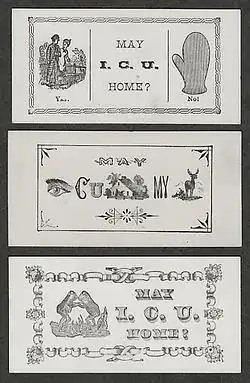
It could be characterized as a rebus

a riddle or puzzle made up of letters, pictures, or symbols whose names sound like the parts or syllables of a word or phrase [Merriam-Webster]

While a rebus often contains images, letters being used to represent syllables is common.

rebus card

[Wikipedia]

In particular, the Encyclopaedia Britannica states

Literary rebuses use letters, numbers, musical notes, or specially placed words to make sentences. Complex rebuses combine pictures and letters. Rebuses may convey direct meanings, especially to inform or instruct illiterate people; or they may deliberately conceal meanings, to inform only the initiated or to puzzle and amuse.

....

A familiar English rebus is the debtor’s “IOU,” for “I owe you.”

If you wanted to be more precise in defining it, you could say alphabetic rebus.

bib
  • 72,782
  • 1
    Interesting idea, but aren't rebuses supposed to be solved? IOU doesn't need to be deciphered. – Mari-Lou A Oct 23 '14 at 12:02
  • 4
    Actually, for those unfamilar with the term (those who arrive in a space ship, or time travellers from the past, or maybe new English speakers) it does have to be puzzled out. You can't pronounce it phonetically. You kind of have to read it aloud, like an initialism, to get it. – bib Oct 23 '14 at 12:26
  • Not my downvote! I think the concept is novel (to me in any case). Could you find anything else about it? Linguistically speaking is it a used term? – Mari-Lou A Oct 23 '14 at 12:29
  • "Literary rebuses use letters, numbers, musical notes, or specially placed words to make sentences." – Mari-Lou A Oct 23 '14 at 13:53
  • Ian Rankin includes a very good example of such a thing in one of his Inspector Rebus novels. " (can't remember the first line).. A Q I C I 8 2 Q B 4 I P" Never knew that rebus was the word for them though. – user1725145 Oct 23 '14 at 14:16
  • I think you should add that quote I posted, tchrist's usage of letters and numbers e.g. "4GO2 say" really do make my head spin, they are, for all intents and purposes riddles/puzzles. – Mari-Lou A Oct 23 '14 at 16:49
  • @Mari-LouA Non verbis sed rebus shall ye know them. :) – tchrist Oct 23 '14 at 17:49
  • @Mari-LouA With a lot of the recent rebuses in chat-speak, anyone not familiar with the solutions will have to look them up or infer them from the letters and / or context. IOU is a very common puzzle, where the solution is widely distributed; however, it is still something that has "the need to decipher", from my dealings with English as a second language speakers and first grade children. The core set of English rules provide nothing to the meaning without some additional puzzle solving via phonetic association. – Edwin Buck Oct 23 '14 at 19:32
16

I think it is a phonetic abbreviation in the sense that IOU represents the (phonetics) sound of “I Owe You”, not its proper initials, similar to CU for “see you”. (From The American Heritage® Dictionary of the English Language)

  • The act or product of shortening.
  • A shortened form of a word or phrase used chiefly in writing to represent the complete form, such as Mass. for Massachusetts or USMC for United States Marine Corps.

IOU: (from Investopedia)

  • An informal document that acknowledges a debt owed. IOU is an abbreviation, in phonetic terms, of "I owe you".
Mari-Lou A
  • 91,183
  • 2
    I think abbreviation can cover everything. I'm curious if there is a more specific term. – Mari-Lou A Oct 23 '14 at 06:54
  • 1
    I see your point..but in your question you say' It can't be an abbreviation'. –  Oct 23 '14 at 06:56
  • @medica I think it's closer to an initialism, each letter represents a word. But, until a few years ago I had never heard of clipping or back-formation, so maybe there's a term out there. I tend to think of abbreviations more like shortenings, but I could be wrong. – Mari-Lou A Oct 23 '14 at 07:36
  • @Mari-LouA You're right. – anongoodnurse Oct 23 '14 at 07:41
  • You know, I'm not convinced that "abbreviation" covers everything. If you asked your Mom what an abbreviation is, she'd probably think you mean "it uses initials". Almost anyone, I reckon, would say IOU is a "weird" abbreviation; indeed coz it is not initials-based. – Fattie Oct 23 '14 at 07:45
  • phonetic abbreviation ohh, tempting. Needs something more official, or an explanation as to why you think this is so. – Mari-Lou A Oct 23 '14 at 07:59
  • well, the explanation is that IOU represent the (phonetics) sound of I Owe You, not the proper initials. Same as CU for 'see you'. –  Oct 23 '14 at 08:01
  • "in phonetic terms" is mentioned in your source... – Mari-Lou A Oct 23 '14 at 08:07
  • Yes..I think phonetics are a key to this issue. That why I chose that source. –  Oct 23 '14 at 08:13
  • I would upvote you twice if I could. I think this is the answer. – anongoodnurse Oct 23 '14 at 08:50
  • Another slang version of this type of phonetic that I've heard recently is UOENO which is meant to mean "you don't even know". Very interesting from a grammatical standpoint. – Alex W Oct 23 '14 at 13:09
  • I think the phonetics would be /aɪoʊju/ or /ajowju/ depending on your transcription ideas about inter-vocalic glides. – tchrist Oct 23 '14 at 13:53
  • The specific term is acronym. – TylerH Oct 23 '14 at 17:16
4

It is a gramogram or grammagram. https://en.wikipedia.org/wiki/Gramogram#Examples_of_sentences

A gramogram or grammagram or letteral word is a letter or group of letters which can be pronounced to form one or more words, as in "CU" for "See you". They are a subset of rebuses, and are commonly used as abbreviations.

Skooba
  • 3,900
guest
  • 41
  • 1
    I was asking myself how it was possible that no one posted this as an answer when I looked at the history of the Wikipedia article, and realised it was first created in 2016. Two years after I had originally posted my question. – Mari-Lou A Oct 07 '20 at 11:24
3

Initialism: an abbreviation consisting of the first letter or letters of words in a phrase, syllables or components of a word, or a combination of words and syllables and pronounced by spelling out the letters one by one rather than as a solid word. - AHDEL

There is also alphabetism (Farlex Trivia Dictionary): The expression of spoken sounds by an alphabet; the representation of the sounds of speech in consistent graphic form.

Initialisms (sometimes called alphabetisms) are formed from the initial letters of a string of words and are pronounced as a sequence of letters, e.g. BYOB, USA, DVD. Acronyms are formed from the initial letters or parts of words in a sequence, but have the distinction of being pronounceable words, e.g. RADAR, SCUBA.

Glottopedia defines alphabetisms as follows: an abbreviation that takes the first letter of each word of the base expression (like an acronym), and is pronounced by spelling out each letter.

But MW defines it as the use of letters as symbols; the representation of speech sounds by vowel and consonantal rather than syllabic signs. (IOU seems to fit that bill.)

Mindmap has subctegories of acronyms which are interesting to consider, including bacronym: refers to a word which seems like an acronym, but actually isn't, and states the difference between an acronym and an initialism is that an acronym forms a new word, while an initalism does not; you say "U.K." is an intialism for United Kindom: the periods are a dead-giveaway that's it's an intialism (but it's not an authoritative source).

Wikipedia, citing Homeland Security, calls it a pseudo-acronym, but the cited article doesn't list IOU.

I think it's a homoiousia of an alphabetism.

anongoodnurse
  • 55,278
  • 1
    FYI is "for your information" and I have begun hearing people actually saying "eff wai/wye i" but said aloud neither -Y nor -F replace their corresponding word. On the contrary, -Y sounds like the word "why". Interestingly if you look up FYI many dictionaries list it as an abbreviation, and not an initialism. Which kinda bring us back to square one :)) – Mari-Lou A Oct 23 '14 at 08:15
  • @Mari-LouA - indeed it does, and my head is spinning. See edit. – anongoodnurse Oct 23 '14 at 08:25
  • 6
    I now want a t-shirt with "I think it's a homoiousia of an alphabetism." on it. – skymningen Oct 23 '14 at 08:36
  • 1
    Hey, did you just say something despective about analphabetics? :) – tchrist Oct 23 '14 at 22:25